 Historical Figure MBTI
#1252 · 9-15-26 · The Carolingian World
Carloman, mayor of the palace
Frankish Mayor · Church Patron · Monastic Retiree
c. 710–754
5 min read
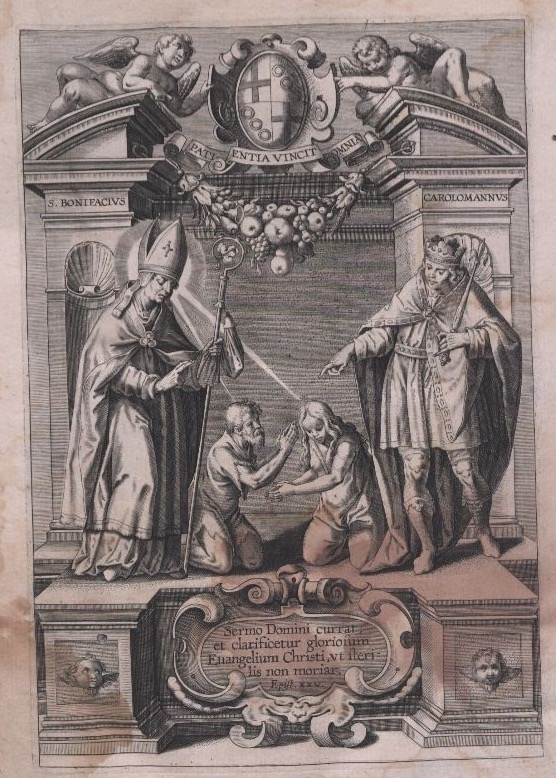
Boniface and Carloman, mayor of the palace — title engraving, 1612 (later depiction)
The ruler who left the palace
The departure was extraordinary enough to require an explanation. In 747, Carloman, mayor of the palace, gave up his share of Frankish power and went to Rome. The man who had commanded armies and supported ecclesiastical reform accepted a religious life. His brother Pepin would become king; Carloman would become a problem for the family’s historians.
He remains Untyped because the evidence does not reveal a consistent personal decision process. A withdrawal into a monastery does not establish introversion, and the sponsorship of reform does not establish a particular moral temperament. The surviving accounts disagree in their emphasis and were written to make sense of a consequential break within the ruling family.
Born around 710, Carloman was a son of Charles Martel. He should be distinguished from his nephew Carloman, the later king and brother of Charlemagne. The mayor’s career belongs to the difficult years before the Carolingians formally replaced the Merovingian dynasty, when family ascendancy still had to be defended across several resistant regions.
Power shared, resistance suppressed
After Charles Martel died in 741, Carloman and Pepin divided the family’s political inheritance. Carloman’s principal sphere was in the eastern Frankish lands, while Pepin held the western portion. These were not sealed territories with settled borders. The brothers campaigned together and faced powers whose submission could not be taken for granted.
Their expeditions against Aquitaine and Bavaria, and Carloman’s operations in Saxony and Alemannia, show an active ruler maintaining inherited claims by force. In 743 they restored a Merovingian king, Childeric III, after the vacancy left during their father’s final years. The kingship still offered a means of stabilizing a political arrangement that the family had not yet decided to replace.
Carloman’s suppression of Alemannic resistance at Cannstatt in 746 was remembered as a bloody punishment of its leadership. Sources differ over the presentation and extent of the killings; some soften them into a lawful correction. The episode prevents a comfortable division between a violent ruling family and a purely spiritual son. Carloman’s government could be coercive even while it pursued religious reform.
Reform with rules and royal protection
The reforming work is better documented than his inner motives. Boniface described Carloman’s support for a church council in a letter to Pope Zacharias. The arrangements associated with the Concilium Germanicum in 742 brought ecclesiastical discipline into a program backed by the mayor’s authority. Bishops and clergy were to be accountable to an order that claimed both religious legitimacy and political support.
The council’s prohibition on clerics bearing arms or participating in warfare, apart from designated pastoral roles with the army, is particularly revealing of the world reform confronted. Sacred office and military service were entangled. Setting a boundary required a rule, people capable of enforcing it, and the cooperation of a ruler whose own power rested partly on war.
Carloman’s participation establishes responsibility and commitment, but it does not settle his personality. The reform program was shared with Boniface and other churchmen; its surviving language is institutional. We can recognize what he enabled without transforming every council provision into a private confession or assuming that religious seriousness explains all of his later choices.
Retirement, return, and an unsettled ending
Carloman went to Rome in 747, received the tonsure, and established a religious house on Mount Soracte before moving to Monte Cassino. Einhard later explained the move by the disturbance caused by visiting Franks at his first retreat. That account conveys a desire for seclusion, but it is not a diary. Other narratives increasingly made Carloman an example of repentance or renunciation.
The proximity of Cannstatt to the withdrawal has encouraged an explanation based on remorse. It is possible, but the earliest narratives do not simply identify the bloodshed as its cause. Piety, political pressure, arrangements for succession, and a wish to leave government are difficult to separate from the available evidence. Choosing one as certain would reproduce the simplifying work of the later historians. The distinction matters because a voluntary change of life and an exclusion from power could look similar in a narrative written after Pepin’s success. Even the vocabulary of withdrawal was part of a dispute about who had yielded authority, who had received it, and whether that transfer deserved praise.
Nor did departure end his political importance. Carloman returned to Francia during the negotiations between Pepin and Pope Stephen II, seeking to obstruct the projected intervention against the Lombards. The annals present him as acting on his abbot’s instructions; modern reconstruction places the mission within Lombard pressure on Monte Cassino. His position threatened the agreement his brother was constructing.
His return was followed by confinement in a Frankish religious house. He died in 754 at Vienne, away from the Italian monastery he had chosen. The early annals’ chronology is uneven and places the death under the following year. The broad sequence is more secure than the polished idea of a powerful man peacefully disappearing from history. Retirement had not made him politically harmless.
Connected Figures
Further Reading
- The Letters of Saint Boniface — Boniface; translated by Ephraim EmertonPersonal appeals and institutional problems make an unusually rich record of the missionary’s work.
- Carolingian Chronicles: Royal Frankish Annals and Nithard’s Histories — Translated by Bernhard Walter Scholz with Barbara RogersThe dynasty’s narrative of its rise and rule, to be read as a politically interested account.
- The Carolingian World — Marios Costambeys, Matthew Innes, and Simon MacLeanA modern account of how dynastic power, religious reform, and regional societies shaped each other.
- Memorable Crises: Carolingian Historiography and the Making of Pippin’s Reign, 750–900 — Frederik Charles Wolter GoosmannThe chapter on Carloman traces how withdrawal, violence, and return were reshaped in dynastic memory.
