 Historical Figure MBTI
#1248 · 9-14-26 · The Carolingian World
Boniface
Missionary · Church Reformer · Letter Writer
c. 675–754
6 min read
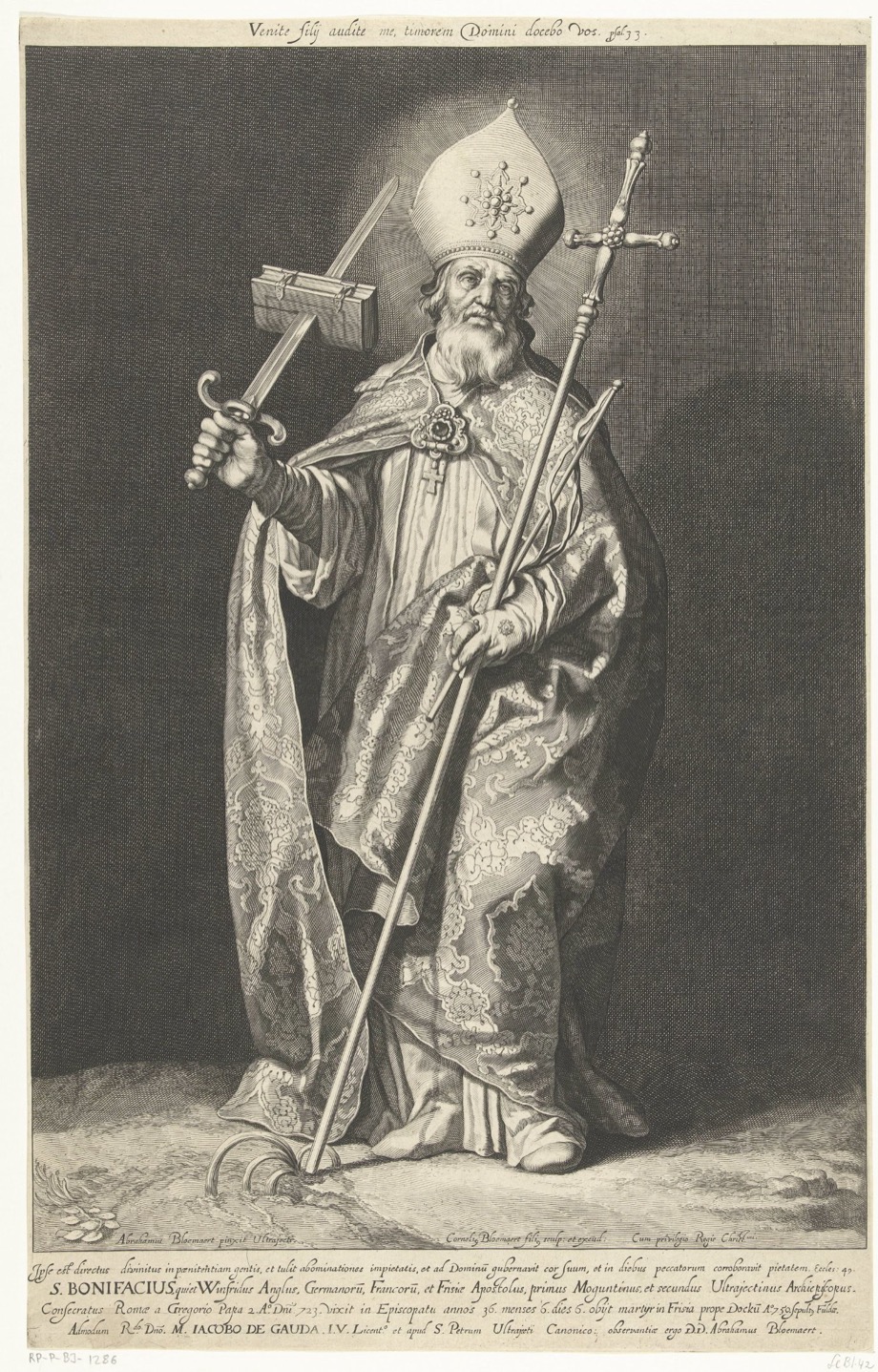
Portrait of Saint Boniface — in or after 1626 (later depiction)
The missionary needed books and friends
Boniface asked for prayers, but also for manuscripts. A mission required words he could trust, collaborators he could rely on, and relationships that could survive distance. His letters turn conversion from a grand historical event into work conducted among shortages, arguments, and anxieties. The writer who tried to reform other people’s conduct repeatedly sought help with his own burdens.
Born Wynfrith in Anglo-Saxon England around 675, he became Boniface after entering the Roman missionary world. His continental career joined preaching to the reorganization of churches and the correction of Christian practices he considered defective. The mission was not directed only toward people who had never heard of Christianity. Much of its difficulty lay among people already claiming Christian authority.
The tentative INFJ reading has more personal material than most entries from this generation. His correspondence shows a persistent purpose, reflection on its meaning, and a careful cultivation of supportive relationships. Yet letters are shaped communications, not transparent diaries. Scriptural language, humility, and requests for assistance belonged to the conventions of his vocation. Their recurrence must be considered alongside particular acts rather than treated as a personality code.
Boniface reads as an INFJ whose dominant Introverted Intuition sustained a missionary purpose through institutions, correspondence, and trusted relationships.
The scattered work belonged to one purpose
A dominant Introverted Intuition interpretation is plausible in the way Boniface relates immediate problems to a continuing account of what the Church ought to become. A question about a ritual, a request for a text, or a complaint about a bishop is not merely a local irritation. It belongs to the pursuit of a Christian community rightly instructed, connected to Roman authority, and capable of continuing after an individual preacher departs.
That purpose took institutional forms. His work involved monasteries, bishoprics, synods, and the cultivation of educated clergy. A successful sermon could not by itself secure a continuing practice. People needed teachers, teachers needed reliable material, and churches needed accepted relations of responsibility. The mission’s durability depended on connecting those parts. The proposed pattern is the persistent relationship between a unifying aim and several different kinds of activity.
It would be mistaken to call this a private visionary’s invention. Boniface inherited the claims of scripture, episcopal office, and Roman authority. His purpose was intelligible within them. The interpretive question is whether he habitually concentrated that inheritance into a sustained direction for his work. An adherence to doctrine could reflect conviction, convention, obedience, or an established reference point; it does not automatically establish intuition.
The missionary’s later biography supplied a more dramatic image of the purpose. Willibald’s Life describes the destruction of a sacred oak and presents the event as a demonstration of divine power against local religion. The account is important evidence for how the mission wished to be remembered. It is also hagiography, written to establish sanctity. The memorable confrontation should not crowd out the less theatrical work preserved in the letters.
The contrast between the oak and the manuscript is useful. One makes a decisive public scene; the other sustains instruction through repeated labor. Both can serve the same religious aim, but the second gives us more opportunities to examine a continuing habit of attention. A personality interpretation earns its force from recurrence across demands, not simply from the boldness of one narrated moment.
Anxiety traveled through a network of trust
Auxiliary Extraverted Feeling has a particularly concrete basis in his manner of seeking counsel. Writing to Bishop Daniel, Boniface explained that trouble led people toward friends whose wisdom and affection they trusted. He placed his difficulties before such a friend rather than presenting an image of self-sufficient authority. The request made emotional support and practical advice part of the same relationship.
This is more specific than saying that a saint cared about people. Boniface repeatedly worked through reciprocal ties: prayers, books, advice, gifts, and the assurance of spiritual fellowship. The recipients included women in English religious communities as well as bishops, abbots, and popes. Those women were contributors to the mission’s material and intellectual world, not simply an audience for his leadership.
The network also had demands and hierarchies. He sought correction and support while insisting on standards for those he wished to reform. A relational orientation does not imply a preference for avoiding conflict. His complaints about clergy and his efforts to secure disciplinary action show a man prepared to make shared religious obligations uncomfortable for people who violated them. Consensus was not his final authority; the community’s proper order was.
His dependence on Frankish rulers exposes the same tension. Charles Martel could protect him, and Carloman supported reforming assemblies. Such assistance made action possible while placing it in a political setting the missionary could not control. Boniface needed cooperation without abandoning his claim to a religious standard beyond the convenience of a ruler. The letters preserve the work of maintaining that precarious relationship.
The interpretation should therefore retain vulnerability as well as resolve. His anxiety does not negate purpose, and his requests for friendship do not prove helplessness. A long undertaking can be sustained precisely because its leader knows where to seek replenishment. The correspondence lets us see that dependence without requiring an invented private crisis behind every appeal.
Accuracy mattered to the spiritual work
A tertiary Introverted Thinking reading can be considered through his insistence on intelligible and reliable instruction. He asked for authoritative texts and clarification of disputed practices. His criticism of defective teaching concerned what people were being led to believe and do, not only the reputations of particular priests. The internal consistency of instruction mattered because error threatened the purpose of the mission.
The evidence nevertheless has limits. A conscientious bishop was expected to distinguish acceptable doctrine from unacceptable claims. Repeated questions might indicate analytical scrutiny, anxiety about responsibility, or fidelity to an inherited norm. The correspondence does not let us securely rank those motives. The argument is strongest when this concern for accuracy is placed beside the persistent aim and the network through which he pursued it.
Boniface died in 754 during a return to Frisia. Willibald gives the killing a martyr’s shape and describes the saint refusing armed resistance. That account belongs to the construction of his sanctity as well as to the history of the attack. It should not become a diagnostic final scene in which every proposed function is conveniently fulfilled. The life’s continuing pattern deserves more weight than a perfectly arranged death.
Why INFJ Over INFP
Why not INFP?
INFP is plausible because the letters contain personal conviction, vulnerability, and affectionate appeals. INFJ receives the preference from the way those elements repeatedly enter an organized mission directed toward a coherent communal order. Yet the vocation itself encouraged such organization, and inherited doctrinal fidelity also permits an ISTJ reading. His own words improve the evidence; they do not eliminate competing explanations.
The medium-confidence interpretation rests on several recurring habits rather than on holiness, missionary occupation, or a dramatic legend. Boniface’s letters show purpose made workable through dependence on other people. They allow a more intimate argument than chronicles alone, provided their rhetoric remains part of the account.
Connected Figures
Further Reading
- The Letters of Saint Boniface — Boniface; translated by Ephraim EmertonPersonal appeals and institutional problems make an unusually rich record of the missionary’s work.
- Life of Saint Boniface — WillibaldA near-contemporary hagiography whose memorable scenes require attention to their religious purpose.
- The Carolingian World — Marios Costambeys, Matthew Innes, and Simon MacLeanA modern account of how dynastic power, religious reform, and regional societies shaped each other.
