 Historical Figure MBTI
#1249 · 9-14-26 · The Carolingian World
Eudo of Aquitaine
Duke of Aquitaine · Defender of a Contested Frontier
d. 735
5 min read
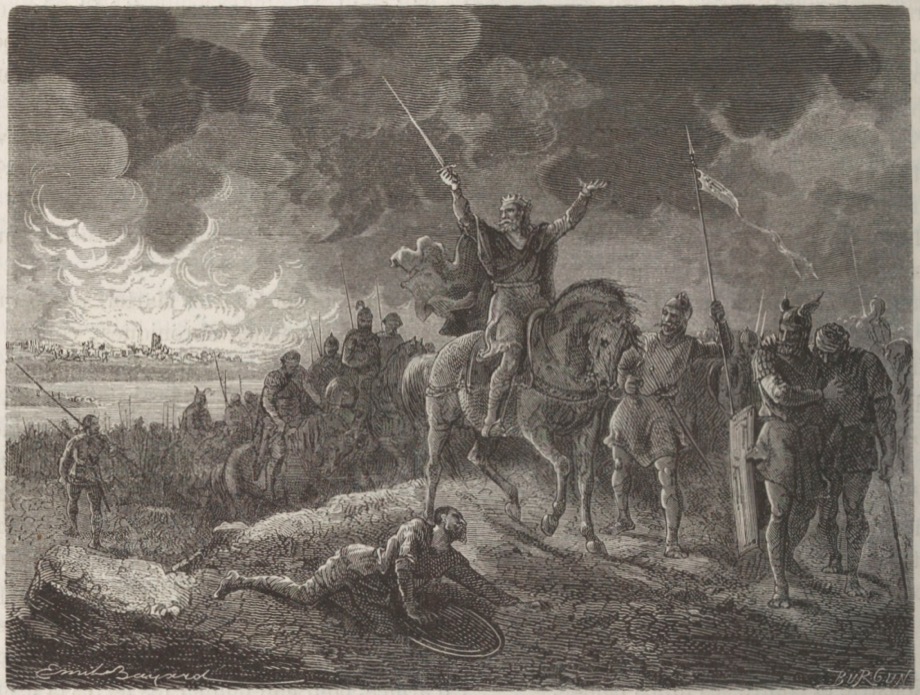
Eudo of Aquitaine leaving burning Bordeaux — Émile Bayard, c. 1867 (later depiction)
The ally had first been a rival
Eudo of Aquitaine did not begin as the southern assistant in Charles Martel’s great story. He was a regional ruler with interests of his own, involved in the struggles among Frankish powers before the campaign of 732 made cooperation necessary. The later account of Charles’s victory often places Eudo in the role of a defeated man seeking rescue. It is a true part of the sequence, but an inadequate account of the career.
His political position joined a degree of independence to continuing relations with the Frankish world. Aquitaine was not a modern sovereign state separated from its neighbors by a settled national border. Nor was it simply a passive province awaiting more effective northern government. Its rulers, aristocratic networks, towns, and military resources formed a regional order that others had to negotiate with or fight.
Eudo remains untyped because the surviving record establishes these predicaments and some consequential decisions without supplying enough personal evidence to distinguish a habitual psychological preference. A change of alliance cannot tell us by itself whether a ruler was visionary, pragmatic, anxious, or principled. The pressure of events may explain the public act better than any proposed temperament.
A northern contest and a southern victory
Eudo entered the Frankish conflict on the side of Charles’s opponents, including King Chilperic II and the mayor Ragamfred. Defeat altered that relationship. The continuations of Fredegar describe retreat and subsequent negotiation over Chilperic’s return to Charles. This is a politically interested account, but it preserves the important fact that Eudo possessed something the northern victor wanted. His place was not exhausted by military weakness.
The exchange illustrates a recurring feature of his situation. A regional ruler could bargain through people, treasure, territory, and the ability to provide or withhold assistance. Defeat reduced options without necessarily removing all leverage. The eventual accommodation with Charles should therefore be understood as a negotiated relationship within an uneven distribution of power, rather than as the end of Eudo’s political significance.
In 721 he defeated an invading army at Toulouse. The Umayyad governor al-Samh was killed, and the success attracted attention beyond Aquitaine. Eudo’s military achievement preceded the more celebrated victory associated with Charles by over a decade. The chronology matters because it prevents the history of resistance in the region from beginning only when the future Carolingian ancestor enters its most famous scene.
Toulouse did not permanently settle the frontier. Forces based south of the Pyrenees continued to operate in southern Gaul, and new commanders pursued further campaigns. A victory could relieve immediate danger while leaving the underlying relations of power unsettled. Eudo’s achievement belongs to a continuing regional contest, not to a single episode in which expansion either ended forever or advanced without interruption.
The frontier could produce agreements as well as raids
Accounts connect Eudo with an alliance involving the Berber leader commonly called Munuza, or Uthman ibn Naissa, and a marriage involving Eudo’s daughter. The alliance is important, although its precise aims and later embellishments require caution. It shows the inadequacy of treating the frontier as two permanently unified religious camps. A ruler’s relations could cross the same boundary over which armies moved.
Munuza’s position brought him into conflict with the governing authority in al-Andalus. His defeat removed an arrangement on which Eudo may have relied. It also belongs to the context of Abd al-Rahman’s subsequent advance into Aquitaine. The chronology can be described without pretending to know every private calculation behind the marriage or the degree to which either party controlled events.
In 732 Abd al-Rahman defeated Eudo in the region of the Garonne and Dordogne. The Iberian chronicle presents the defeat as severe, followed by further destructive movement northward. Eudo’s earlier victory at Toulouse did not make him immune to another commander or another campaign. His strategic position had changed, and resistance now required assistance he could not provide from his own resources alone.
He turned toward Charles, the man whose expansion had previously threatened his own authority. The cooperation was not inexplicable inconsistency. A ruler could face different dangers at different moments and judge one accommodation necessary to withstand another. It would be equally reductive to call this a proof of cynical opportunism or a revelation of selfless Christian unity. The event establishes a choice made under pressure.
A life returned to its own scale
The army from al-Andalus withdrew after the encounter with Charles, and Abd al-Rahman died. Later narration enlarged the battle into a decisive confrontation between whole civilizations. Eudo’s place becomes clearer when the scale is brought back to the regional sequence: a ruler had fought, bargained, been defeated, and sought cooperation to preserve a position that was already contested.
He died in 735. Aquitaine’s difficult relationship with the emerging Carolingian power continued through his successors. That continuation does not prove he had failed to understand his situation; it shows that his situation could not be permanently resolved by one ruler’s decision. Regional authority had its own networks and momentum, and northern consolidation required repeated intervention rather than a single moment of submission.
The surviving stories give little access to Eudo’s voice. They tend to measure him through the ambitions or victories of others. Restoring his agency means taking his recorded actions seriously, not supplying an undocumented inner speech. His role at Toulouse and his later accommodation with Charles can stand together as parts of a consequential career.
Connected Figures
Further Reading
- The Age of Charles Martel — Paul FouracreReassesses Charles through the contemporary record and the changing uses of his reputation.
- The Arab Conquest of Spain, 710–797 — Roger CollinsPlaces campaigns north of the Pyrenees within the changing political world of early al-Andalus.
- Franks, Romans, and Countrymen: Imperial Interests, Local Identities, and the Carolingian Conquest of Aquitaine — Rutger KramerExamines how regional identities and partisan narratives shaped Aquitaine’s incorporation.
