 Historical Figure MBTI
#1250 · 9-14-26 · The Carolingian World
Abd al-Rahman al-Ghafiqi
Governor of al-Andalus · Commander at Tours
d. 732
5 min read
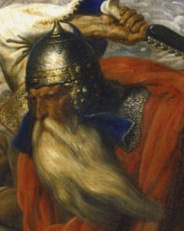
Detail identified as Abd al-Rahman al-Ghafiqi from The Battle of Tours — Charles de Steuben, 1837 (later imagined depiction)
The commander on the other side of the story
Abd al-Rahman al-Ghafiqi is often introduced at the moment of his death, as the opponent whose defeat explains Charles Martel’s greatness. The arrangement gives a Frankish victory a recognizable adversary and leaves that adversary with very little life of his own. His historical role begins elsewhere: in the government of al-Andalus and the campaigns that carried forces across the Pyrenees into southern Gaul.
He was a governor and military commander within the Umayyad world, not the sovereign of an independent Spanish kingdom. Authority in al-Andalus belonged to a wider hierarchy and to a recently conquered society whose politics remained unsettled. Campaigning beyond its northern limits therefore formed part of a changing regional situation. It should not be imagined as the simple execution of a single unaltered plan directed from Damascus.
The surviving narratives establish the campaign of 732 and his death during it more securely than they establish his personal habits of judgment. He remains untyped. A successful advance, a decision to fight, or a fatal reverse does not supply enough evidence to distinguish the mind of a commander from the requirements of his office and the pressures of the army he led.
Expansion had a frontier and internal divisions
The conquest of much of Iberia had made movement north of the Pyrenees possible, but it did not abolish earlier political relationships or local resistance. Muslim forces established a position at Narbonne and pursued campaigns elsewhere in southern Gaul. Eudo of Aquitaine’s victory at Toulouse in 721 showed that such movement could meet a serious reverse. The region’s history was already one of advances, defeats, and accommodations before Abd al-Rahman’s best-known expedition.
His career belonged to that continuing contest. Governing authority had to be exercised over an army and a population that cannot responsibly be treated as a single undifferentiated Arab bloc. Berber participation was essential to conquest, and disagreements within the expanding order affected frontier politics. Recognizing those differences does not require us to assign undocumented motives to every participant. It requires us to resist the uniform army imagined by later civilizational stories.
The Berber leader commonly called Munuza entered an arrangement with Eudo that accounts associate with a marriage involving the duke’s daughter. Munuza then fell in a conflict with the governing power of al-Andalus. The episode supplies part of the context for the later expedition. It also shows why the frontier’s alliances could cross religious boundaries while rivalries could divide people whom a retrospective narrative places on the same side.
Abd al-Rahman’s place in this setting was one of governing and commanding under those unstable conditions. The surviving evidence does not disclose a private commitment to conquest of the whole continent, a settled contempt for the northern enemy, or an emotional reaction to earlier defeats. Such claims would add a personality-shaped explanation where the record preserves primarily a political and military sequence.
From Aquitaine toward the Frankish army
In 732 he advanced into Aquitaine and defeated Eudo in the area of the Garonne and Dordogne. The Iberian chronicle depicts destruction and a severe defeat before the army moved farther north. The account is a Christian author’s description, and its moral language belongs to its perspective. The fact of the advance need not be doubted in order to recognize how its violence was made meaningful by the narrator.
The movement threatened wealthy places as well as military positions. The account connects the expedition with the prospect of plundering the shrine of Saint Martin at Tours. Religious institutions accumulated resources and stood within the landscape of power. Their appearance in a campaign narrative can concern wealth, symbolic importance, and the chronicler’s own loyalties at once. It does not settle every question about the expedition’s final objectives.
Eudo’s defeat brought him toward cooperation with Charles Martel. Abd al-Rahman thus encountered a configuration of opponents different from one regional ruler acting alone. The battle usually dated to 732 ended with his death and the withdrawal of the army from al-Andalus. The precise site and the detailed conduct of the fighting remain matters of historical uncertainty. A responsible account should not fill the gaps with confident tactical diagrams.
The relatively early Iberian narrative describes Frankish uncertainty on the following morning, when the opposing camp appeared to remain in place. Scouts established that the army had departed. The detail gives the victory a more contingent texture than later triumphal accounts. Neither side’s actions can be reduced to the certainty with which subsequent writers knew the outcome.
A defeat enlarged after the event
Later narration made Abd al-Rahman the defeated representative of a civilization whose expansion had supposedly reached its final possible barrier. The claim that a single victory saved Europe depends on assumptions about what would have followed a different result. Those assumptions cannot be verified simply by repeating the importance later generations attached to the battle.
His defeat was consequential without requiring that counterfactual. The expedition ended, a governor was killed, Charles gained prestige, and the regional balance changed. Muslim power in southern Gaul did not disappear instantly, while Frankish authority also required continuing campaigns. The surviving political history is more complicated than either an unstoppable tide or a permanently sealed frontier.
Abd al-Rahman’s death left little direct testimony through which to restore a private voice. The task is therefore to describe his office and his recorded actions at their proper scale. Refusing a type preserves that distinction. A named opponent can have historical agency without being furnished with an invented psychology to match the victor’s legend.
Connected Figures
Further Reading
- The Arab Conquest of Spain, 710–797 — Roger CollinsPlaces campaigns north of the Pyrenees within the changing political world of early al-Andalus.
- Conquerors and Chroniclers of Early Medieval Spain — Kenneth Baxter WolfTranslations and analysis of Iberian narratives, including the Chronicle of 754.
- The Age of Charles Martel — Paul FouracreReassesses Charles through the contemporary record and the changing uses of his reputation.
