 Historical Figure MBTI
#1251 · 9-15-26 · The Carolingian World
Pepin the Short
Frankish King · Papal Ally · Founder of a Royal Dynasty
c. 714–768
6 min read
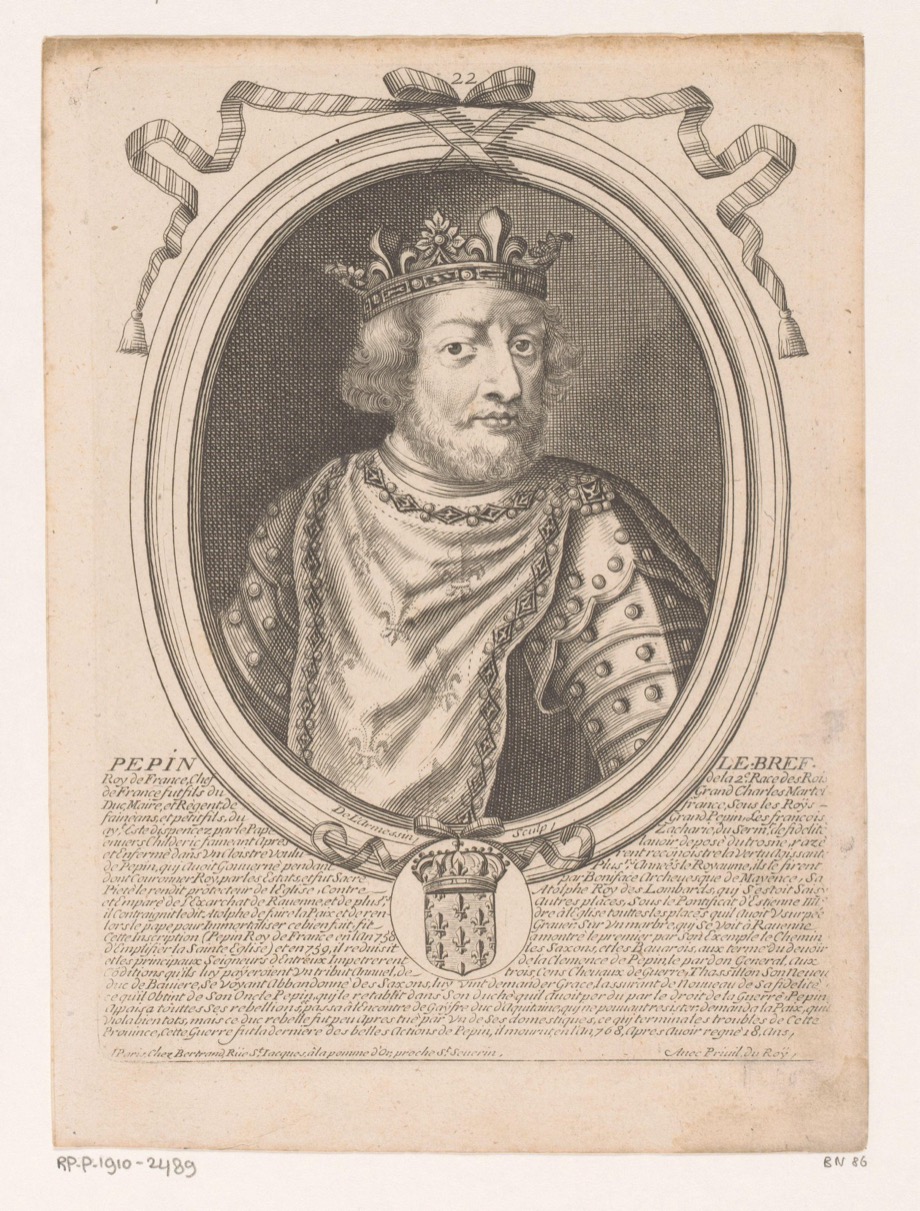
Portrait of Pepin the Short — 1647–1678 (later depiction)
The man who made the title follow the power
When the Frankish court asked Rome whether a king should be the man who possessed the title or the man who exercised its power, the question already contained a desired answer. Pepin the Short had inherited the machinery of government. He wanted its highest office. The consultation with Pope Zacharias helped transform a family’s ascendancy into a kingship that could be acknowledged, blessed, and transmitted.
An ESTJ reading fits the emphasis on making authority explicit and workable. It remains a low-confidence interpretation. The records reveal decisions, negotiations, and campaigns far more readily than a private temperament. Pepin’s practical consolidation is the evidence to examine; the fact that he founded a dynasty cannot by itself identify his mind.
Born around 714, he was a son of Charles Martel and the father of Charlemagne. Those two larger reputations often leave him appearing as a connecting passage. His own reign supplied something neither connection explains away: a durable correspondence between the family’s actual control, the royal name, and a new relationship with the Roman Church.
Pepin the Short is a tentative ESTJ: dominant Te sought authority that could be recognized, organized, and enforced.
Te: authority that could be acted upon
After Charles Martel died in 741, Pepin and his brother Carloman shared the family’s power. Campaigns against Aquitaine, Bavaria, and Saxony were part of preserving that inheritance, rather than expressions of an untroubled national government. The brothers also restored a Merovingian king, Childeric III, in 743. The old royal line still had a use before it became an obstacle.
Carloman’s retirement in 747 left Pepin the dominant mayor of the palace. The subsequent appeal to Zacharias joined a political fact to an authoritative judgment. In the later Royal Frankish Annals, the pope answers that the royal name should belong to the holder of royal power. This is the dynasty’s account of its legitimacy, written after the event; it is evidence for the argument advanced, not an independent transcript of every exchange.
Pepin became king in 751, and Childeric was tonsured and removed to a monastery. The annals connect the elevation with Frankish election and anointing by Boniface, although the identity of the officiant is debated. What is secure is the change in kingship. For a tentative Te reading, the significant pattern is the effort to settle an ambiguity of command through recognizable procedures and enforceable recognition.
Si: changing the ruler through inherited forms
The replacement of a dynasty might appear an odd foundation for an interpretation emphasizing continuity. Pepin did not preserve the old king. He did, however, make the transfer intelligible through institutions that already carried weight: assembly, royal office, ecclesiastical judgment, and sacred consecration. His innovation used established languages of obligation rather than treating possession of troops as a sufficient public explanation.
The encounter with Pope Stephen II enlarged that settlement. Threatened by the Lombards, Stephen crossed the Alps and sought Frankish assistance. In 754 he consecrated Pepin and his sons at Saint-Denis; Bertrada was included in the royal ceremony. The association extended beyond one successful mayor. It gave the family’s succession a solemn claim upon both Frankish recognition and papal protection.
This does not make Pepin a servant who simply executed a pope’s wishes. Frankish intervention was expensive and politically consequential. The alliance was a bargain that met different needs. Stephen obtained a protector, while Pepin obtained a relationship that distinguished his newly royal house. An Si interpretation rests on this reuse and reinforcement of legitimating forms, not on a claim that an eighth-century ruler must have preferred tradition.
Ne: a new partner beyond the mountains
Pepin’s dealings with Rome show room for adaptation within that institutional emphasis. The pope’s appeal could have remained another distant petition. Pepin made it the basis of an enduring connection across the Alps. His Italian expeditions in the mid-750s forced the Lombard king Aistulf to make concessions; renewed resistance required a second intervention. A promise needed the ability and willingness to enforce it.
The resulting transfer of territories to the Roman Church, remembered as the Donation of Pepin, helped establish the territorial basis of papal rule. Its geography and the sequence of promises deserve careful reconstruction. It was not a modern deed creating a neatly bounded state at a stroke. Nor should the much-debated Donation of Constantine be confused with Pepin’s actual commitments: the former is a forged imperial document, the latter a Frankish political arrangement.
Calling this subordinate Ne is an interpretive convenience for the widening of available solutions. It cannot recover how Pepin experienced the possibility. The stronger point is observable: he recognized that a relationship outside the traditional Frankish center could stabilize authority at home, and then supported that relationship with action.
A settlement made by repeated war
The reign was also a long exercise in coercion. Pepin took Narbonne in 759, ending the remaining Muslim-held stronghold in Septimania. In the 760s his campaigns against Duke Waifar of Aquitaine repeatedly devastated territory and attacked the resources of resistance. The royal annals dress these operations in the language of rightful rule and the correction of broken faith. The inhabitants who endured them are much less visible.
The record of rebuilding Argenton in 766 and placing Frankish troops there and at Bourges offers a particularly concrete view of consolidation. A victory was followed by a position that could be held. This is compatible with the proposed practical emphasis, but efficiency has no automatic moral content. Establishing durable control could mean destruction, hostage-taking, and the narrowing of another region’s choices.
Pepin died in 768 after the final Aquitanian campaign. His sons Charles and Carloman inherited divided portions of the kingdom. That arrangement reminds us that the later empire was not already waiting inside his plans. His achievement was a stronger royal house and a consequential alliance, passed into a future whose conflicts he did not resolve.
Why ESTJ Over ENTJ
Why not ENTJ?
ENTJ is plausible because the change of dynasty and the Roman alliance had consequences extending well beyond an immediate crisis. Yet a large result is not evidence of a visionary decision process. The surviving sequence more often shows Pepin regularizing power already acquired, negotiating obligations, and returning to enforce agreements. ESTJ gives slightly greater weight to that practical institutional pattern.
The distinction remains fragile. Both readings can accommodate a king who combined force with legitimacy, and court narratives deliberately make his choices appear coherent. Without intimate correspondence or an independent account of his deliberations, ESTJ should remain a qualified judgment rather than a settled diagnosis.
Connected Figures
Further Reading
- Carolingian Chronicles: Royal Frankish Annals and Nithard’s Histories — Translated by Bernhard Walter Scholz with Barbara RogersThe dynasty’s narrative of its rise and rule, to be read as a politically interested account.
- The Carolingian World — Marios Costambeys, Matthew Innes, and Simon MacLeanA modern account of how dynastic power, religious reform, and regional societies shaped each other.
- Life of Charlemagne — EinhardIts opening explains the transfer of kingship from the perspective of the victorious dynasty.
- The Age of Charles Martel — Paul FouracreReassesses Charles through the contemporary record and the changing uses of his reputation.
