 Historical Figure MBTI
#1247 · 9-14-26 · The Carolingian World
Charles Martel
Frankish Mayor · Commander · Dynastic Consolidator
c. 688–741
7 min read
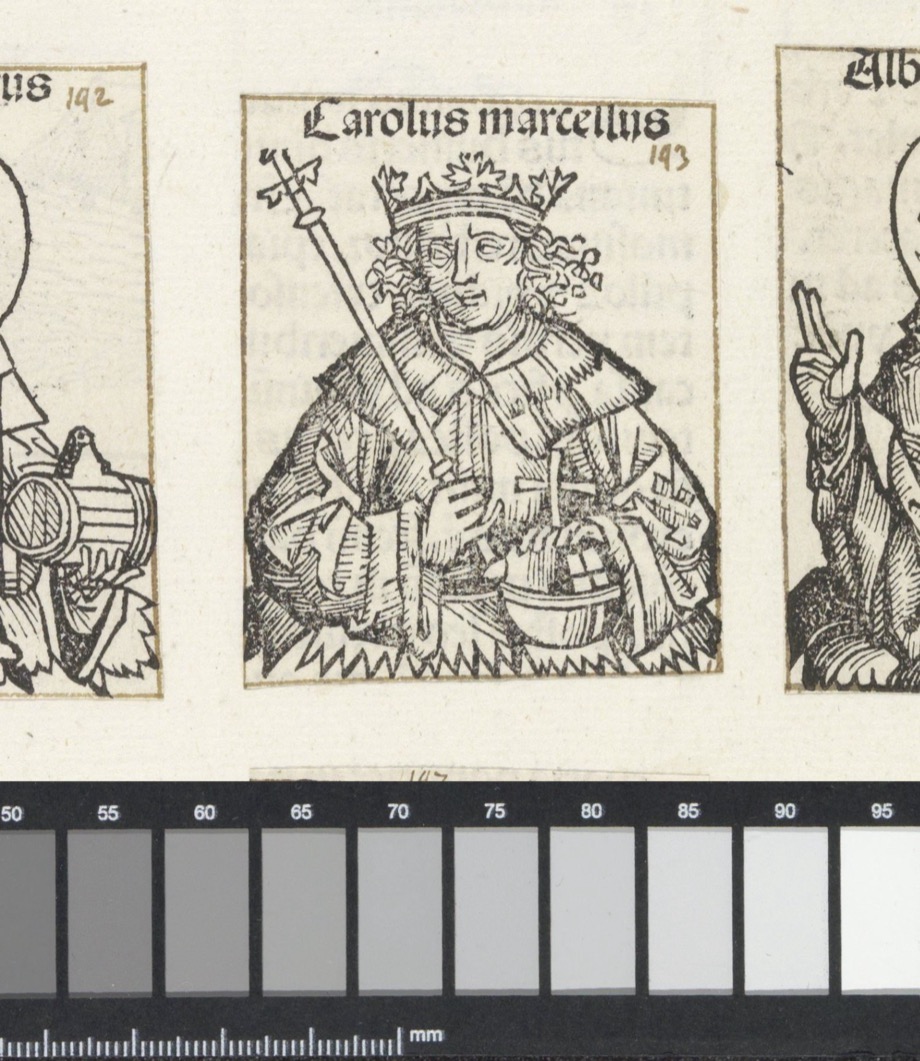
Later imagined portrait of Charles Martel — 1493
Protection had a signature
Charles Martel’s surviving order for Boniface does not describe a warrior suddenly moved by the beauty of a sermon. It announces a decision to bishops, counts, officials, and other people who might obstruct the missionary. Boniface is under Charles’s protection. Disputes outside the ordinary law are to be brought before the mayor himself. The order is sealed with his ring. A spiritual undertaking acquires a practical route through the world.
That act is a useful beginning for a tentative ESTJ reading. Charles appears less as the owner of an abstract destiny than as a man repeatedly making authority operative: assembling support, enforcing decisions, and extending protection through recognizable institutions. It is a low-confidence interpretation of public conduct. Neither command in battle nor the possession of a seal can establish a complete private personality.
Born around 688, a son of Pippin of Herstal, Charles emerged from the conflicts following his father’s death to become the dominant Frankish mayor of the palace. He never assumed the title of king. His sons inherited a position whose effective power would eventually make a change of dynasty possible. Later memory often compresses this long construction into the single victory at Tours in 732. The compression loses much of the man’s actual work.
Charles Martel tentatively reads as an ESTJ whose dominant Extraverted Thinking made protection, victory, and office into working authority.
An instruction should reach the people who matter
The strongest dominant Extraverted Thinking case lies in the protection order’s structure. Charles does not simply approve Boniface’s purpose; he tells a hierarchy of people how they are expected to treat him. Protection includes the bishop’s associates, and difficult cases have a designated destination. The document connects a declared intention to an enforceable procedure. Its authority depends on other people recognizing Charles’s capacity to intervene.
The order also reveals why the mayor’s importance cannot be described only through battlefield strength. The exercise of power linked military reputation to the settlement of disputes, the management of access, and the creation of obligations. A missionary could enter a region with papal authorization and still require someone able to make local resistance costly. Charles supplied a form of security the pope could request but could not personally enforce on the ground.
This cooperation was not an uncomplicated union of identical purposes. Boniface sought religious transformation under Roman authority. Charles’s consolidation of Frankish power had interests of its own. The two projects could assist each other without becoming the same project. A ruler’s protection should not be turned into proof that every ecclesiastical ambition was his preferred policy, or that every action toward church property met the reformer’s standards.
His wider career likewise required a capacity to turn victory into continuing influence. The mayoralty gave him an office within the Merovingian order, but the effectiveness of that office had to be won against rival claimants and regional powers. Titles did not remove those competitors. The proposed pattern is practical concentration: securing people and resources so that the office could operate beyond its nominal boundaries.
It would be easy to admire this as efficiency while forgetting what consolidation meant to those it constrained. An opponent’s independence could become a ruler’s disorder. Military pressure could make a regional settlement possible by narrowing other people’s choices. The type argument concerns the means by which Charles made decisions consequential; it cannot certify the justice of every result.
Power grew inside an inherited frame
Auxiliary Introverted Sensing is plausible where Charles used the established political order as a framework he could strengthen rather than immediately replace. For much of his career he governed through the mayoralty while Merovingian kings continued to provide the royal name. After Theuderic IV died in 737, however, he left the throne vacant until his own death in 741. Later Carolingian writers presented those kings as emptied of substance. Their depiction served the successor dynasty and should not be mistaken for an impartial measure of what royal legitimacy had meant to contemporaries.
Charles’s choice to remain mayor therefore matters more than the retrospective joke about a king riding in an ox cart. Effective power and recognized kingship did not have to coincide in one person. He could extend the former while leaving the latter in an inherited house. That arrangement supplied continuity, even when the balance within it had changed dramatically. It also offered his family opportunities which depended on the old order still being intelligible.
The preference for ESTJ rests partly on this incremental use of existing forms. Yet it is only a preference. A strategically imaginative ruler could preserve a royal framework because it was useful, while a precedent-minded ruler could depart from it when conditions changed. The documents do not tell us which habitual process lay behind each decision. The conduct supplies an argument about continuity, not a demonstration of inward reference.
His sons Carloman and Pepin received the consequences of that consolidation. Their eventual division of responsibilities and Pepin’s later kingship show how the father’s position became dynastic capital. Charles did not need to foresee every later coronation for his actions to make it possible. Historical consequences are often larger and more orderly in retrospect than the purposes of the people who produced them.
The victory and the stories attached to it
The campaign of 732 brought Charles into confrontation with Abd al-Rahman al-Ghafiqi after the latter had defeated Eudo of Aquitaine. The surviving Iberian chronicle describes a hard-fought encounter, followed by the withdrawal of the invading force and uncertainty in the Frankish camp. Its victors did not immediately know whether the enemy had gone or was preparing an ambush. That hesitation is a valuable detail against the later image of an effortless, predetermined triumph.
Tours was a real victory, and Abd al-Rahman died. The claim that the battle simply saved Europe from inevitable conquest goes much further than the evidence. Campaign objectives, the capacity to sustain expansion, and the significance of the reverse require interpretation. Later accounts magnified casualties and framed Charles as the appointed defender of Christianity. Those accounts disclose the work of commemoration as well as the memory of battle.
A tertiary Extraverted Intuition interpretation might be considered through his use of opportunities produced by shifting relations. Eudo had been a regional competitor; danger from the south made cooperation possible. The resulting alignment served immediate security and altered the balance of power. Still, the situation itself supplied strong reasons for adjustment. It does not prove a distinctive appetite for novel possibilities.
The useful psychological picture therefore remains weighted toward organization and continuity. It should not be expanded into four equally confident function portraits because a complete stack looks tidy. Charles’s actions are visible in several contexts; his private reflections are not. The disparity is one of the entry’s central facts.
Why ESTJ Over ENTJ
Why not ENTJ?
ENTJ is a credible alternative because his consolidation had far-reaching strategic consequences. ESTJ receives a narrow preference from his sustained use of established offices, personal obligations, and recognizable procedures rather than a clearly articulated new political vision. The distinction remains insecure: later dynastic coherence may conceal improvisation, and institutional continuity may have been a strategic choice rather than a cognitive preference.
The type is a restrained reading of repeated public action. Charles left an unusually consequential position, but little evidence with which to rank his inner processes. The practical ruler can be described without turning the later savior of Europe into a recovered personality.
Connected Figures
Further Reading
- The Age of Charles Martel — Paul FouracreReassesses Charles through the contemporary record and the changing uses of his reputation.
- The Carolingian World — Marios Costambeys, Matthew Innes, and Simon MacLeanA modern account of how dynastic power, religious reform, and regional societies shaped each other.
- The Letters of Saint Boniface — Boniface; translated by Ephraim EmertonPersonal appeals and institutional problems make an unusually rich record of the missionary’s work.
- Chronicle of 754 — Anonymous Iberian chroniclerA relatively early account of the campaign of 732, distinct from later Frankish triumphal narratives.
