 Historical Figure MBTI
#1246 · 9-13-26 · The Rise of the Marathas
Jai Singh I
Ruler of Amber · Imperial Commander · Negotiator
1611–1667
7 min read
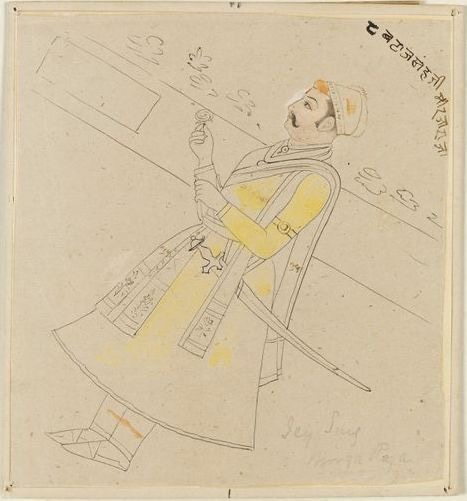
Portrait of Jai Singh I — 19th century (later depiction)
The battle continued inside the negotiation
When Shivaji came to negotiate at Jai Singh’s camp below Purandar in 1665, military pressure did not politely disappear. In Jadunath Sarkar’s reconstruction from correspondence, fighting remained visible from the tent. The meeting occurred within a situation the imperial commander had worked to create: resistance was costly, surrender had terms, and the man across from him could become useful after defeat.
Jai Singh I, the Kachhwaha ruler of Amber, spent much of his life in Mughal service. He was a commander whose responsibilities reached across distant imperial frontiers. His relationship with the empire involved a ruling house as well as a career. He brought hereditary standing, military resources, and accumulated experience to his assignments; service did not make him an anonymous instrument of the throne.
The tentative ENTJ reading rests on his effort to bring force, authority, and negotiated interests into one practical strategy. It does not rest on the fact that he commanded armies. The record is suggestive where he sought control over the conditions of action and then used that control to produce a political result. The confidence remains low because military dispatches preserve a professional performance more readily than an ordinary personality.
Jai Singh I tentatively reads as an ENTJ whose dominant Extraverted Thinking joined delegated authority, military pressure, and negotiated results.
One command for several kinds of work
The strongest dominant Extraverted Thinking evidence is unusually concrete. Preparing for the campaign against Shivaji, Jai Singh objected to a division between command in the field and administrative authority elsewhere. If promotion, payment, transfer, and other decisions remained outside his control, military operations could be impaired. He sought the authority to make those parts of the enterprise work together.
This was a claim about the organization of responsibility. The officer charged with producing a result wanted access to the decisions that shaped it. The argument did not require him to deny the emperor’s supremacy. It required the emperor to delegate effectively. Such insistence suggests attention to executable arrangements rather than satisfaction with a prestigious title unsupported by the necessary powers.
Jai Singh’s preparations also extended beyond the army immediately before him. He approached people who had reasons to oppose Shivaji and sought to turn grievances into assistance. Rank, promises, and money were tools alongside artillery. The campaign was therefore directed at a political network, not merely a fort. A commander who could isolate an opponent might make each subsequent act of force more effective.
The same evidence has a harsher side. Raiding and devastation placed pressure on the countryside as well as on defended positions. These methods could make an adversary negotiate by making continued resistance costly for people outside the garrison. Describing them as coordinated does not make them humane. The pursuit of a workable imperial result could include deliberate injury to livelihoods.
An interpretation through organization earns its place only if it retains both aspects. Jai Singh’s ability was not a benevolent managerial abstraction. It operated within a coercive empire, with consequences for residents, soldiers, and rival rulers. The fact that he could connect instruments to objectives is more secure than any judgment that his chosen objectives were desirable for everyone affected.
An enemy could become part of the next campaign
Auxiliary Introverted Intuition is plausible where Jai Singh treated the immediate siege as a stage in a wider arrangement. Purandar’s settlement did not aim solely to announce that Shivaji had been defeated. It reduced his territorial position, placed his son Sambhaji within the imperial service structure, and opened the possibility of using Maratha forces in the campaign against Bijapur.
The former opponent was not simply to be erased. He possessed knowledge, followers, and a capacity to act in terrain where the empire had repeatedly encountered difficulty. Incorporating some of that capacity could change the next problem. The strategy imagined a sequence: military pressure, negotiated submission, and redirected service. The parts depended on each other rather than constituting three unrelated acts.
This interpretation should not overstate originality. Mughal expansion had long involved recruiting useful enemies and negotiating the terms of their incorporation. Jai Singh had learned within that system. The question distinguishing the proposed reading from ESTJ is whether he appears primarily to reproduce a familiar procedure or to organize available procedures around an anticipated configuration of power. The sources permit both accounts.
The Bijapur campaign demonstrated the limitations of the sequence. Success against Shivaji did not guarantee success against another state. Strong defenses, difficulties in sustaining the army, and disagreements within the imperial camp constrained the expedition. A design that had worked at one stage could falter at another. The practical ambition was real; so was the resistance of conditions he could not arrange away.
His support for Shivaji’s visit to the imperial court in 1666 continued the search for a durable relationship with the emperor. The encounter at Agra instead produced conflict and confinement, followed by escape. Jai Singh could help negotiate an approach to power without controlling what happened at its center. The failure reminds us that a strategist’s plan passes through other people’s purposes and judgments.
Reading the immediate field
Tertiary Extraverted Sensing can be considered through his use of the immediate military situation. Forts were not interchangeable marks on a map. Positions, approaches, artillery, and the visible progress of an assault altered the terms on which an opponent might negotiate. In the Purandar campaign, the reduction of supporting defenses helped make the main position vulnerable. Practical command depended on treating those relationships as material facts.
The negotiation itself belonged to that material setting. Jai Singh’s assurances about Shivaji’s safety were important because a meeting under pressure could otherwise become a trap. At the same time, the continuing threat made surrender urgent. The commander worked with both recognition and coercion, allowing the prospective agreement to appear attainable while leaving the costs of rejecting it plainly present.
This is evidence of skilled action, but a function claim remains a second step. An experienced commander might respond in this way through training and discipline irrespective of temperament. The tentative reading links immediate responsiveness to the larger pattern of organized pressure and anticipated settlement. It does not infer a psychological hierarchy from battlefield competence alone.
We know still less about the private values that may have governed his acceptance of imperial duty, personal undertakings, or political risk. The record does not justify completing an inferior Introverted Feeling portrait from his occupation. A full stack in a typological heading is a hypothesis, not permission to fill every position with a convenient anecdote.
Why ENTJ Over ESTJ
Why not ESTJ?
ESTJ is a strong alternative because his effectiveness drew on long experience and established Mughal practices of command and incorporation. ENTJ receives a cautious preference from the way the Purandar settlement appears organized toward a subsequent strategic configuration, rather than merely the restoration of a familiar arrangement. The distinction is weak: a veteran applying precedent intelligently can produce the same public behavior.
The type is therefore an editorial interpretation of a documented method, not a verdict on an entire private life. Jai Singh’s correspondence and the campaign’s sequence permit a specific argument about how he coordinated action. They leave uncertainty about whether anticipation or accumulated precedent provided the deeper reference point.
Connected Figures
Further Reading
- Shivaji and His Times — Jadunath SarkarAn influential reconstruction using Persian correspondence and other sources; its character judgments require scrutiny.
- The Marathas 1600–1818 — Stewart GordonPlaces individual rulers within the military, social, and familial structure of the Maratha polity.
- The Mughal Empire — John F. RichardsA modern synthesis of conquest, administration, and the changing ideological basis of Mughal power.
