 Historical Figure MBTI
#1243 · 9-13-26 · The Rise of the Marathas
Shivaji
Maratha King · Builder of a Rival Sovereignty
1630–1680
9 min read
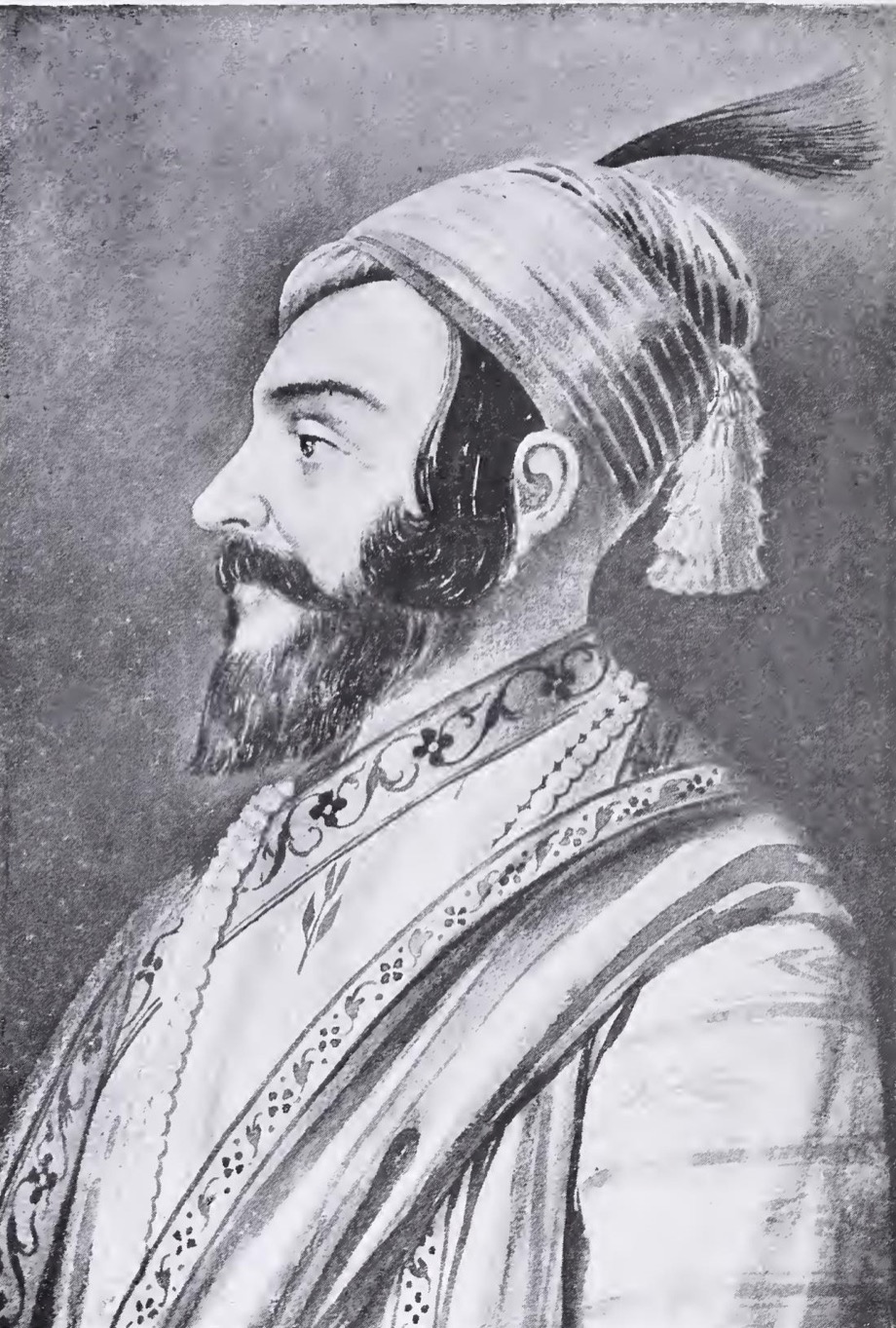
Portrait of Shivaji — published 1918; underlying portrait undated (later depiction)
A Crown Above the Forts
In June 1674, Shivaji was crowned at Raigad. The ceremony did more than celebrate a successful soldier. Brahman specialists, royal genealogy, ritual purification, gifts, titles, and offices made a public argument that a man who had acquired power through force and negotiation possessed the standing of a sovereign. His enemies might call him a troublesome landholder. He intended to answer with a kingdom.
The distance between those descriptions defines his achievement. Born at Shivneri in 1630, he belonged to a family already embedded in the service politics of the Deccan. His father, Shahaji, held military employment and territorial interests under competing powers, eventually serving Bijapur. His mother, Jijabai, remained central to the household in the Pune region. Their son did not begin outside politics and then discover it; he grew up among its estates, obligations, wars, and broken promises.
Shivaji’s story has since acquired the clarity that successful national memories prefer. The historical record is less tidy and more interesting. He negotiated with the Mughals, fought other Maratha families, employed people across religious boundaries, raided prosperous towns, and sought recognition through older forms of sacred kingship. His originality lay in assembling familiar materials into an authority that could survive beyond a single raid or battlefield triumph.
Shivaji reads as an ENTJ through Extraverted Thinking: military success repeatedly became a demand for a more durable arrangement of power.
Making Possession Governable
Taking a fort was only the beginning. It needed provisions, reliable officers, a garrison, access to surrounding revenue, and arrangements that made betrayal harder. The Sabhasad chronicle, written in 1697 under Shivaji’s younger son Rajaram, describes differentiated responsibilities within fort administration rather than a single commander controlling everything. Such arrangements belong to a recognizable effort to turn military possession into managed authority.
The same chronicle presents Shivaji as restraining hereditary local magnates who maintained fortified residences and armed followings. It describes fixing dues and limiting their ability to obstruct collection. These claims should not be read as proof that every local autonomy disappeared. Stewart Gordon’s account of Maratha society emphasizes the continuing importance of powerful families and their negotiated rights. Shivaji’s government worked through that landscape as well as against it.
What matters for the personality interpretation is the recurring direction of his activity. He sought resources that could be counted, offices that could be supervised, and strategic positions that could be maintained. A fort network without revenue was a liability. Revenue without enforceable command could remain someone else’s property. His campaigns repeatedly linked the two.
This is the strongest basis for Extraverted Thinking, although it remains an inference about behavior rather than a recovered mental process. The evidence supports an interest in usable arrangements of power. It does not justify imagining a modern administrator with a complete plan already in hand. His institutions grew through experiments, inherited practices, bargains, and emergencies.
Maritime power exposed the same relationship between resources and organization. The Konkan coast was a field of competing ports, European companies, and the Siddis of Janjira. Building coastal forts and naval capacity required specialists and sustained expenditure as well as an appreciation of strategic vulnerability. Shivaji did not simply export the methods of hill warfare to the sea. He attempted to give the kingdom another means of controlling access and resisting pressure. The uneven results are part of the story: an expanding state could identify a need before it possessed the means to meet that need completely.
From Regional Leverage to Sovereignty
The early acquisitions around Pune gave Shivaji a defensible base in a country where hills, passes, and monsoon conditions shaped movement. Torna, Rajgad, and other strongholds supplied more than refuge. They made it possible to hold territory while moving forces elsewhere. Control of routes connecting the plateau and the Konkan widened the project beyond a single estate.
The eventual coronation expressed a larger ambition than advantageous service under Bijapur or the Mughal emperor. Shivaji sought a public status from which he could appoint officers, authorize revenue demands, and command allegiance in his own name. Sanskrit titles and royal ritual helped establish that status. These were instruments available within his political world, not decorative additions to an otherwise modern state.
An Introverted Intuition reading becomes plausible in this movement from scattered gains toward a unifying claim. Particular victories increasingly served a picture of what his authority should become. The claim did not eliminate compromise. After the pressure of Jai Singh’s campaign in 1665, Shivaji surrendered twenty-three forts under the Treaty of Purandar and retained twelve. Accepting a severe settlement could preserve the possibility of future action.
His later southern campaign in 1677 further extended his interests into the Karnataka country associated with his father’s career. It brought new forts and resources, but also new distances and contested rights. The project therefore remained unfinished at his death in 1680. Its coherence lay in an expanding claim to sovereignty, not in a neat blueprint for the much larger eighteenth-century Maratha confederacy.
Finding the Opening
Institutions alone cannot explain the man who entered Shaista Khan’s quarters in Pune during the night attack of 1663. The episode depended on access, timing, familiarity with the city, and willingness to act at close quarters. It damaged the prestige of an imperial commander without requiring Shivaji to defeat the entire Mughal army in an open battle.
His confrontation with Afzal Khan near Pratapgad in 1659 likewise combined negotiation, personal danger, and prepared forces. Accounts differ about intentions and the first violent movement at the meeting. Later retellings often supply certainty that the evidence cannot sustain. The secure outline is that Afzal Khan died, Shivaji survived, and the encounter opened into a major military success for Shivaji’s side.
The attacks on Surat in 1664 and 1670 show another aspect of his tactical judgment. A wealthy trading city offered resources and exposed the limits of imperial protection. The raids were also acts of coercion that inflicted losses on inhabitants and merchants. Admiring their strategic effectiveness does not require treating the suffering they caused as incidental to the historical record.
In 1666, Shivaji traveled to the Mughal court at Agra with his son Sambhaji. The visit became a crisis of rank and confinement. Their eventual escape is secure history; every picturesque detail of the famous basket story is not equally secure. The episode fits a commander attentive to immediate openings under pressure. It should not be used as a transparent account of everything he thought or planned.
Extraverted Sensing is a useful secondary description of this responsiveness to terrain, access, danger, and opportunity. Its force in the interpretation comes from repeated conduct, not a list of daring anecdotes. Shivaji could act quickly, but his quick action often repaired or expanded a position that slower administrative work had made valuable.
A Hindu King in a Plural Political World
Shivaji’s coronation asserted Hindu kingship, and religious patronage mattered to his legitimacy. This did not make his alliances reducible to a conflict between two uniform religious camps. Maratha families served Muslim-ruled states; Muslim officers and specialists could serve Shivaji; the Mughal army itself included Rajput commanders and many other constituencies. Political loyalty crossed the categories that later nationalist accounts often harden.
Sabhasad describes support for both Hindu religious establishments and Muslim shrines or mosques. Other traditions commend restraint toward women and religious texts. These sources are valuable evidence for the ethical image associated with his government, but particular stories need scrutiny and official ideals do not establish flawless conduct by every soldier. Respectful policies and destructive raiding could coexist.
It would therefore be misleading to call Shivaji a modern secular liberal or to erase his religious commitments in order to make him admirable. He pursued kingship within a world of sacred authority, caste standing, lineage, and negotiated service. His coalition had practical breadth without ceasing to possess a particular cultural center.
The evidence for a private hierarchy of values is less accessible than the evidence for his public organization. Inferior Introverted Feeling belongs to the proposed ENTJ stack, but assigning it a detailed story would outrun the sources. His religious choices and remembered codes of conduct illuminate commitments; they do not by themselves reveal how he internally resolved every moral conflict.
Who Gets to Tell the Founder’s Story?
The earliest substantial Marathi narrative was written after Shivaji’s death in the service of a successor facing an enormous war. Sabhasad’s account preserves indispensable details, yet it also serves dynastic needs. Its favorable presentation of the founder and hostile treatment of Sambhaji cannot be separated from the circumstances of composition. Later chronicles elaborate speeches, prophecies, and family scenes with still greater freedom.
Persian court narratives, European commercial records, and correspondence offer checks on that tradition, but each has its own concerns. A merchant’s report may see lost cargo more clearly than a new political settlement. An imperial account may classify successful resistance as disorder. Historical reconstruction works by comparing these partial views, rather than choosing whichever source best resembles the hero or villain a reader wants.
This caution also constrains personality typing. A founder’s reputation can make every decision appear more purposeful after the event. Shivaji suffered reverses, surrendered valuable positions, relied on other people, and operated under uncertainty. The proposed type is most persuasive when it describes the repeated connection between action and organization, and weakest when it turns his entire life into an inevitable expression of four letters.
Testing the ENTJ Reading
Why not ESTP?
ESTP is a substantial alternative. Shivaji’s intimate knowledge of terrain, surprise attacks, negotiated escapes, and willingness to accept immediate danger could support a reading centered on Extraverted Sensing. Those traits deserve more weight than a stereotype of the commanding king. ENTJ is preferred because tactical openings repeatedly fed a broader effort to establish revenue, offices, strategic depth, and sovereign legitimacy. The distinction is provisional: the surviving sources document results much better than the private balance between improvisation and prior design.
The ENTJ interpretation has moderate confidence. It explains a recurrent pattern without claiming that kingship proves a type or that later administrative descriptions reproduce Shivaji’s mind. His tactical flexibility remains central to the account, including moments when preserving the project meant submitting to terms he could not immediately overturn.
Connected Figures
Further Reading
- Siva Chhatrapati — Krishnaji Anant Sabhasad, translated by Surendranath SenThe 1697 court narrative, with later extracts and notes; indispensable when read with attention to dynastic purpose.
- Shivaji and His Times — Jadunath SarkarA detailed reconstruction using Persian, Marathi, and European records; its judgments should be tested against later scholarship.
- The Marathas 1600–1818 — Stewart GordonPlaces Shivaji among local lineages, service relationships, and the institutions of Maratha power.
- Land and Sovereignty in India — André WinkExplores sovereignty and agrarian relationships behind the making of Maratha authority.
