 Historical Figure MBTI
#1245 · 9-13-26 · The Rise of the Marathas
Sambhaji
Maratha King · Scholar · Defender Under Siege
1657–1689
7 min read
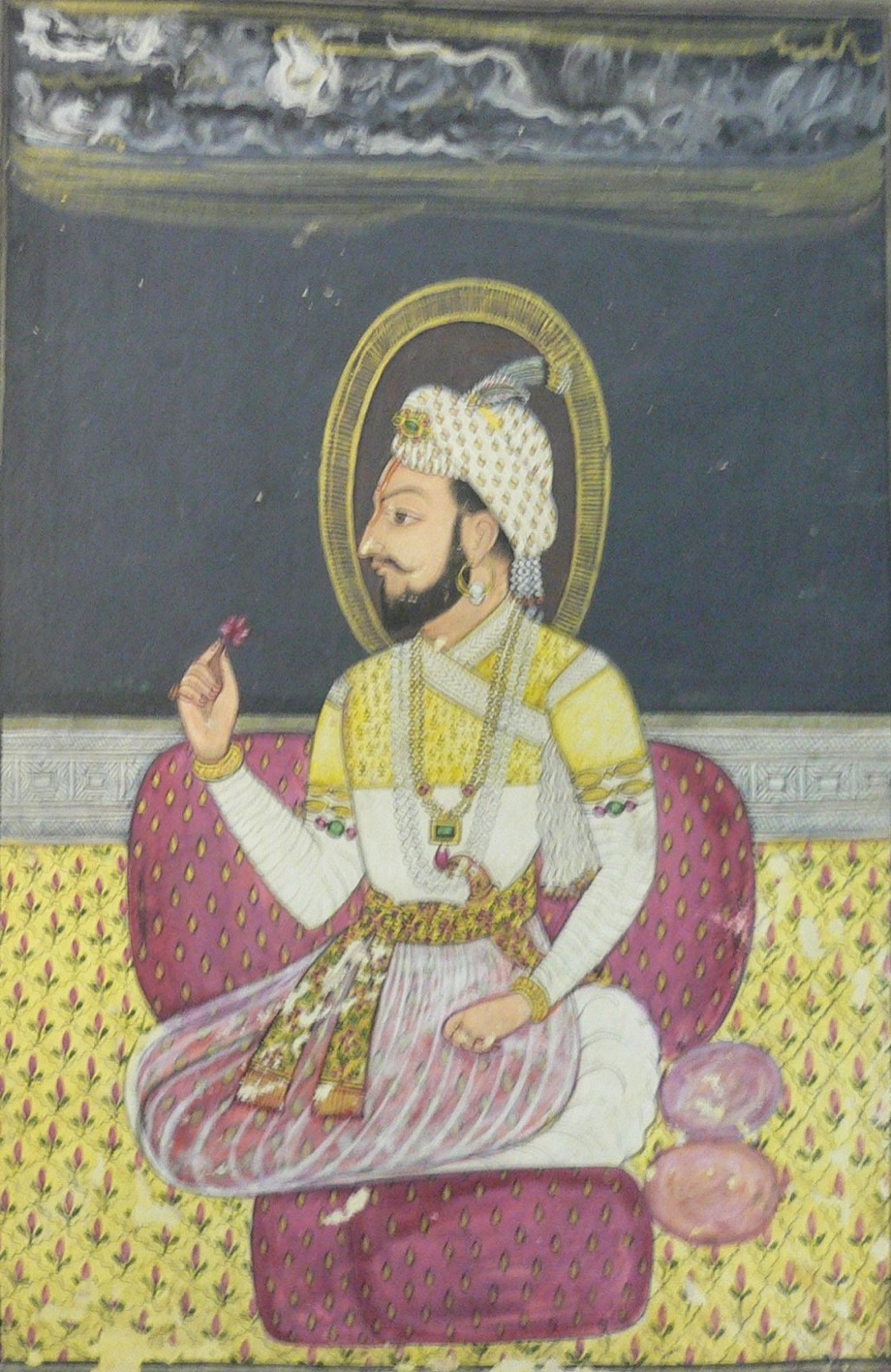
Portrait of Sambhaji — late 17th century
The heir who crossed the line
Sambhaji did not spend his entire youth on the side he would eventually defend to the death. In 1678 he joined the Mughal commander Dilir Khan, turning away from the authority of his father, Shivaji. He later returned. The episode sits awkwardly between two familiar portraits: the unruly son whose conduct supposedly explains every failure, and the flawless hero whose martyrdom should remove every earlier complication. Neither portrait leaves enough room for a difficult life.
Born in 1657, Sambhaji grew up inside the making of a new kingdom. As a child, he had already been incorporated into the settlement of Purandar, which assigned him a place in Mughal service. He accompanied his father to Agra in 1666. The boundary between imperial service and resistance was therefore part of his experience before he could choose a political course for himself.
The proposed ENTP reading asks whether a recurring willingness to reconsider available alignments operated alongside a habit of intellectual engagement. It remains low confidence. Defection can result from fear, resentment, ambition, or constraint; literary learning can reflect education and patronage. Neither restlessness nor scholarship should be promoted into an automatic account of how his mind worked.
Sambhaji tentatively reads as an ENTP whose dominant Extraverted Intuition sought openings even within apparently settled political relationships.
Possibility was a political instrument
A dominant Extraverted Intuition interpretation has its strongest chance where Sambhaji treated an apparently fixed political relationship as something that could be rearranged. His movement toward the Mughals and back is one such episode, but too ambiguous to carry the claim alone. The more consequential example belongs to his reign: sheltering Aurangzeb’s rebellious son Muhammad Akbar after the prince’s failed challenge to his father.
This Akbar was a seventeenth-century prince, not the earlier emperor of the same name. His arrival offered Sambhaji a possibility beyond fighting each imperial army as it appeared. The Mughal dynasty’s own division might be used against its ruler. An alliance could place an alternative claim to imperial authority alongside Maratha resistance. The enemy’s family was not a single closed institution; it contained an opening that might change the wider contest.
The possibility did not become the outcome its participants wanted. Aurangzeb remained emperor, and Akbar eventually left India. A historical reading through possibilities must include possibilities that failed. Sambhaji’s willingness to entertain an altered configuration of power shows a political move, not proof that he could foresee its consequences or control the interests of everyone involved.
It also operated within necessity. A relatively young kingdom facing a much larger imperial opponent had reasons to seek partners and exploit divisions whatever its ruler’s personality. The tentative reading concerns the combination of this move with other acts of crossing and reconsidering alignment. The pattern is suggestive enough to discuss, but the pressure of the situation explains much of it without requiring a type.
The accession itself required him to secure his claim against a rival arrangement around his younger half-brother Rajaram after Shivaji’s death in 1680. Coronation followed in 1681. He inherited institutions and loyalties, but neither inheritance nor seniority made the transfer effortless. The ruler who later defended the kingdom first had to establish that its authority would pass through him.
Learning is evidence of work, not a complete mind
Sambhaji’s association with the Sanskrit Budhabhushana gives an intellectual dimension to a record often dominated by war and accusation. Scholarly discussion describes a work concerned with royal duties, ministers, counsel, fortifications, armies, and other elements of government. It belongs to the learned tradition of reflecting on kingship. The association complicates an account that would make him merely an impulsive fighter.
It does not, however, prove auxiliary Introverted Thinking. A courtly text may compile inherited material, involve learned collaborators, and present ideals that its royal author did not consistently follow. Questions of attribution and composition have to remain separate from the four-letter argument. The responsible claim is that learned political discourse belonged to Sambhaji’s world and reputation, not that every verse transcribes his private reasoning.
An interpretive connection is possible between engaging categories of rule and questioning particular arrangements of authority. The former asks what makes counsel or government sound; the latter can expose the difference between an inherited position and a judgment about its use. Yet the surviving materials do not establish a continuous chain from text to decision. It would be fiction to have Sambhaji consult a particular maxim before an undocumented act.
This is the weakest part of the assigned reading, and should be acknowledged as such. The intellectual evidence prevents an impoverished portrait, but it cannot securely distinguish analytical detachment from moral conviction, pedagogical convention, or the wish to inhabit an accomplished royal identity. The interpretation has value only while those alternatives remain visible.
The kingdom was more than the king’s reputation
A tertiary Extraverted Feeling reading can be cautiously considered through the relationships that enabled his rule. A ruler had to sustain recognition among commanders, officials, and allied groups, and Sambhaji could not govern by challenging authority alone. His position depended on people accepting him as the bearer of a continuing Maratha sovereignty. That dependence is a fact of kingship, however, and does not establish an especially harmonious or persuasive social temperament.
His reign involved sustained warfare against Mughal forces and conflict with other regional powers, including the Portuguese. Campaigns along the western coast connected maritime interests, forts, and inland warfare. The record shows a ruler required to respond across several fronts. It does not justify reducing every reversal to indiscipline, or every success to personal brilliance. Commanders, geography, supplies, and the movement of enemies all mattered.
Hostile descriptions of his habits have often supplied a simple explanation for the end. Such descriptions require the same questions applied to praise: who wrote them, with what access, and for what purpose? The victorious empire had reasons to discredit a defiant king. Later defenders had reasons to purify his memory. A biography need not decide between those total portraits in order to describe acts independently supported by the sources.
Sambhaji was captured at Sangameshwar in 1689 and executed on Aurangzeb’s orders after brutal treatment. Accounts of the final exchange and the precise conditions offered to him differ. His death should not be embroidered with an invented speech or a single explanation of the emperor’s motives. What remains secure is the violent elimination of a resisting ruler, followed by the continuation of resistance rather than its disappearance.
Why ENTP Over ESTP
Why not ESTP?
ESTP is a strong alternative because the clearest record concerns immediate risk, military action, and changing circumstances. ENTP receives only a narrow preference from the combination of politically alternative alignments and an association with learned reflection on kingship. Neither is decisive. The first may be compelled by circumstances, while the second cannot establish his habitual reasoning without firmer personal evidence.
The type should remain a revisable interpretation rather than the key to his defection, reign, or death. Sambhaji’s record contains discontinuity and endurance together. A useful portrait preserves both, refusing to make either accusation or martyrdom answer every question about the living man.
Connected Figures
Further Reading
- The Marathas 1600–1818 — Stewart GordonPlaces individual rulers within the military, social, and familial structure of the Maratha polity.
- The Mughal Empire — John F. RichardsA modern synthesis of conquest, administration, and the changing ideological basis of Mughal power.
- Chhatrapati Sambhaji (1657–1689 A.D.) — Pandit Shankar JoshiA University of Bombay research thesis comparing sources for his reign and its contested reputation.
- Shivaji and His Times — Jadunath SarkarAn influential reconstruction using Persian correspondence and other sources; its character judgments require scrutiny.
