 Historical Figure MBTI
#1244 · 9-13-26 · The Rise of the Marathas
Jijabai
Dynastic Matriarch · Mother of Shivaji
1598–1674
5 min read
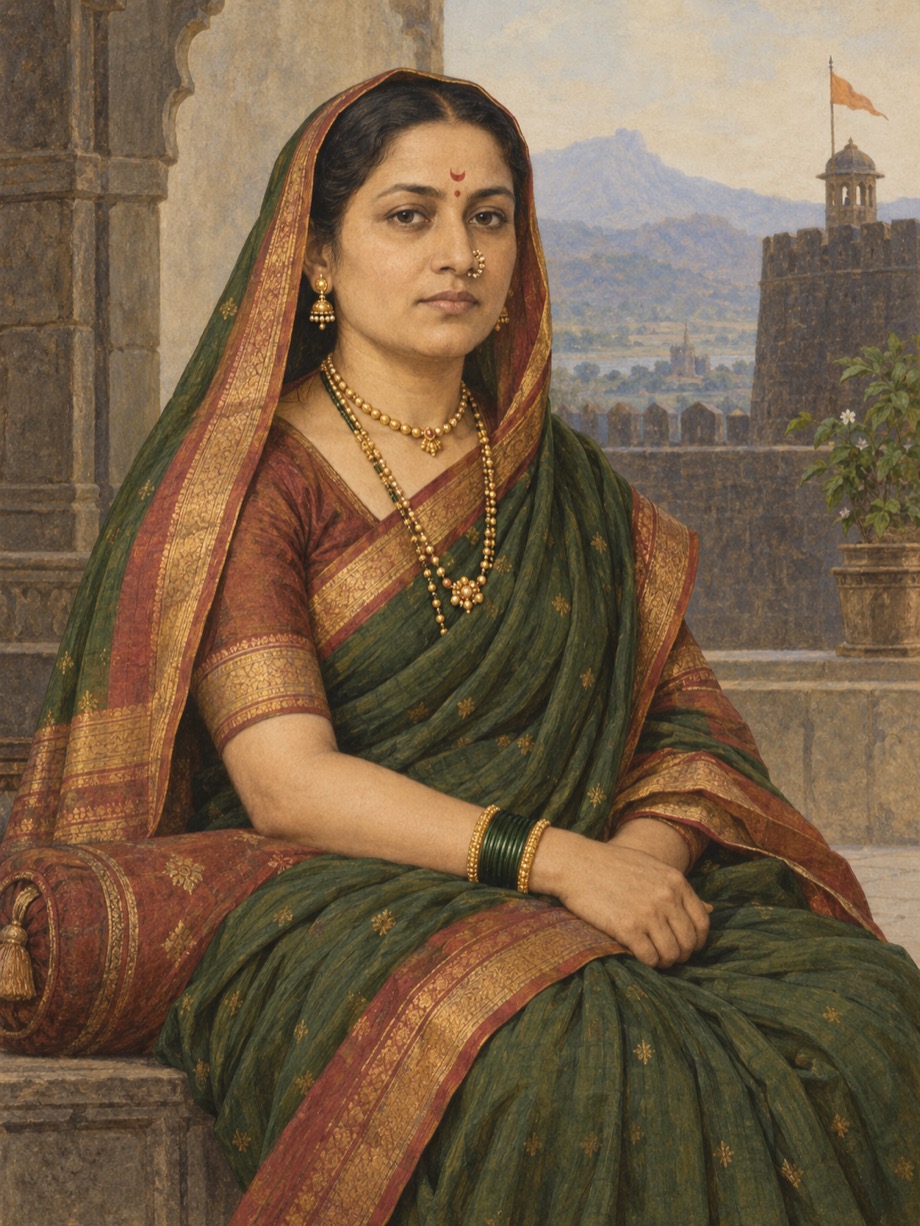
AI-assisted Portrait of Jijabai
The Mother Left in Charge
When Shivaji prepared to travel to the Mughal court in 1666, he had to leave more than a household behind. Forts, officers, accounts, and a fragile authority would continue operating while he went north. The Sabhasad chronicle places important arrangements under the custody of his mother, Jijabai. However cautiously that later narrative must be read, its description gives her a role more concrete than that of an inspiring figure in a child’s imagination.
Jijabai’s later fame has often moved in the opposite direction. Paintings, popular histories, and performances show her teaching the future king his destiny. These images express the significance subsequent generations assigned to her. They cannot supply the missing record of private childhood conversations. The historical task is to recognize her authority without requiring those conversations to have happened exactly as later writers imagined.
A Household Formed by Service and War
Born in 1598 into the Jadhav family, Jijabai married Shahaji Bhonsle in a society where lineage, military service, and landed rights were closely entangled. Her natal and marital families belonged to the political order of the Deccan sultanates. Their ambitions and quarrels make little sense when translated into a simple opposition between a foreign court and an entirely separate local society.
Shahaji’s changing employments brought opportunity and danger to the family. The collapse of Ahmadnagar’s power and the intervention of Mughal and Bijapuri armies disrupted territories and loyalties. Shivaji was born at Shivneri in 1630 amid this instability. The family’s future depended on negotiating claims to land and service rather than occupying an uncontested ancestral kingdom.
After Shahaji established himself in Bijapur’s service, Jijabai and Shivaji were based in the Pune region. Dadaji Konddev administered the family’s interests there. His work, the household’s presence, and the restoration of cultivation belonged to the same practical problem: making a damaged territory support a durable establishment. Assigning all of that work to either Jijabai or Dadaji alone would simplify a shared enterprise beyond the evidence.
Authority Beyond the Domestic Scene
It is tempting to describe every woman in a ruling family as exercising only influence behind a curtain. Jijabai’s position resists that assumption. In the account of the Agra journey, custody of Rajgad and other strongholds is connected with her and with named senior officers. The arrangement suggests recognized standing within the government, even though it does not provide a diary of her interventions.
The distinction matters. An officer could possess operational responsibility while a dynastic elder supplied authority, continuity, and a point of allegiance. A mother entrusted with such a position was neither a decorative symbol nor necessarily the sole director of every decision. The available narrative establishes her importance more firmly than it establishes the exact limits of her command.
Shivaji’s confinement at Agra made continuity at home especially important. His eventual escape restored the founder to a base that had survived his absence. Jijabai’s contribution belongs within that wider network of officers, kin, and fort commanders. Heroic accounts may concentrate agency in one person, but maintaining a polity required people who stayed as well as the man who escaped.
Faith, Memory, and the Missing Conversations
Jijabai is remembered as a religious mother who communicated epic models of courage and rightful kingship to her son. Such a role is plausible within her cultural world, but plausibility is not a transcript. The stories most familiar today usually reach us through retrospective chronicles and much later commemorative writing. Their precise speeches, lessons, and predictions should not be treated as contemporary evidence.
The same caution applies to portraits of her marriage. Later historians have sometimes explained her influence through an imagined psychology of neglect, loneliness, or resentment. These explanations convert gaps in the archive into a complete emotional life. Her family circumstances can be described without pretending to know every private response they produced.
The surviving material therefore supports leaving her untyped. Her maternal role, religious commitments, and entrusted authority do not distinguish a particular cognitive pattern. A responsible biography can describe what she helped sustain while admitting that its record does not permit the detailed personality reconstruction sometimes offered in her name.
Seeing the Coronation
Jijabai lived to see Shivaji’s coronation at Raigad in June 1674 and died shortly afterward. The proximity of those events has supplied later writers with a perfect ending: a mother’s lifelong mission completed just before her death. The chronology is meaningful, but the mission in that precise form remains a narrative construction rather than a surviving statement from Jijabai.
What she witnessed was nevertheless consequential. Her son’s authority had moved from inherited family interests and contested forts to a formal claim of kingship. The ceremony drew upon lineage and religious standing, exactly the kinds of social resources in which an elder of her position mattered. Her presence connected the new crown to a family history that the coronation sought to authorize.
Connected Figures
Further Reading
- Siva Chhatrapati — Krishnaji Anant Sabhasad, translated by Surendranath SenThe early dynastic narrative includes Jijabai in the arrangements made before Shivaji’s Agra journey.
- The Marathas 1600–1818 — Stewart GordonReconstructs the service, landholding, and family networks within which her household operated.
- Shivaji and His Times — Jadunath SarkarUseful for chronology and documentary references; distinguish evidence from the author’s conjectures about her private life.
