 Historical Figure MBTI
#1242 · 9-12-26 · The Mughal Empire
Shah Shuja
Mughal Prince · Governor of Bengal · Claimant
1616–c. 1661
5 min read
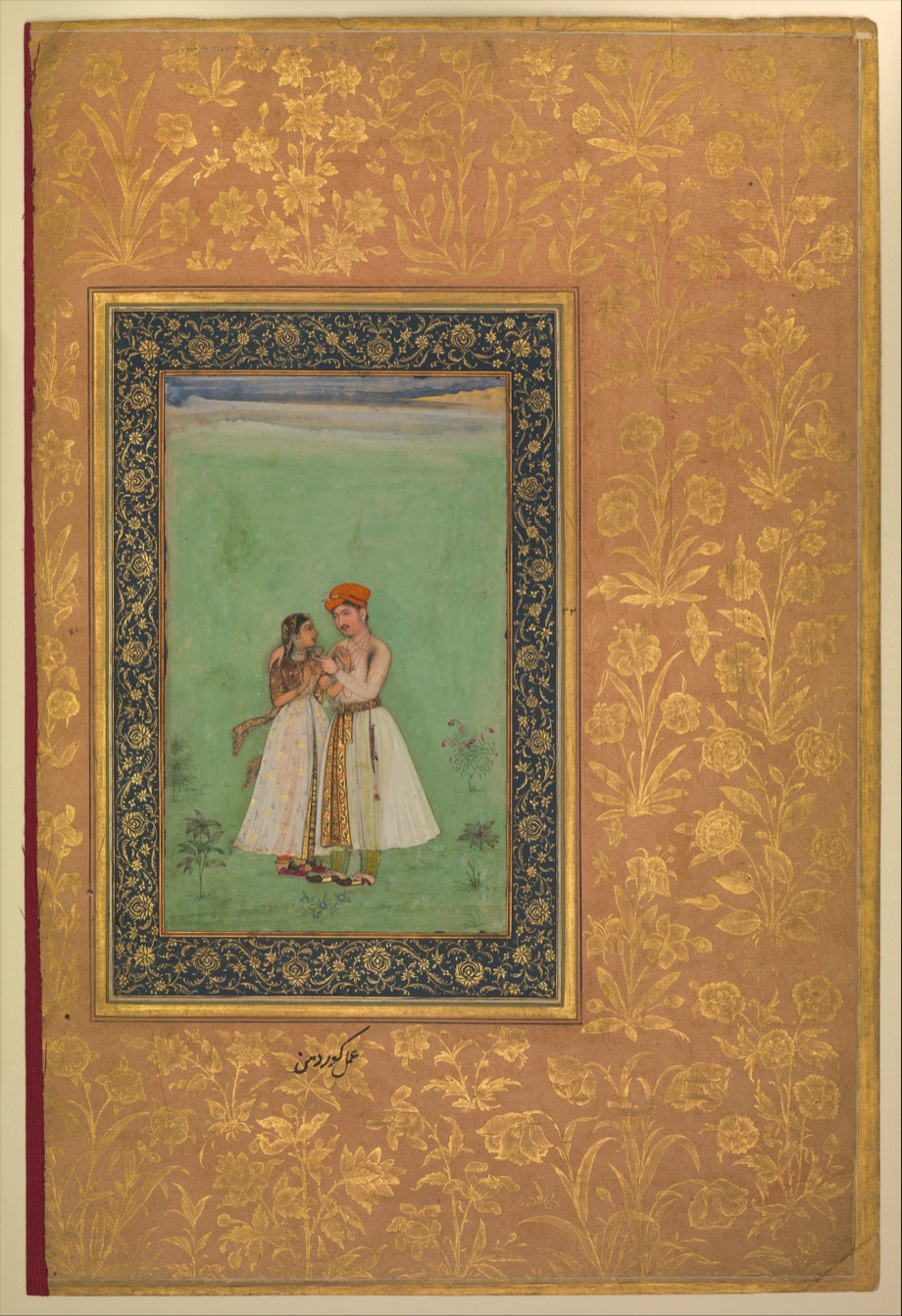
Portrait of Shah Shuja with a beloved — c. 1632
A prince whose province was not enough
Shah Shuja possessed one of the advantages that made a Mughal prince dangerous: a substantial provincial position from which to pursue a claim to the whole empire. Bengal gave him resources, followers, and distance from the imperial center. When Shah Jahan fell seriously ill in 1657, Shuja did not accept that the succession belonged automatically to Dara Shikoh or to Aurangzeb. He declared his own kingship and advanced his claim through war.
That initiative is easy to overlook because his story ends away from the court that had produced him. Defeats, retreat, and flight into Arakan moved him from the category of contender into that of a fugitive dependent on another ruler. The change was political before it was psychological. A prince could remain himself while losing the institutions that made his decisions consequential.
He remains untyped here. The evidence establishes ambition, military action, and repeated attempts to preserve a position. Those are meaningful features of a career, but they do not distinguish a reliable cognitive pattern. Descriptions of pleasure, generosity, or intrigue come through observers whose judgments must be assessed rather than adopted as a personality test.
The eastern base of an imperial claim
Shuja was the second son of Shah Jahan and Mumtaz Mahal, born in 1616. His long association with Bengal placed him inside a provincial world whose wealth and political relationships mattered to the larger empire. A governorship was not simply an exile from court. It could supply the financial and military basis of an independent princely establishment, while also bringing obligations and conflicts that shaped what the prince could mobilize.
The illness of the emperor exposed the tension in those establishments. Princes had been entrusted with the resources of government, yet could use those resources against one another when the succession became uncertain. Shuja’s declaration belonged to this structure. Calling it rebellion repeats one side’s judgment; calling it an inevitable right erases the competing claims. The more useful description is a bid for sovereignty in a dynasty without an automatic transfer that all participants accepted.
He advanced toward the north Indian center of power and suffered an early defeat near Banaras in 1658 against forces associated with Dara’s son Sulaiman Shikoh and Jai Singh. The setback did not immediately end his claim. He returned to the contest after Aurangzeb’s initial victory over Dara had changed the political situation. His persistence deserves recognition without becoming a ready-made story of indomitable will.
The field and the shrinking alternatives
At Khajwa in January 1659, Shuja fought Aurangzeb and lost. The defeat made the eastern provinces the setting for a continuing pursuit rather than the secure foundation of an alternative reign. Military position, loyalty, and access to resources now became problems that had to be solved under pressure. A prince’s title did not compel an army to remain available forever.
Mir Jumla’s campaign against him extended Aurangzeb’s effort to remove a surviving claimant. In this phase, the question was increasingly how Shuja might escape or retain room to act, rather than how he might march directly to the throne. His movements therefore need to be read as responses to altered conditions. Retreat does not tell us that he lacked courage, and renewed effort does not tell us that he possessed a particular personality type.
Bernier’s initial portrait calls him more capable in some respects than Dara while accusing him of excessive attachment to pleasure. Such a combination makes a satisfying explanation of promise squandered. Yet it remains the traveler’s assessment, shaped by court information and by a literary account of the brothers’ competition. It can be cited as testimony about reputation without becoming the controlling explanation for defeats whose military and political causes were much wider.
Beyond the court that could protect him
Shuja fled into Arakan in 1660 with members of his household. There he depended on a ruler outside the Mughal structure in which his rank had previously mattered. Hospitality and refuge could not be assumed to produce lasting safety. Relations deteriorated, and reports of his subsequent end differ in chronology and detail. His death is commonly placed around 1661, but the precise circumstances should not be narrated with certainty.
The uncertainty extends to claims about the fate of his family. Accounts of demands, conspiracies, killings, and escape have circulated through different traditions, and they do not support a single effortless reconstruction of every person’s last moment. A tragic ending does not become better history when its gaps are filled with the most dramatic version. This profile leaves those details unresolved instead of asserting that every member of the household shared one documented fate.
What can be described securely is the loss of his autonomous political base. In Bengal, he had possessed an establishment within an empire and could challenge the center. In Arakan, he had become a displaced claimant whose safety depended on a relationship he did not control. The passage explains a great deal about the vulnerability of defeated princes without requiring a conjecture about his inner character.
Connected Figures
Further Reading
- Travels in the Mogul Empire, A.D. 1656–1668 — François BernierAn interested contemporary account of the succession war; separate witnessed events from court reports and moral judgments.
- The Mughal Empire — John F. RichardsPlaces princely competition, imperial government, and expansion within their institutional setting.
- The Anecdotes of Aurangzeb — Jadunath Sarkar, translator and editorCollected reports and correspondence to read with attention to transmission, attribution, and the purposes of imperial self-presentation.
- An eventful politics of difference and its afterlife: Chittagong frontier, Bengal, c. 1657–1757 — Rishad ChoudhuryRevisits Shuja’s flight and final years through competing accounts and the later memory of the Bengal–Arakan frontier.
