 Historical Figure MBTI
#1231 · 9-10-26 · The Mughal Empire
Shah Jahan
Mughal Emperor · Patron of Imperial Magnificence
1592–1666
10 min read
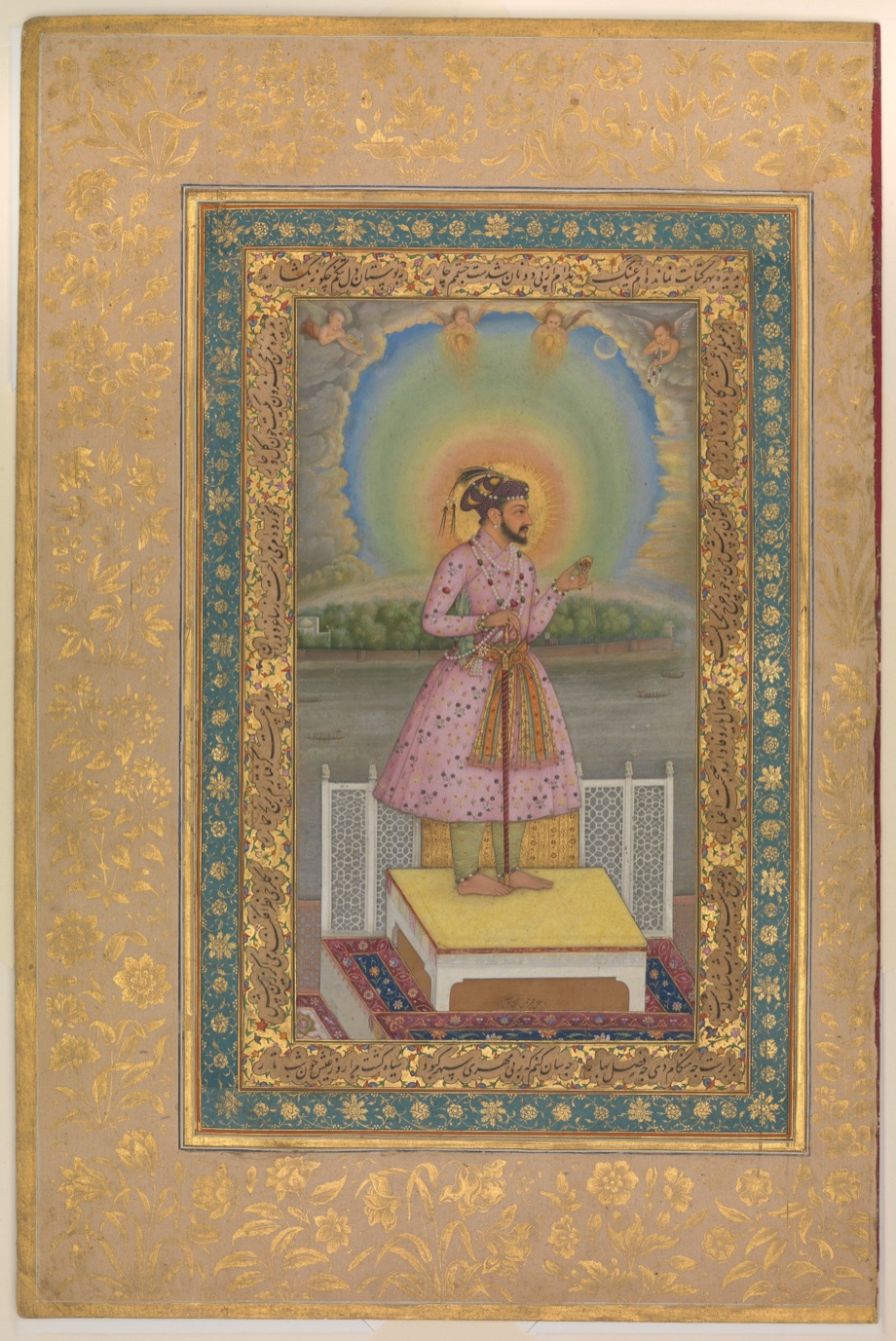
Portrait of Shah Jahan on a terrace — 1627–1628
A world arranged around the throne
In the frontispiece of his imperial chronicle, Shah Jahan faced Timur across the opening of a book. The arrangement made ancestry visible: the living ruler and the conqueror from whom his dynasty claimed descent occupied a shared pictorial world. Shah Jahan adopted a version of Timur’s celebrated title, presenting himself as the second Lord of the Auspicious Conjunction. He wanted power to possess a shape that could be seen, remembered, and recognized as inevitable.
He had learned how far inevitability was from the experience of acquiring it. Born Khurram in 1592, a son of Jahangir, he commanded armies, advanced within a dangerous imperial family, rebelled against his father, and survived the consequences. His accession in 1628 depended on allies as well as ability. The reign’s orderly representations came after a youth in which obedience, ambition, and the prospect of exclusion repeatedly collided.
The proposed INTJ reading begins with this effort to concentrate scattered instruments of rule into a coherent account of sovereignty. It does not begin with the Taj Mahal’s symmetry. Patrons approve buildings designed by specialists; neither geometry nor white marble reveals the patron’s mental organization. What is more suggestive is the sustained relationship among dynastic claims, court ceremony, historical narrative, and the creation of a new imperial capital.
Even that relationship supports only a low-confidence interpretation. A Mughal emperor inherited expectations of magnificence and central authority. Shah Jahan could fulfill those expectations without having invented an inward vision distinct from them. The question is whether his choices give those conventions an unusually concentrated direction. The answer can be argued, but it cannot be read directly from a palace wall.
Shah Jahan tentatively reads as an INTJ whose dominant Introverted Intuition sought to make a reign express one enduring imperial order.
The reign should tell one story
Dominant Introverted Intuition is a plausible description of the tendency to make different parts of a reign express one organizing conception. Shah Jahan’s desired image was a sovereignty elevated above ordinary contingency: richly ordered, genealogically legitimate, and difficult to imagine without him at its center. A painting, a title, an audience, and a city could perform different tasks while advancing the same claim. Their relationship matters more than any single object’s splendor.
The Padshahnama made this claim historical. The official chronicle and its paintings presented victories, ceremonies, and imperial encounters within an authoritative account of the reign. It was a record, but also an arrangement of memory. The ruler’s actions should become episodes in a recognizable order rather than an accumulation of disconnected events. A court history necessarily selects and praises. Under Shah Jahan, its visual language helped turn selection into an experience of hierarchy.
That continuity is distinguishable from Jahangir’s more personal delight in particular appearances, though the distinction should not be exaggerated. Both rulers commissioned images of themselves; both used inherited artistic conventions. Shah Jahan’s formal royal representation placed a different emphasis on the stable figure of the sovereign. The official portrait did not merely show what he looked like. It showed how other people ought to understand his position.
The move to Shahjahanabad, inaugurated as the imperial capital in 1648, gave this conception an urban setting. The Red Fort, the city’s routes and markets, and the congregational mosque connected royal residence to a larger lived environment. Such projects could not be completed by the emperor’s imagination alone. Their realization required designers, officials, suppliers, and laborers. Yet choosing to establish a new capital was a consequential statement about the continuing future of the dynasty.
The distinction between a coherent program and its author’s personality remains important. We can observe the program more confidently than the private act of thinking that preceded it. An institution may develop coherence through many people’s work. The tentative interpretation is that Shah Jahan persistently selected and sustained an imperial image, not that he single-handedly conceived every spatial or pictorial expression of it.
This approach also explains why an apparent contradiction need not end the argument. A ruler may want permanence while improvising constantly to obtain it. His youthful rebellion, shifting alliances, and military negotiations were not orderly exercises conducted from a secure position. They were responses to risk. The proposed pattern appears in the direction toward which he tried to bring those responses, rather than in an absence of tactical adjustment.
Magnificence required a working apparatus
Auxiliary Extraverted Thinking would describe the practical translation of a chosen order into commands, offices, and sustained projects. Shah Jahan’s reign drew on a mature imperial system, and it benefited from skilled servants. His father-in-law Asaf Khan helped secure the accession; experienced officials and commanders then carried much of the work of government. The emperor did not need to perform every task personally to exert a decisive influence over priorities.
The Deccan settlement of 1636 illustrates how military pressure could become a political arrangement. After the destruction of the remaining Ahmadnagar state, Bijapur and Golconda accepted tributary relations with the Mughals. Direct annexation of every neighboring kingdom was not the only available expression of supremacy. Submission, payment, and recognized imperial superiority could secure an objective while leaving local rulers in place. The result joined coercion with institutional compromise.
This is a stronger example for the proposed practical pattern than the mere fact that he commissioned construction. It shows the selection of a form of control rather than an undifferentiated appetite to conquer. Yet it also belongs to established imperial statecraft. An effective settlement cannot prove a function any more than a successful battle can prove a temperament. The interpretation depends on recurrence and relationship, not the promotion of one decision into a diagnostic test.
The reign’s buildings likewise depended on continuity of execution. Stone had to reach the site, specialists had to coordinate their contributions, and work had to outlast the immediate moment of royal interest. A monument is evidence that such an apparatus operated. It is not evidence that the patron possessed every craft it contained. The sensible claim is that Shah Jahan could set priorities which his government was capable of sustaining at extraordinary scale.
The costs belong inside that claim. Courtly magnificence rested on resources collected from a much larger society. Warfare could destroy livelihoods even when official narration transformed it into victory. To describe the imperial apparatus as effective is to describe its ability to produce the ruler’s desired results; it says nothing by itself about equitable distribution or the welfare of everyone drawn into its operation. Administrative achievement and human suffering can occupy the same reign.
Shah Jahan’s military ambitions also encountered serious limits. Campaigns beyond the Hindu Kush and repeated failures to recover Kandahar exposed the difficulty of forcing a distant frontier into an imperial conception. Resources and rank could not abolish terrain, supply problems, or determined opposition. A coherent intention can generate waste when the world will not accommodate it. The failures are necessary evidence against any account in which vision automatically produces mastery.
One attachment within an imperial life
Mumtaz Mahal died in 1631 while accompanying Shah Jahan in the Deccan. The mausoleum he commissioned for her eventually became the most widely recognized expression of his reign. It is tempting to make this response stand for a hidden emotional essence: a calculating emperor finally revealed as a devoted husband. The surviving evidence deserves a less convenient treatment. Affection and the expression of sovereign magnificence could reinforce each other.
Tertiary Introverted Feeling is a possible interpretive language for the concentration of value in particular attachments. Mumtaz occupied an exceptional place in the imperial household. The scale and endurance of her memorial show that her remembrance mattered greatly to Shah Jahan. They cannot tell us precisely how he experienced loss, and still less how she would have understood the monument. A husband’s public act of commemoration is evidence about his priorities, not a recovered conversation between the couple.
The Taj Mahal belongs simultaneously to bereavement, Islamic funerary culture, and imperial representation. Its garden, inscriptions, materials, and carefully ordered approach participate in meanings larger than a private marriage. The woman buried there is honored through the resources and language of a sovereign state. Recognizing this does not empty the building of feeling. It places feeling within the world that gave it an architectural form.
His preference for Dara Shikoh likewise brought personal attachment into the problem of political continuity. A favored son could appear to offer the future Shah Jahan wanted, while other sons accumulated military experience and independent support. The father’s valuation did not settle the succession. What felt fitting within the household had to survive a political system in which several princes could make armed claims.
Here the limits of the type become particularly visible. Private loyalty can be described, but the documents do not reliably distinguish every conviction from strategy, convention, or retrospective royal praise. The proposed interpretation remains a way of relating recorded choices. It should never become permission to supply undocumented tenderness, inward conversations, or emotional motives wherever the narrative leaves a space.
The order broke while its maker lived
In 1657 Shah Jahan’s illness opened the crisis his representations of permanence could not prevent. His sons struggled for the throne before his death. Aurangzeb’s victory in 1658 ended his father’s effective rule, and Shah Jahan spent his final years confined in Agra Fort. Jahanara remained with him. He died in 1666 and was buried beside Mumtaz Mahal.
The conclusion does not prove an inferior Extraverted Sensing failure. A succession war involves institutions, armies, alliances, and chance; it cannot responsibly be reduced to one old man’s difficulty facing immediate facts. What it does show is the distance between an image of sovereignty and the sovereign’s continuing command of events. The court could picture an orderly world more easily than the dynasty could guarantee one.
His confinement gives the reign its sharpest reversal. A man who had made spaces for imperial authority now occupied a space controlled by another ruler. The monuments remained while access, movement, and political choice narrowed. We need no invented scene of him perpetually gazing at the Taj to understand the loss. The contrast between the built claim and the captive life is already exact enough.
Why INTJ Over ENTJ
Why not ENTJ?
ENTJ is a strong alternative because his military career and imperial government required sustained outward organization. The narrower preference for INTJ rests on the apparent priority of a concentrated conception of sovereignty across different media, with execution serving that conception. Official patronage may create this appearance independently of personality, so neither the order of the functions nor the introversion claim is secure.
The reading is deliberately tentative. His commissioned works establish what his court wanted visible, while his political history establishes decisions with real consequences. Together they permit an argument about coherence and execution, but not a reconstruction of the architect inside the emperor’s mind.
Connected Figures
Further Reading
- The Complete Taj Mahal and the Riverfront Gardens of Agra — Ebba KochA detailed reconstruction of the entire complex, its urban setting, and its architectural meanings.
- The Mughal Empire — John F. RichardsA modern synthesis of conquest, administration, and the changing ideological basis of Mughal power.
- Travels in the Mogul Empire — François BernierAn observer’s account of the succession struggle and court life, requiring care with rumor and European assumptions.
- The Padshahnama — Abd al-Hamid LahoriThe official chronicle and its illustrated manuscript present the reign’s authoritative dynastic image.
