 Historical Figure MBTI
#1234 · 9-10-26 · The Mughal Empire
Ustad Ahmad Lahori
Architect · Imperial Building in a Collaborative Age
Active first half of 17th century; died c. 1649
5 min read
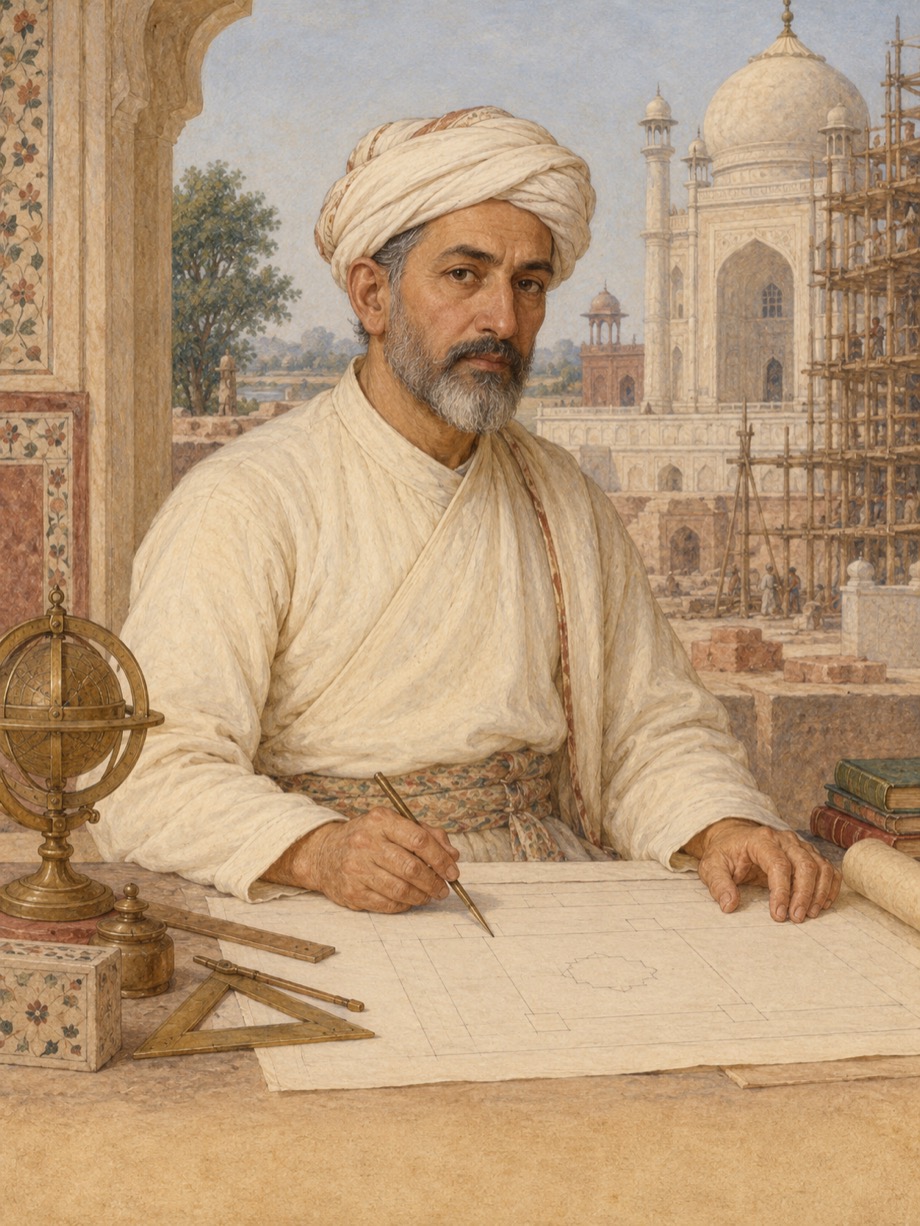
AI-assisted Portrait of Ustad Ahmad Lahori
A name inside a collective achievement
Ustad Ahmad Lahori is remembered through a building that has become larger than the circumstances of its making. UNESCO identifies him as the principal architect of the Taj Mahal. The association is important, but it requires a different kind of biography from the familiar story of a solitary genius imagining a masterpiece and then handing it to obedient craftsmen. Imperial architecture was a coordinated enterprise, and authorship was distributed across more roles than a modern signature can contain.
Ahmad worked in the first half of the seventeenth century, during Shah Jahan’s reign, and is generally thought to have died around 1649. Much of the personal detail readers might expect from an artist’s life is absent or uncertain. The surviving attribution gives him a consequential place in the history of building. It does not give us a reliable account of his everyday conduct, private ambitions, or habitual way of resolving problems.
He remains untyped. The Taj Mahal’s geometry cannot establish the architect’s personality, especially when the extent of any one person’s contribution is difficult to isolate. A design may be rigorously ordered because of training, shared conventions, a patron’s requirements, and the work of several specialists. To label its maker from its appearance would mistake a professional result for a psychological confession.
What the evidence actually attributes
One significant source of the attribution is Ahmad’s son, Lutfullah Muhandis. Scholarly discussion of the family records notes a poem in which Lutfullah credits his father with the Taj Mahal as well as major imperial works at Delhi. A son’s statement is evidence, and a statement with a particular relationship to its subject. It should neither be ignored because it is familial nor accepted as a complete allocation of every architectural decision.
M. Abdulla Chaghtai’s study of the problem distinguishes this family testimony from contemporary court references to architects working on Delhi’s imperial buildings. He also separates design attribution from named supervision of the Taj’s construction. The distinctions matter. A person directing expenditure or coordinating the site did not necessarily supply its architectural conception; a calligrapher whose name survived in an inscription did not thereby become the designer of the whole complex.
The resulting picture permits a serious association with Ahmad while preserving uncertainty over the exact division of work. The title ustad indicates recognized mastery. The name Lahori situates him in relation to Lahore. Neither supplies the missing personal narrative. His importance should be stated through the evidence for professional authority, rather than strengthened by a fictional childhood, an undocumented moment of inspiration, or a claim that he alone solved every problem.
Architectural history often has to work at this uneven scale. A building can survive in extraordinary detail while the decisions that produced it remain incompletely documented. The material record and the textual record answer different questions. The walls may disclose methods, relationships, and corrections that a biography cannot assign securely to a named individual. Acknowledging that difference makes the attribution more precise rather than less meaningful.
An architecture with many kinds of work
The Taj Mahal was commissioned after Mumtaz Mahal’s death in 1631. Its production required stonecutters, masons, inlayers, carvers, calligraphers, and other specialists drawn from a wide geographical area. These were skilled contributors, not an undifferentiated mass whose only function was to realize somebody else’s completed thought. Their knowledge helped determine what could be built and how the intended effects could be achieved.
The complex also extends well beyond the white marble mausoleum. Ebba Koch’s reconstruction attends to the mosque and guesthouse, the entrance sequence, the forecourt, attendants’ quarters, and the commercial structures associated with the monument. The visitor’s encounter depended on a whole environment. Thinking about Ahmad within that environment is more historically productive than treating the familiar domed silhouette as the complete object of his work.
Coordination across such an enterprise would have required communication among different forms of expertise. The historical evidence does not preserve every conversation, so the biography should not dramatize imaginary exchanges between architect and emperor. But the scale of the result establishes that design and execution had to remain connected over time. Professional mastery included participation in that connection, whatever the exact administrative boundaries of Ahmad’s role.
Shah Jahan’s patronage supplied authority and resources, and his preferences formed part of the setting in which architects worked. It would be equally misleading to give the patron all creative credit or to remove him from the process. A court project could have a principal architect and still possess many authors. The useful distinction is between identifiable responsibility and exclusive invention.
The building cannot answer for the man
Ahmad’s surviving reputation invites admiration for technical and artistic accomplishment. It does not establish that he was inwardly austere, visionary, perfectionist, or solitary. Those adjectives often travel from a building’s effects to an architect’s imagined character without an intervening source. In this case the transfer would be especially uncertain because the production was collaborative and the biographical record is thin.
Leaving the entry untyped therefore protects a distinction worth preserving. We can know that a person occupied an important professional position without knowing enough to assign a personality. We can recognize a major attribution while remaining uncertain about individual decisions within the work. Historical restraint allows the achievement to remain large without enlarging the claims beyond their evidence.
Connected Figures
Further Reading
- The Complete Taj Mahal and the Riverfront Gardens of Agra — Ebba KochA detailed reconstruction of the entire complex, its urban setting, and its architectural meanings.
- The Architect of the Taj and Its Place in World Architecture — M. Abdulla ChaghtaiExamines competing attributions, family testimony, and the distinction between design and supervision.
- Taj Mahal — UNESCO World Heritage CentreDocuments the monument’s significance and identifies Ahmad Lahori as its main architect.
