 Historical Figure MBTI
#1233 · 9-10-26 · The Mughal Empire
Jahanara Begum
Imperial Princess · Patron · Sufi Writer
1614–1681
7 min read
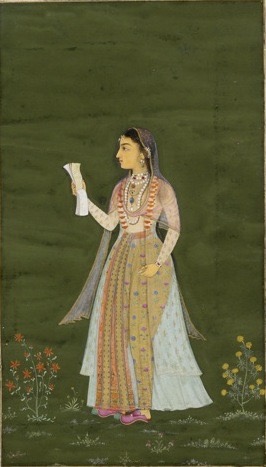
Portrait of Jahanara Begum — 1631–1633
The princess who wrote her own approach
Jahanara Begum did not leave her spiritual life entirely to the descriptions of court historians. In the Risala-i Sahibiyah she traced her search for guidance, remembered the growth of her devotion, and described the benefit she received from her master’s letters. The writing is reverential, but it is also an act of self-placement. She wanted the reader to understand how she had come to stand within a lineage of spiritual authority.
Born in 1614, the daughter of Shah Jahan and Mumtaz Mahal, she became the leading woman of the imperial household after her mother’s death in 1631. She was seventeen. The position gave her responsibilities, access, and wealth, while placing her within the relationships on which the dynasty depended. The young princess who inherited this role eventually became a writer, a patron, and an influential participant in family politics.
The proposed INFJ reading considers a recurring conjunction: an organizing account of spiritual meaning expressed through relationships, patronage, and mediation. Neither mysticism nor compassion proves the type. More useful is the way Jahanara tried to connect an inwardly understood path with the world in which her rank allowed her to act.
Jahanara Begum reads as an INFJ whose dominant Introverted Intuition gave spiritual purpose a continuing expression in relationships and patronage.
A life gathered into a path
Her spiritual writing suggests a dominant Introverted Intuition interpretation because it arranges experience around a unifying direction. In the Risala she presents devotion as something that strengthened over time, deepened through pilgrimage and instruction, and led toward clearer understanding. This is not simply a record of feelings succeeding one another. Earlier experiences gain significance within an account of where the search has brought her.
The distinction requires caution. Spiritual autobiography often gives a life precisely this shape; the pattern may reflect a literary and devotional convention as much as individual cognition. Jahanara wrote within a Sufi world that understood guidance, discipleship, and realization through inherited forms. Her use of those forms becomes personally revealing where she describes what she sought, what she found useful, and how she understood the relationship between herself and her guide.
Although attached to the Qadiri order through Mulla Shah, she also revered the Chishti tradition and wrote Munis al-Arwah, a biography of Muin al-Din Chishti. These commitments should not be mistaken for a modern rejection of religious boundaries. They show a princess finding authority within more than one established spiritual inheritance. The imagined unity was pursued through particular teachers, texts, and practices, rather than through a detached preference for universal ideas.
Her account of Mulla Shah’s correspondence is especially telling. She valued the clarity with which he communicated difficult spiritual matters and the affection accompanying his instruction. She understood guidance through both meaning and relationship. In scholarly analysis of her writings and devotional images, a portrait of the master participates in the practices surrounding her initiation. The image belonged to a disciplined search, not merely to collecting or decoration.
A coherent spiritual purpose did not remove the contradictions of privilege. Jahanara could write in the language of humility while possessing substantial resources. That combination is historically intelligible within royal Sufism, but it should not become a moral exemption. The interpretation concerns the way she ordered her account of self, not whether the account resolved every tension between spiritual aspiration and imperial life.
The path led back toward people
Auxiliary Extraverted Feeling is a plausible account of how Jahanara’s purposes moved through relationships. Her position required managing a household as well as sustaining ties with the emperor and the princes. During the succession crisis she supported Dara Shikoh, whose spiritual interests overlapped with her own. This was a consequential allegiance, not a generic desire that everyone should be comfortable.
When Aurangzeb defeated his rivals and confined Shah Jahan in Agra Fort, Jahanara remained with her father and cared for him until his death in 1666. The choice has often become the emblem of her life. It deserves recognition as loyalty exercised under altered conditions of power. It does not establish that she was incapable of political calculation, or that her importance ended when the court’s center moved away from the captive emperor.
After Shah Jahan’s death she retained a place under Aurangzeb, despite her earlier support for Dara. The continuation is significant. A person who had invested in one family future had to operate within another. Maintaining a relationship with the victorious brother could preserve influence and resources without retroactively erasing her earlier loyalty. Mediation and accommodation were forms of action, not evidence that the conflict had ceased to matter.
Her public patronage supplied another route from position to relationship. Building and garden projects made her presence consequential outside the secluded household. A mosque, a caravanserai, or an urban amenity connected a princess’s resources to worshippers, travelers, merchants, and residents. Commissioning such works involved officials and specialists, but the decision to support them expressed priorities with public consequences.
Commerce belongs beside this patronage. Her income included revenues associated with Surat, and scholarship describes her involvement in maritime enterprise. These were sources of capacity within the same life that produced spiritual prose. The writer’s devotion should not dissolve the patron’s economic position. Jahanara’s ability to act rested partly on wealth and access, while her choices helped determine what those advantages made possible.
The writing does not surrender the person
A tertiary Introverted Thinking interpretation finds limited support in her attention to intelligible spiritual instruction. In the Risala, affection for a teacher does not appear wholly separable from the content and clarity of his letters. She describes receiving explanation and insight, and places those experiences within a narrated progression. This suggests an interest in making meaning coherent, though the evidence is too narrow to establish a complete mental hierarchy.
The most responsible account keeps the stronger patterns in the foreground. She wrote a path, sustained relationships, and used resources. Her rank affected which choices were available and which actions the sources considered worth recording. It is possible that a similar temperament without those advantages would have left no comparable patronage or political record. Historical personality cannot be separated from the material conditions through which it becomes visible.
A severe burn injury in 1644 further exposes the sources’ different agendas. Accounts agree that the accident endangered her life, while explanations of recovery emphasize different spiritual agencies. Court historians and devotional writers made the event meaningful in different ways. It belongs to her bodily history, but it also reminds us that an apparent inner portrait can be constructed by people advancing another person’s sanctity or a dynasty’s legitimacy.
Why INFJ Over INFP
Why not INFP?
INFP is plausible because her writings contain personal devotion and an intimate account of spiritual aspiration. The preference for INFJ rests on the way she organizes that aspiration into a sustained path and repeatedly works through established relationships and public responsibilities. The distinction is tentative: devotional genres can make private conviction look like a unified vision, and political duties can make any princess appear relationally oriented.
The interpretation should preserve both the searcher and the person of power. Her spiritual writing provides unusually valuable personal evidence, but it does not replace the history of money, rank, and dynastic allegiance. The reading is strongest when it relates those parts of the life without turning one into an explanation of everything.
Connected Figures
Further Reading
- Risala-i Sahibiyah — Jahanara Begum; extract translated by Sunil SharmaHer account of spiritual searching and instruction supplies direct evidence beyond courtly descriptions.
- Faces of God: Images of Devotion in Indo-Muslim Painting, 1500–1800 — Murad Khan MumtazStudies devotional images alongside the writings and practices of Jahanara, Dara Shikoh, and Mulla Shah.
- Jahanara Begum — Stephen F. Dale, Encyclopaedia IranicaA concise scholarly biography covering her household role, spiritual interests, and patronage.
- The Mughal Empire — John F. RichardsA modern synthesis of conquest, administration, and the changing ideological basis of Mughal power.
