 Historical Figure MBTI
#1232 · 9-10-26 · The Mughal Empire
Mumtaz Mahal
Empress · A Life Beyond the Monument
1593–1631
5 min read
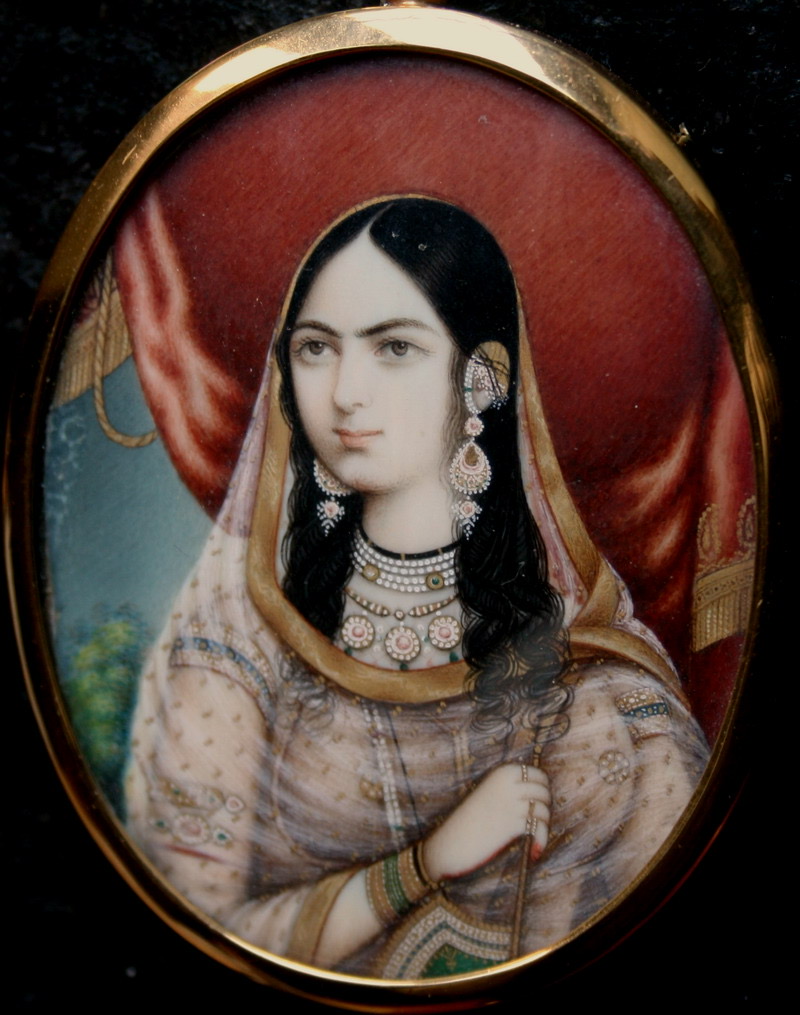
Portrait of Mumtaz Mahal — circa 1840 (later depiction)
The woman beneath the commemoration
The Taj Mahal makes Mumtaz Mahal impossible to forget and surprisingly easy to overlook. Its beauty directs attention toward a husband’s grief, an emperor’s resources, and the skill of its builders. The woman it commemorates can become the reason for a building rather than the subject of a life. Recovering her requires beginning before the monument, with a person who occupied an important place in a mobile, politically active imperial household.
Born Arjumand Banu Begum in 1593, she was the daughter of Asaf Khan and the niece of Nur Jahan. She married Prince Khurram, the future Shah Jahan, in 1612, after a betrothal several years earlier. Her family connections placed her within the central relationships of Jahangir’s court. She was not an outsider whose beauty alone carried her into a royal romance. The marriage joined people already embedded in imperial power.
Her exceptional position as Shah Jahan’s consort is well attested. Her individual personality is much harder to establish. Praise of an ideal wife, the reported intensity of the emperor’s mourning, and the magnificence of the tomb do not provide an independent account of her habitual judgments. She remains untyped because the evidence supports her place and consequences more securely than it supports a reconstructed mind.
A household that traveled with power
Mumtaz accompanied Khurram through a demanding period of campaigns and dynastic conflict. Royal movement was not a holiday arranged around the preferences of a modern couple. The entourage carried servants, guards, goods, family members, and the routines necessary to sustain a household away from a fixed residence. Her presence connected the prince’s domestic life to his military and political career.
Calling her a companion recognizes something real but incomplete. It tells us that the couple’s lives were closely joined; it does not tell us how every journey was decided, whether she welcomed particular movements, or how much disagreement lay outside the record. The surviving language tends to celebrate constancy. A careful biography can acknowledge that constancy without making it the whole substance of her agency.
The pregnancies that marked her married life belong in this account as bodily experiences, not merely as additions to a genealogical list. She bore the children who later became the central actors of Shah Jahan’s succession crisis. Jahanara, Dara Shikoh, Shah Shuja, Roshanara, Aurangzeb, and Murad Bakhsh were among them. Several other children died young. The dynastic future depended on reproductive work whose cost was borne by women even when official history foregrounded princes and battles.
There is no need to invent a private protest or to presume passive acceptance in order to acknowledge that cost. The sources do not provide the conversations through which she understood repeated pregnancy, travel, and loss. They do establish a life in which these experiences recurred. The absence of her direct testimony should leave the questions open rather than license a sentimental answer.
Authority inside the imperial household
Accounts of the empress record her custody of the imperial seal, an important sign of Shah Jahan’s confidence. That responsibility places her within the mechanisms of royal authority. It should not be inflated into proof that she independently governed the empire. Equally, it should not be dismissed as an ornament of affection. A seal authenticated command, and its custody belonged to a world where access, trust, and household position had practical consequences.
Her position also brought wealth. After her death, Jahanara received a substantial share of her estate, with the remainder distributed among the surviving children. The transfer reminds us that the empress possessed resources which outlasted her and helped shape another woman’s authority. Wealth in an imperial household could enable expenditure, gifts, patronage, and influence. It is a historical fact about capacity even where the record preserves few individual transactions.
Claims that she lacked political ambitions often arise within praise of the perfect consort. Such claims need more scrutiny than their conventional wording suggests. The ideal encouraged devotion to the husband and made female influence most acceptable when framed as service. It could conceal the work of intercession or consultation. We should neither accept its absence of ambition literally nor replace it with an undocumented program of rule.
Her agency is clearest at the scale the evidence permits: participation in the household’s movement, an exceptional relationship of trust, possession of wealth, and a central position in a network of kinship. These forms of consequence are less spectacular than a battlefield decision, but they helped sustain the dynasty. Historical importance does not require a biography to supply a dramatic act in every paragraph.
A death and an altered family
Mumtaz died at Burhanpur in June 1631 while giving birth to Gauhar Ara Begum. She had accompanied Shah Jahan to the Deccan. Her body was first buried there and later brought to Agra. The movement of the remains preceded the great mausoleum, whose construction and elaboration occupied years. The familiar finished image compresses a much longer process of loss, temporary burial, transfer, and commemoration.
Within the household, her death changed responsibilities immediately. Jahanara, still a young woman, assumed the leading female position and became an important source of support to her father. The mother’s absence thus helped define the daughter’s subsequent public life. It was not merely a change in the emperor’s feelings. An imperial family had lost a person around whom its relationships and arrangements had been organized.
Connected Figures
Further Reading
- The Complete Taj Mahal and the Riverfront Gardens of Agra — Ebba KochA detailed reconstruction of the entire complex, its urban setting, and its architectural meanings.
- The Mughal Empire — John F. RichardsA modern synthesis of conquest, administration, and the changing ideological basis of Mughal power.
- Jahanara Begum — Stephen F. Dale, Encyclopaedia IranicaPlaces the consequences of Mumtaz’s death within the history of her eldest surviving daughter.
