 Historical Figure MBTI
#1227 · 9-9-26 · The Mughal Empire
Nur Jahan
Empress · Patron · Power at Jahangir’s Court
1577–1645
6 min read
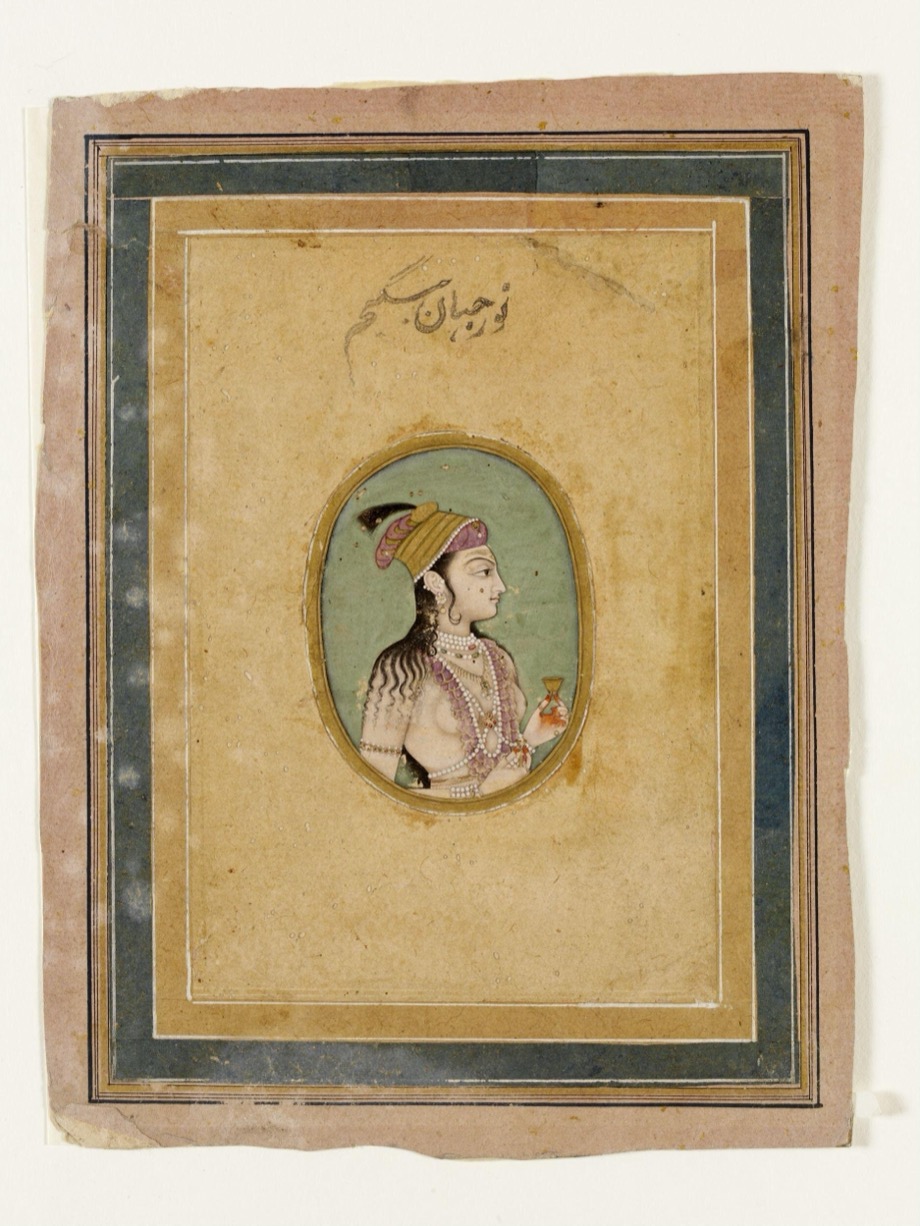
Portrait of Nur Jahan — 18th century (later depiction)
A Name on the Money
On a gold coin struck at Surat in 1626, the names of Jahangir and Nur Jahan share the language of sovereignty. The object survives in the British Museum. A woman’s authority here was more than a rumor circulating behind palace walls: the state put it into precious metal. Yet the coin also locates her power within Jahangir’s kingship. Their partnership could expand her reach without erasing his position, and its dependence on the living emperor would become painfully clear when he died.
Born Mihr-un-Nissa in 1577, she entered imperial history through a Persian migrant family, marriage to Ali Quli known as Sher Afgan, widowhood in 1607, and marriage to Jahangir in 1611. Those stages matter because they interrupt the familiar romance in which a beautiful woman suddenly enchants a helpless ruler. Nur Jahan was already an adult with a daughter and experience of displacement, court life and loss. Beauty appears repeatedly in the sources; it cannot explain the administrative and political choices that followed.
The proposed personality reading is an interpretation of those choices, with medium confidence rather than a recovered diagnosis. Her career shows an unusual ability to turn personal access into public instruments: appointments, patronage, marriage alliances and recognized commands. It also shows failures, especially when the interests of her daughter and brother diverged. A portrait that removes those reversals would misunderstand the kind of authority she possessed.
The tentative ENTJ reading begins with Extraverted Thinking: Nur Jahan repeatedly made influence effective by organizing people, resources and the public signs of command.
Authority That Could Be Used
Jahangir’s own memoir supplies a particularly concrete instance. After Ghiyas Beg died in 1622, the emperor transferred his establishment and the powers attached to his office to Nur Jahan, ordering her ceremonial music to follow the king’s. This was a redistribution of resources and standing, not simply a compliment. The same memoir records her presenting robes of honor to numerous grandees. Such gestures made rank legible, rewarded service and placed the giver within the daily workings of government.
Extraverted Thinking offers a useful language for this outward organization. She worked through available institutions rather than waiting for an independent constitutional office that Mughal women did not ordinarily hold. An imperial household carried money, servants, communication and access. Converting these into durable political leverage required decisions about who received support and how an instruction would travel. The evidence concerns observable administration; being an empress by itself would establish none of these psychological preferences.
Court historians sometimes describe her rise by reducing Jahangir to appetite and dependency. That formula makes a sharp story, but his continuing involvement in appointments, justice and campaigns resists it. Her effectiveness did not require his complete disappearance. It required a partnership that could delegate substantial authority to her. Nor does competence establish benevolence: advancement through family connections could close opportunities for others even when it made the central household more cohesive.
The Family as a Political Future
Nur Jahan’s alliance with her father and brother connected her marriage to an expanding network of imperial service. But a family network was never a single mind. Asaf Khan’s daughter Arjumand Banu married Prince Khurram, the future Shah Jahan; Nur Jahan’s daughter Ladli Begum married Shahryar. These unions eventually attached siblings to competing possible emperors. The distinction is essential. Calling the whole group a permanent faction hides the moment when its members began pursuing incompatible futures.
The auxiliary Introverted Intuition interpretation concerns her concentration on a future arrangement of authority. Marriage could carry today’s influence across an emperor’s death. Support for Shahryar therefore belongs to a dynastic strategy, not merely a mother’s domestic preference. Yet strategy is easier to name retrospectively than to reconstruct in real time. The surviving record cannot demonstrate that every earlier alliance was one step in a plan already complete in her imagination.
Her brother’s success after Jahangir died in 1627 showed the vulnerability of that projected future. He secured the court for Khurram, while Nur Jahan lost the center from which her commands had issued. The change did not prove she had never exercised power. It revealed how much of that power depended on a particular relationship and an alliance that could fracture. Her foresight deserves attention alongside its limits.
The River Would Not Yield
Mahabat Khan seized Jahangir at the Jhelum in 1626, exploiting a moving court whose forces and household had become separated. Nur Jahan answered with an attempted armed rescue. The river crossing failed, with serious losses, and she joined the emperor in captivity. Contemporary and later accounts differ in their emphasis and embellishment. The secure historical point is that she intervened actively and accepted a dangerous military test; courage did not make the attempt successful.
Tertiary Extraverted Sensing is a tentative way to describe that willingness to engage an immediate physical crisis. More revealing than the dramatic crossing is her subsequent adjustment. Recovery required attention to the distribution of soldiers, the movements of the court and the captor’s gradually weakening hold. She could abandon the first method without abandoning the objective. The episode joins decisive action to political patience, rather than making either a permanent caricature of her.
The famous huntress should be treated with similar care. Jahangir admired her marksmanship, but skill with a gun does not identify a mental function. A royal hunt was also a public performance recorded by an affectionate husband. The river crisis carries greater interpretive weight because it links action to a specific problem of authority and shows what happened when that action encountered resistance.
Testing the ENTJ Reading
Why not ESTJ?
An ESTJ interpretation could explain her practical administration and command of established court procedures. It remains a serious alternative. ENTJ fits somewhat better because the most distinctive choices organized those procedures around a projected succession and a changing distribution of power. This is a difference in emphasis within an incomplete record, not proof that she valued innovation over every inherited custom.
Inferior Introverted Feeling should remain the least confident part of this reconstruction. Her provision for dependents, investment in family monuments and attachment to Ladli reveal commitments, but they do not tell us how she privately ranked them. The sources too readily turn a woman’s political decisions into the expression of love or jealousy. Keeping that temptation in view is part of making the type provisional.
Connected Figures
Further Reading
- Nur Jahan: Empress of Mughal India — Ellison Banks FindlyA detailed political biography tracing authority, patronage and the crisis of 1626.
- Empress: The Astonishing Reign of Nur Jahan — Ruby LalA modern biography that places her actions within the constraints and possibilities of Mughal royal life.
- The Jahangirnama: Memoirs of Jahangir, Emperor of India — Jahangir; translated by Wheeler M. ThackstonThe emperor’s testimony, useful for documented appointments and household activity but shaped by his own perspective.
- Architecture of Mughal India — Catherine B. AsherPlaces the tomb of her parents within Mughal architecture and patterns of imperial patronage.
