 Historical Figure MBTI
#1258 · 9-16-26 · The Carolingian World
Hildegard of Vinzgau
Frankish Queen · Mother of a Royal Generation
c. 758–783
5 min read
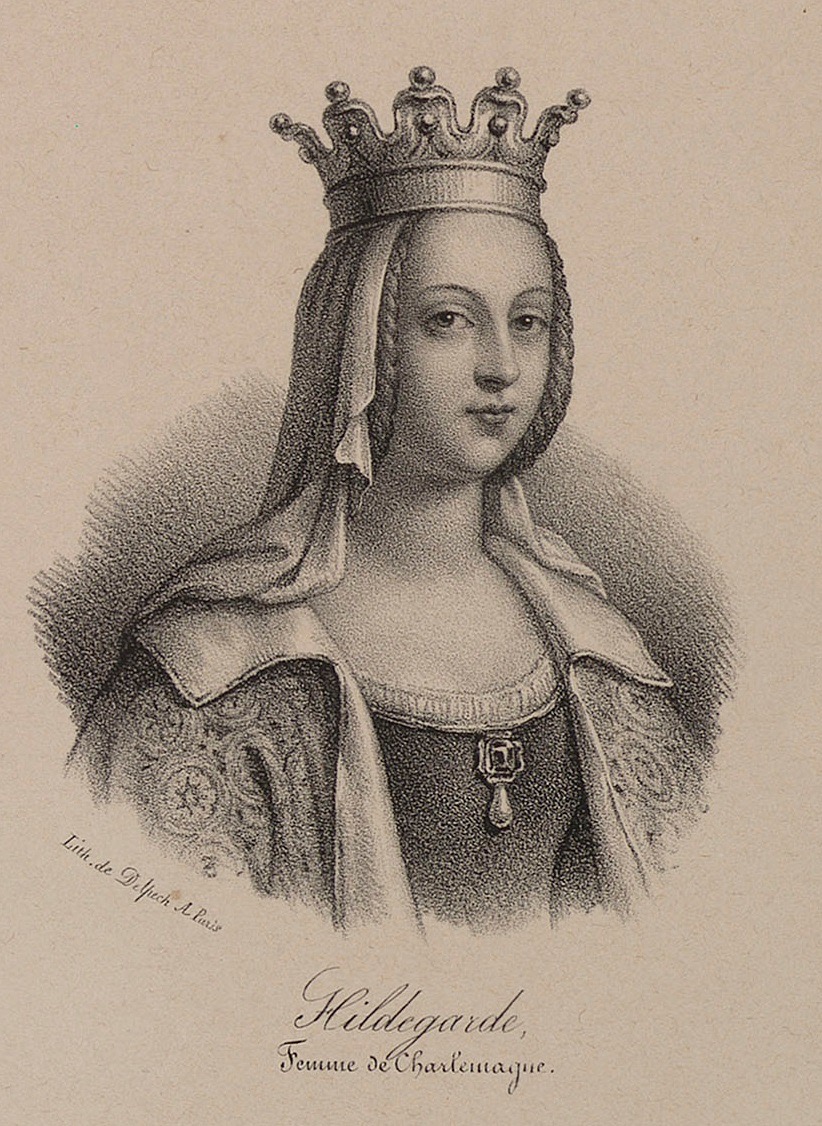
Portrait of Hildegard of Vinzgau — 19th century (later depiction)
The Queen in the Funeral Verse
When Hildegard died in 783, the language chosen to remember her joined beauty, virtue, marriage, and royal dignity. Paul the Deacon’s commemorative verse placed her within the dynasty rather than leaving her as an incidental spouse. A queen whose children carried the family’s future could not be separated from the meaning of the reign.
The same verse creates a difficulty for biography. Praise written for the dead describes what a community wishes to honor and how a patron wants a loss remembered. It does not reproduce the deceased person’s voice. Hildegard is visible through her relationships, her children, and the care invested in her burial, but her private judgments remain much less accessible.
A Marriage within a Changing Royal Family
Hildegard came from an aristocratic family associated with the Alemannic or Swabian region. Her birth is conventionally placed around 758. The exact timing of her marriage in the early 770s is debated, partly because the dating language of her epitaph can be interpreted in different ways. That uncertainty is a reason to avoid building a confident account of her childhood or courtship around a single calculated age.
Charlemagne married her after ending his union with a daughter of the Lombard king Desiderius. The change belonged to a wider reconfiguration of family and diplomacy. It also brought Hildegard into a household in which the king’s mother, Bertrada, still held an honored position. The marriage did not create an isolated couple outside the political structures of kinship.
Einhard identifies Hildegard’s high birth and lists the children through whom she mattered to the succession. His description is brief, but its placement in the family narrative is significant. The queen appears at the junction between an earlier diplomatic marriage and the royal generation that would govern parts of the expanding realm.
Motherhood as a Political Relationship
Her sons included Charles, Pepin, and Louis. Pepin became king in Italy and Louis king in Aquitaine in 781; Louis eventually inherited the imperial dignity. These appointments show how the children of the royal household helped organize rule across different regions. Their mother’s standing was therefore a dynastic matter as well as a domestic one.
It would be reductive to treat this importance as nothing more than producing heirs. A royal mother occupied a place within networks of kinship, patronage, access, and commemoration. Yet recognizing those possibilities is different from asserting particular interventions for which no evidence survives. Hildegard’s influence cannot be measured by inventing conversations with her husband or attributing his decisions to her counsel.
The record also contains infant deaths. Paul’s verses for royal daughters preserve losses alongside dynastic achievement. The family’s history was not simply an orderly progression toward successful inheritance. Commemoration made space for grief, while later genealogy often reduces the same lives to names that survived or failed to survive.
Even the number of children listed in a source requires attention to its purpose. Einhard’s summary concentrates on the children relevant to his account and cannot be treated as a complete registry of every birth. The difference between narrative selection and household experience is especially important when reconstructing a queen whose biography has little room outside motherhood.
Metz and the Work of Remembering
Hildegard was buried at Metz in a setting associated with Saint Arnulf and the dynasty’s ancestry. Paul’s history of the bishops of Metz likewise joined ecclesiastical memory to the royal family. Burial thus located her within a meaningful geography: the dead queen belonged to a lineage whose legitimacy was narrated through saints, bishops, and remembered origins.
The epitaph’s language of royal dignity should not be dismissed as empty ornament. Praise could only work by drawing on recognizable expectations, and acknowledging a queen’s place in rule tells us something about those expectations. It still does not specify which administrative tasks she performed or how frequently she influenced a decision.
Scholars also examine the transmission of the funeral verses rather than assuming they formed an unchanged part of Paul’s original historical work. The surviving text has its own history of copying and arrangement. That history matters because later readers encounter a commemorative ensemble that may not exactly reproduce the circumstances of composition.
A Person Beyond the Available Portrait
Hildegard died on 30 April 783. Charlemagne subsequently married Fastrada, while the children from his marriage to Hildegard remained central to royal plans. The household continued, but her death did not remove her from the dynasty’s memory. Poetry and burial gave her an enduring position within the family’s public past.
Claims about her sweetness, piety, or ideal queenship should be read as statements within a commemorative genre. They may preserve recognizable qualities, but they offer no reliable way to distinguish particular psychological preferences. Maternal status and religious praise cannot substitute for evidence of how she repeatedly reasoned, chose, or responded under different conditions. She therefore remains untyped.
Connected Figures
Further Reading
- King and Emperor: A New Life of Charlemagne — Janet L. NelsonReconstructs the ruler through political relationships, family decisions, and close reading of the sources.
- Courts, Elites, and Gendered Power in the Early Middle Ages — Janet L. NelsonCollected studies recover the political significance of royal women while examining the limits of their representation.
- The Narrative Worlds of Paul the Deacon — Christopher HeathShows how Paul organized history and memory, including the dynastic setting of his work on Metz.
