 Historical Figure MBTI
#1259 · 9-17-26 · The Carolingian World
Widukind
Saxon Leader · Opponent of Frankish Conquest
fl. 777–785
7 min read
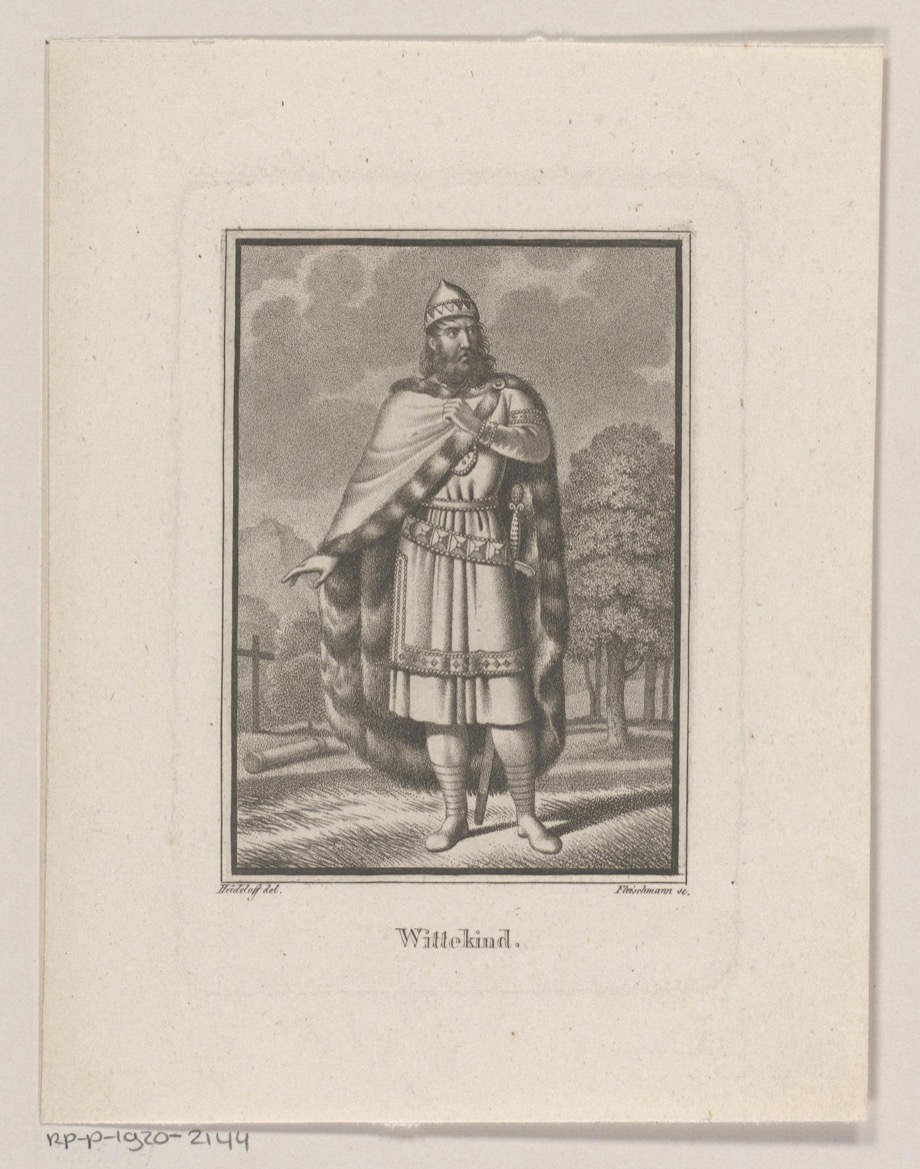
Portrait of Widukind — 1821 (later depiction)
The Man Missing from the Assembly
Widukind’s first clear appearance is an absence. In 777, the Frankish royal annals describe a gathering at Paderborn where Saxons came into the orbit of Charlemagne’s authority. Widukind was elsewhere, having taken refuge among northern neighbors. The assembly presented submission; his refusal to attend made the submission incomplete.
For a biographer, it is a suggestive beginning with a strict limit. We know that Frankish writers regarded him as important enough to identify. We do not know everything he hoped to achieve, how he understood his own authority, or which commitments governed his decisions. The record gives a name to resistance without preserving an equivalent voice from the resisting side.
His securely documented activity belongs to the years 777–785. A birth date is unknown, and familiar death dates such as 807 or 810 should not be treated as established. Later centuries supplied the missing beginning and ending in different ways. The historical profile must remain anchored in the interval for which the evidence is strongest.
A Conquest without Easy Boundaries
The Frankish wars in Saxony began before Widukind becomes visible. Charlemagne attacked in 772, including the destruction of the religious site associated with the Irminsul. Subsequent campaigns demanded hostages, submission, and acceptance of Christianity. The struggle involved more than a single confrontation between two armies. It repeatedly entered the lives of communities whose political and religious practices the king sought to alter.
Saxony was not a modern nation directed by an undisputed national leader. Regional groups, aristocrats, and changing coalitions shaped resistance and accommodation. Calling Widukind king of all the Saxons would give him a uniform authority the sources do not establish. His prominence need not be denied in order to recognize the wider distribution of agency.
The frontier also mattered. Refuge among the Danes or other northern contacts could place a leader beyond immediate Frankish control. This was a practical resource, not merely a picturesque exile. It gave an opponent somewhere to survive while the king attempted to obtain compliance through assemblies and campaigns.
Einhard explains the recurring war through Saxon faithlessness. His language assumes the justice of Frankish demands and treats renewed resistance as a moral defect. The same sequence can be understood as communities rejecting obligations imposed under military pressure. That alternative does not make every Saxon action innocent; it makes the conqueror’s classification insufficient as an explanation.
The Leader Named in Renewed Resistance
The annals connect Widukind with renewed opposition in 778 and 782. Those years belong to a period in which Charlemagne was pursuing campaigns elsewhere as well as in Saxony. The expedition across the Pyrenees in 778 exposed the breadth of his commitments. Resistance on another frontier could exploit the limits of a ruler’s attention and the vulnerability of local forces.
Widukind’s prominence in these entries is real, but it does not demonstrate personal command of every action the annalist associates with rebellion. Court histories often concentrate responsibility in named leaders. Doing so gives the king an identifiable enemy and makes collective resistance easier to narrate. The individual’s influence and the narrative’s need for an adversary can reinforce each other.
The violence of 782 sharpened the stakes. Following a Frankish defeat, the annals report the execution of 4,500 Saxons at Verden. Historians debate aspects of the episode and the transmitted figure. Whatever judgment is reached on those questions, the narrative belongs to a coercive campaign rather than a simple story of religious persuasion.
It would be equally unwarranted to invent a personal response from Widukind. No reliable speech records his grief, anger, or resolve after Verden. These feelings may be imaginable, but imagined feelings cannot become biographical evidence. His later actions must be described through what the sources report, with their gaps left visible.
What Conversion Required
The capitulary directed at Saxony reveals the intrusiveness of Frankish incorporation. It threatened severe penalties for refusal of baptism and certain prohibited religious practices, while regulating church support, burial, and public assembly. The law did not merely ask people to recognize a distant overlord. It sought changes in worship, resources, and the organization of community life.
The precise dating and application of the capitulary are subjects for scholarship. A written penalty is not proof that every prescribed execution occurred. Yet the text establishes the coercive horizon within which acceptance of Christianity took place. It helps explain why resistance could concern social order as well as military independence.
Alcuin later criticized aspects of coercive mission and emphasized the need for instruction and willing faith. His criticism does not prove a personal relationship with Widukind, nor does it turn all Frankish churchmen into opponents of conquest. It shows that Christian advisers could disagree about the means through which the king’s religious goals were pursued.
For Widukind, we cannot disentangle every possible reason for accepting baptism. Religious conviction, exhausted resources, concern for followers, negotiated advantage, or some combination may have mattered. The political circumstances are better documented than the interior transition. Neither a triumphant conversion legend nor a modern assumption of pure cynicism can resolve that uncertainty.
Hostages and the Baptism of 785
The annals describe negotiations in 785 involving Widukind and another leader, Abbio. They sought assurances that they could approach the king safely. Charlemagne supplied hostages through an envoy, and the leaders came to Attigny, where they received baptism with their companions. This detail of reciprocal security is especially valuable: even an account celebrating royal victory preserves the mechanics of a bargain.
Charlemagne’s role as sponsor gave the ceremony a political meaning alongside its sacramental one. The former opponent entered a relationship with the king that publicly reversed the earlier confrontation. Bonnie Effros’s study of conversion and mortuary practice emphasizes how such acts could express Frankish supremacy. The ceremony was therefore not merely a private religious event.
The annalist presents the submission as if it completed the subjection of Saxony. The wider history supplies a correction: warfare and renewed opposition continued after 785. Widukind’s disappearance from the principal record does not mean that every Saxon community ceased resisting. A narrative can reach its desired conclusion before the political situation does.
After baptism, the securely documented personal career becomes elusive. Later traditions assign him descendants, church foundations, a tomb, and stories of miraculous persuasion. Some genealogical connections may be recoverable, but a complete post-conversion life cannot be reconstructed from those traditions without separate examination. The end of his rebellion is clearer than the end of his life.
Resistance without a Recovered Personality
Widukind remains untyped because a military role and a negotiated baptism do not distinguish a psychological preference. Frankish praise or condemnation can explain the intended moral shape of the story without telling us how he habitually thought. Courage, caution, conviction, and calculation are possible qualities, but the record cannot distribute them reliably enough to support a type.
This limit does not diminish his historical importance. His resistance made incorporation difficult and exposed the costs of Charlemagne’s project. His baptism provided the conqueror with a highly visible act of submission. The same man could therefore become important to competing memories even though the evidence leaves much of the person beyond recovery.
Connected Figures
Further Reading
- Carolingian Chronicles — Translated by Bernhard Walter Scholz with Barbara RogersMakes the Royal Frankish Annals and Nithard accessible while preserving the need to distinguish their viewpoints.
- King and Emperor: A New Life of Charlemagne — Janet L. NelsonReconstructs the ruler through political relationships, family decisions, and close reading of the sources.
- De partibus Saxoniae and the Regulation of Mortuary Custom — Bonnie EffrosExamines conversion, burial, and Frankish power in Saxony, distinguishing religious demands from their political setting.
- The Carolingian World — Marios Costambeys, Matthew Innes, and Simon MacLeanPlaces conquest and incorporation within the social structures of the empire.
