 Historical Figure MBTI
#1274 · 9-20-26 · The Carolingian World
Bernard of Italy
King of Italy · Dynastic Claimant · Victim of Imperial Punishment
c. 797–818
5 min read
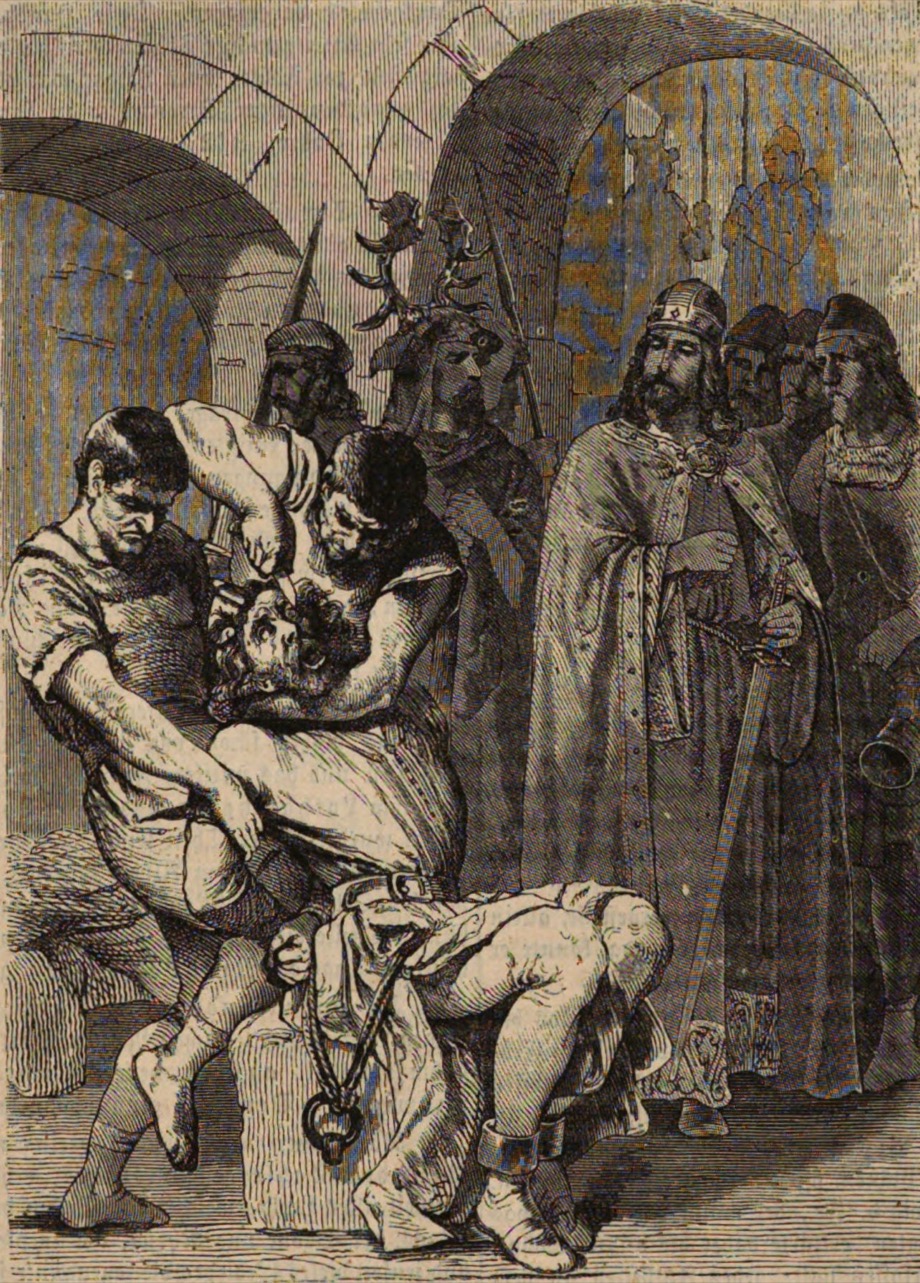
Louis the Pious orders Bernard of Italy blinded — Franz Kollarž, c. 1872 (later depiction)
The young king outside the settlement
Bernard of Italy stood inside the Carolingian family but outside the central arrangement made for its future. His father, Pepin of Italy, was a son of Charlemagne; Bernard succeeded to the Italian kingship after Pepin’s death. When Louis the Pious organized the succession among his own sons in 817, the place of this nephew became a dangerous question. Kinship gave Bernard a claim, but did not guarantee that imperial policy would preserve it on terms he accepted.
His story ended before he could establish a long record of rule. Opposition in 817 collapsed, and an imperial judgment in 818 sentenced him to death. Louis commuted that punishment to blinding. Bernard died from its consequences. The attempt to remove a rival without executing him therefore produced a death that remained a burden within the emperor’s political and religious life.
Bernard remains untyped. The sources reveal a dynastic position, an episode of resistance, and the actions of those who defeated him. They offer much less about how he ordinarily judged problems, related to people, or made decisions outside a crisis. Neither rebellion nor surrender can responsibly stand in for a personality pattern.
An inheritance within an empire
The Italian kingship was not a detached national monarchy. Bernard held it within the larger Carolingian order, whose authority had been built by his grandfather. That relationship could leave room for a local ruler while also making his position dependent on the emperor and on arrangements made elsewhere. The family’s hierarchy was a practical political fact, not simply a genealogical chart.
The ordinance of 817 elevated Lothair to imperial seniority and assigned kingdoms to his brothers. Bernard is not named in its provisions. Its Italian clause placed the kingdom under the emperor’s intended successor, but the implications for the existing king cannot be reduced to a plainly stated personal dismissal. The document’s silence about Bernard is significant without being a complete explanation of everything he did.
This distinction prevents a convenient but overconfident narrative. It is plausible that the settlement threatened his standing; it does not follow that a single clause fully explains his intentions or those of every supporter. Italian interests, family expectations, and the choices of powerful advisers belonged to the situation. A young king’s political action depended on other people who had reasons of their own.
Reports of rebellion and a shrinking following
The Royal Frankish Annals report that Bernard guarded the Alpine approaches and that news reaching Louis claimed broad Italian support. The annalist explicitly admits that the reports were partly true and partly false. Even a narrative favorable to the emperor thus preserves a warning about the information on which a rapid response was based.
Louis gathered forces, and Bernard’s following diminished. He surrendered rather than carry the confrontation into a sustained war. The surviving account portrays this as the collapse of a conspiracy, but the terminology belongs to the imperial side. What can be observed securely is the imbalance between his claim and the support available when an emperor moved against him.
Surrender should not be turned into cowardice, just as the initial opposition should not be made into proof of boldness. Both actions occurred under pressures that changed quickly. They can describe a political sequence without revealing a stable preference for caution, improvisation, loyalty, or self-assertion. The shortness of the record makes those distinctions especially important.
A punishment described as mitigation
The judgment at Aachen brought Bernard and leading associates under imperial power. Blinding was presented as a commutation of a capital sentence, while implicated bishops were deposed and confined to monasteries. The distinction between sentences mattered within contemporary political language, but it cannot make the violence inflicted on Bernard disappear.
His death exposed the limits of calling the punishment merciful. It also changed the meaning of the episode for Louis. The emperor had suppressed opposition, yet the result was the death of a nephew whose kingship had belonged to the same dynasty. Victory in the immediate contest did not settle its moral or religious consequences.
Louis’s public penance at Attigny in 822 included responsibility for Bernard’s death. Modern scholarship treats such penance within the wider political use of confession and atonement. It should not be reduced either to empty theater or to a private feeling we can measure. The public act mattered because royal responsibility could be discussed in religious terms before the people who helped sustain royal government.
The person behind the crisis remains obscure
Bernard is often remembered mainly through what happened to his eyes and through the emperor’s later remorse. That gives the victim a place in another ruler’s story while leaving his own kingship compressed into a prelude to punishment. A fuller historical perspective keeps his Italian position visible, even when the evidence cannot recover an equally full personal portrait.
The limitations are not a reason to replace the missing person with a type inferred from his fate. A disastrous outcome does not prove defective judgment, and victimhood does not imply a particular moral temperament. The archive can acknowledge his importance and the violence of his end while declining to claim that a few actions disclose the structure of his mind.
Connected Figures
Further Reading
- Royal Frankish Annals, 817–818 — Anonymous Frankish annalistsPrimary account of the confrontation and punishment; its imperial perspective and admission of mixed reports require attention.
- The Ordinance of Louis the Pious, 817 — Louis the Pious; translated by Ernest F. HendersonPrimary succession text whose treatment of Italy must be distinguished from a direct statement about Bernard.
- Spin and Silence: Royal Penance and Carolingian Propaganda — Rachel StoneScholarly account of Bernard’s death within the changing political language of royal confession and penance.
