 Historical Figure MBTI
#1272 · 9-20-26 · The Carolingian World
Pepin of Italy
King of Italy · Son of Charlemagne
777–810
5 min read
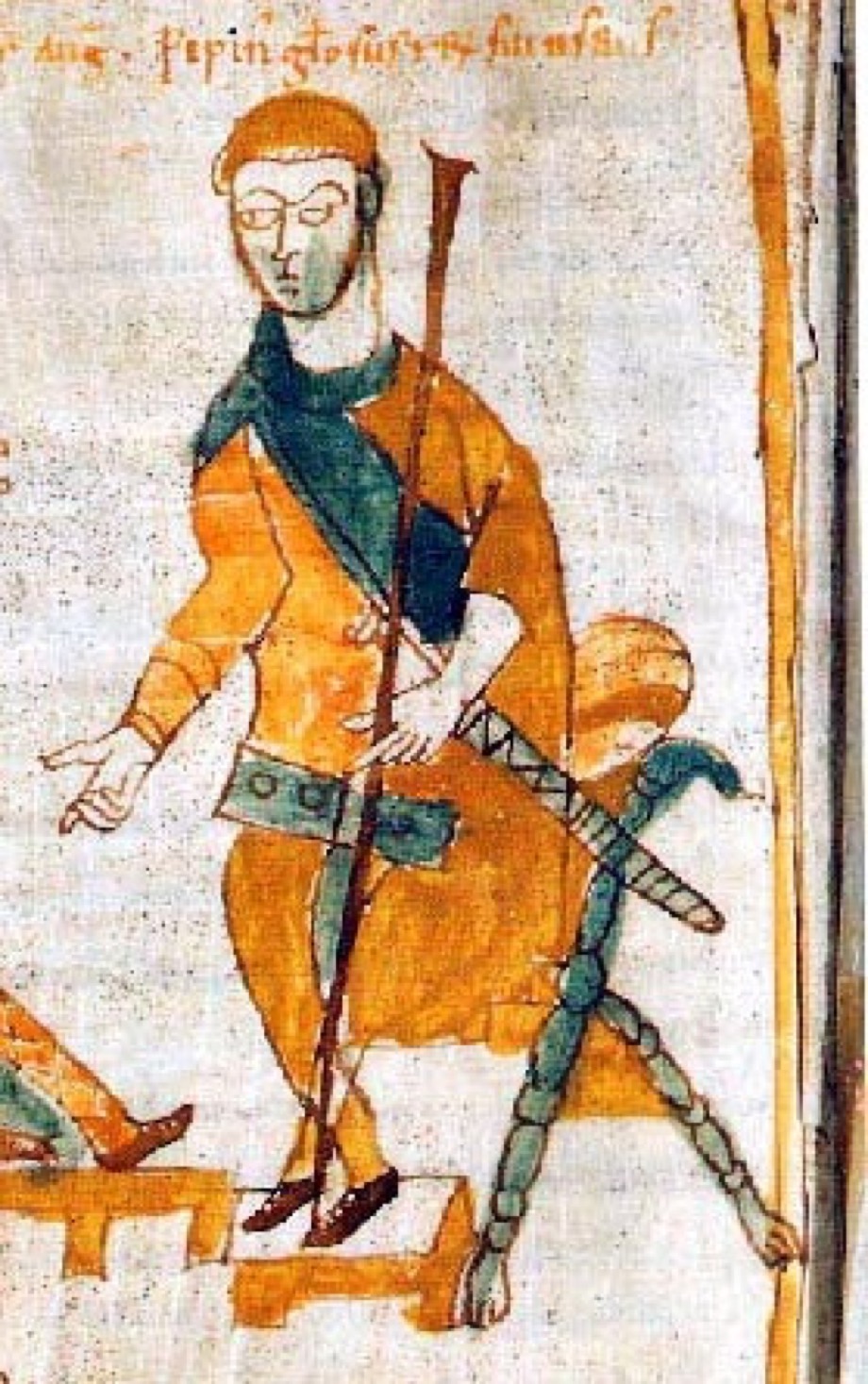
Portrait of Pepin of Italy — 10th century copy of a lost 829–836 original (later depiction)
A kingdom given to a child
At Rome in 781, a child who had been called Carloman received the name Pepin and was consecrated king of Italy. The ceremony joined baptism, dynastic memory, and an assigned territory. His father had conquered the Lombard kingdom only a few years earlier. Giving it a royal son helped make the conquest into an enduring arrangement of government.
Pepin of Italy remains Untyped. The surviving record is unusually clear about offices, expeditions, and succession plans, but much less clear about the personal preferences through which he understood them. A young king acting within his father’s empire cannot be typed simply from military achievement or obedience to a dynastic role.
Born in 777 to Charlemagne and Hildegard of Vinzgau, he was distinct from his older half-brother Pepin, often called the Hunchback. The names themselves carry the politics of the household. The Italian king’s career belonged to a scheme that distributed royal sons across an expanding realm without making those sons independent sovereigns in the modern sense.
An Italian kingship within a larger rule
Pope Hadrian I baptized and consecrated Pepin at the same visit in which Louis was anointed for Aquitaine. The papal participation connected the sons’ offices to the relationship their father had built with Rome. It did not remove Charlemagne’s overarching authority or mean that a small child personally directed the administration from the moment of consecration.
Government required experienced advisers, local elites, ecclesiastical cooperation, and the continued exercise of royal oversight. Italy also retained political traditions and regional interests that could not be erased by changing the king’s family. Pepin’s office was one means of connecting those conditions to the Frankish dynasty, rather than proof that the kingdom had become a simple copy of Francia.
As he grew older, his military responsibilities widened. The annals record operations against opponents on different sides of the Italian kingdom, as well as the place of Italy within the campaigns against the Avars. These notices establish active command. They do not establish whether his decisions were adventurous, cautious, reflective, or personally ambitious beyond the expected work of kingship.
The Avar campaign and its treasure
In 796 Pepin led an army into Pannonia against the Avars. The campaign followed an earlier operation in which Eric of Friuli’s men and a Slavic commander, Wonomir, had seized treasure from the Avar center amid conflict among its leaders. Pepin’s achievement therefore belonged to a sequence of operations, not to a single unassisted conquest.
The royal annals report the submission of a new khagan and Pepin’s occupation of the fortified center known as the ring. He returned to Aachen with further treasure, where Charlemagne received him. The narrative makes the son’s success part of the father’s imperial standing. Both the operation and its representation matter to understanding what a junior king could accomplish within the dynasty.
Court verse welcomed the returning Pepin. Angilbert addressed him in a poem that transformed achievement into an anticipated reunion with the royal circle. Praise is evidence of how victory was celebrated, not a neutral evaluation of every action in the field. Nor can its elevated language be treated as a direct statement of Pepin’s private ideals.
Southern Italy and the Adriatic
The southern frontier remained difficult. Benevento had not disappeared with the fall of the Lombard kingdom, and Frankish campaigns sought submission, tribute, and control without producing a uniformly settled peninsula. Pepin commanded forces against Beneventan territory during Charlemagne’s journey to Rome in 800. War and diplomatic accommodation continued to alternate.
The Adriatic brought competition with Byzantium into the same field. The royal annals describe Pepin’s attack on Venice in 810 as a victory, but Venetian traditions preserve a different account of resistance and the limits of the expedition. The later settlement left Venice within the Byzantine sphere. It is safer to recognize a contested campaign than to repeat either side’s triumph as an uncontested result.
Naval operations also expose the variety of pressures on Italian rule. Fleets could defend islands, attack coastal territory, or confront another empire’s ships. A king’s apparent success depended on commanders, vessels, local cooperation, and changing negotiations beyond his own court. Those practical conditions give substance to his reign without supplying the intimate evidence needed for a personality judgment.
The inheritance that passed through him
Charlemagne’s division of 806 envisaged a future in which Pepin would hold Italy with additional lands north of the Alps, while Charles the Younger and Louis received other portions. The document’s arrangements were designed to regulate cooperation and succession among living sons. It was a plan, not a map of what would inevitably happen.
Pepin died on 8 July 810, before his father. Charles died the following year, and the anticipated division lost two of its principal heirs. Louis eventually became the sole surviving legitimate son available to inherit imperial rule. The altered outcome illustrates how strongly a political settlement could depend on the survival of particular members of a family.
Pepin’s son Bernard was subsequently established in Italy. His later conflict with Louis belonged to the inheritance Pepin left behind, but cannot be projected backward as something Pepin necessarily foresaw. The father’s kingship had created a recognizable dynastic position that the next generation would struggle to accommodate.
Connected Figures
Further Reading
- Carolingian Chronicles: Royal Frankish Annals and Nithard’s Histories — Translated by Bernhard Walter Scholz with Barbara RogersThe dynasty’s narrative of its rise and rule, to be read as a politically interested account.
- Life of Charlemagne — Einhard; translated by Samuel Epes TurnerA courtier’s biography whose personal observation and dynastic loyalties must both be considered.
- The Carolingian World — Marios Costambeys, Matthew Innes, and Simon MacLeanA modern account of how dynastic power, religious reform, and regional societies shaped each other.
- Pippin, formerly Karlmann — Rudolf SchiefferThe Neue Deutsche Biographie entry provides a concise scholarly account of dates, kingship, and succession.
