 Historical Figure MBTI
#1270 · 9-19-26 · The Carolingian World
Angilbert
Court Poet · Abbot · Royal Companion
c. 750–814
5 min read
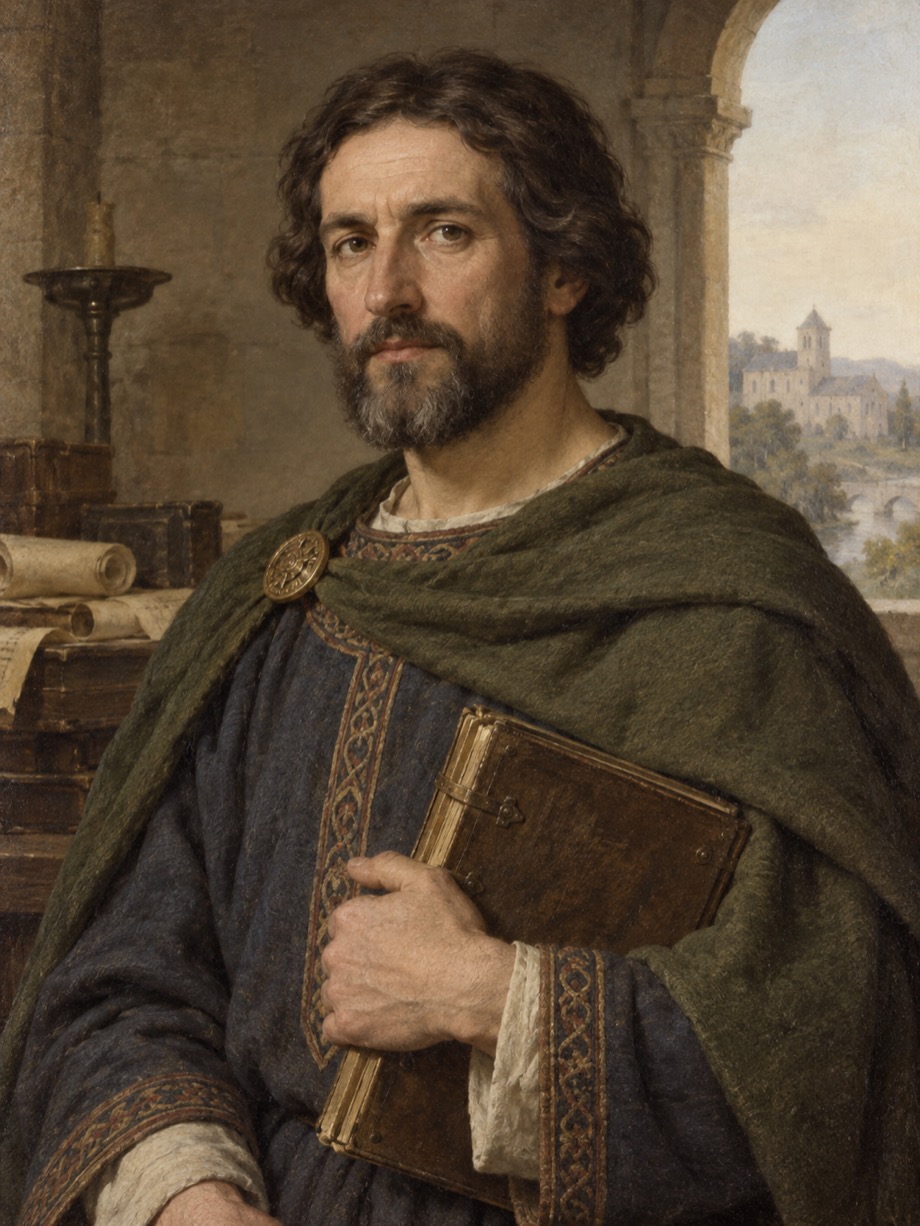
AI-assisted Portrait of Angilbert
Homer at the Frankish court
Angilbert answered to Homer among the learned companions of Charlemagne. The name was playful, ambitious, and social: an ancient poet’s identity was brought into a Frankish circle that made books, verse, friendship, and royal service part of the same conversation. The nickname establishes a place within that world. It does not establish the personality of the man who carried it.
An ENFP reading is tentative and low confidence. Its basis is the connection he made among expressive forms, people, and religious projects, rather than the simple fact that he wrote poetry. An equally serious reading could emphasize organized public meaning and the obligations of a royal patron’s servant. The evidence is too indirect to make the distinction secure.
Born around 750, Angilbert became a poet, royal associate, envoy, and the head of Saint-Riquier, also called Centula. He died in 814, soon after Charlemagne. His life crossed court and monastery in ways that resist a modern division between an artistic career and an administrative one.
Angilbert is a tentative ENFP: dominant Ne connected poetry, people, and sacred projects across the world of the court.
Ne: carrying meaning between forms
His poem addressed to Pepin of Italy after the Avar campaign places royal achievement within a welcome imagined for the young king. The point is not merely to report a victory. Verse carries it into a network of affection, expectation, and recognition. His court poetry uses inherited classical language to make contemporary people visible in a different register.
This movement among available forms offers a possible Ne reading. A campaign could become a greeting; a court friendship could assume a classical name; a religious foundation could combine architecture, inscriptions, and ritual. The pattern lies in making connections rather than in an assertion that poets are naturally intuitive. Literary convention and patronage also explain much of the surviving work.
The famous poem about Charlemagne’s court and the meeting with Leo III has sometimes been attributed to Angilbert, but the attribution is disputed. It cannot safely provide a privileged window into his imagination. Using uncertain authorship as certain psychological evidence would compound two different kinds of speculation.
Fi: a life inside the royal household
Angilbert’s relationship with Bertha, Charlemagne’s daughter, produced two sons, Hartnid and Nithard. Nithard explicitly identifies his parents in his own history. This is firmer evidence than later stories attempting to reconcile a revered abbot’s reputation with his family life. The precise formal standing of the union is less clear.
The relationship places Angilbert inside the dynasty’s domestic history, not simply at the edge of its intellectual circle. It also warns against imposing an easy opposition between religious commitment and personal attachment. Early medieval arrangements could combine roles whose later biographies found uncomfortable, and those biographies sometimes supplied an exemplary conversion where the contemporary record was less tidy.
A possible Fi reading would locate weight in attachments that were not exhausted by official rank. That inference must remain modest. Fatherhood and affection do not identify a function, and Nithard’s praise records a son’s memory rather than an independent account of Angilbert’s inner values. The strongest evidence here is a relationship whose existence need not be fictionalized.
Te: the monastery as a coordinated work
Angilbert directed the rebuilding and organization of Saint-Riquier from the 790s. The foundation brought together churches, altars, relics, inscriptions, and regulated worship. Accounts of its arrangements survive partly through the later chronicler Hariulf, who preserved earlier materials. They must be read with attention to the distance between Angilbert’s program and the institution’s subsequent memory.
The liturgical arrangements connected movement through sacred space with the celebration of particular feasts and saints. The monastery’s processions could also involve its surrounding communities. Architecture was used, traversed, sung through, and interpreted. The religious project depended on coordination of people and resources as well as the conception of a meaningful setting.
For an ENFP interpretation, subordinate Te supplies a tentative name for turning connections into an organized undertaking. Yet an abbot needed administrative competence regardless of type. The evidence supports an ambitious, coordinated program; it does not show that organization was difficult for him, that he improvised habitually, or that he disliked routine.
The patron and the person
Charlemagne celebrated Easter at Saint-Riquier in 800, according to the royal annals. The royal presence placed the monastery within the court’s geographical and devotional life. Angilbert’s work could serve a local religious community and also express the dynasty’s standing. Those purposes did not have to compete.
His friendship with Alcuin belonged to a learned environment where affection, admonition, and political service could coexist. Court names and literary exchange were not proof that these men lived without discipline or disagreement. A poet could be praised, corrected, employed, and trusted by the same circle.
What survives is a substantial set of connections rather than an unguarded personal voice. Angilbert appears as someone who helped bring a royal and religious culture into material and verbal form. His versatility is historically meaningful; treating it as automatic evidence of an outgoing, spontaneous temperament would make the record say more than it does.
Why ENFP Over ENFJ
Why not ENFJ?
ENFJ is a strong alternative because his verse and monastic program organized public recognition around shared religious and royal meanings. ENFP receives a slight preference from the variety of forms through which he made connections. The distinction is narrow, and the requirements of patronage could explain both patterns without establishing either type.
The judgment should remain provisional. A medieval poem has an audience and a purpose; a monastery has offices and resources. Neither is a transparent test of its maker’s preferences. Angilbert’s record permits a carefully bounded interpretation of his connecting work, rather than confidence about a private personality.
Connected Figures
Further Reading
- Faith, Art, and Politics at Saint-Riquier: The Symbolic Vision of Angilbert — Susan A. RabeStudies the foundation through its surviving architectural, liturgical, and textual program.
- Carolingian Chronicles: Royal Frankish Annals and Nithard’s Histories — Translated by Bernhard Walter Scholz with Barbara RogersThe dynasty’s narrative of its rise and rule, to be read as a politically interested account.
- Poetry of the Carolingian Renaissance — Peter GodmanTexts and translations place court verse within the literary practices of the period.
- The Carolingian World — Marios Costambeys, Matthew Innes, and Simon MacLeanA modern account of how dynastic power, religious reform, and regional societies shaped each other.
