 Historical Figure MBTI
#1269 · 9-19-26 · The Carolingian World
Pope Leo III
Pope · Imperial Coronation · Roman Politics
d. 816
7 min read
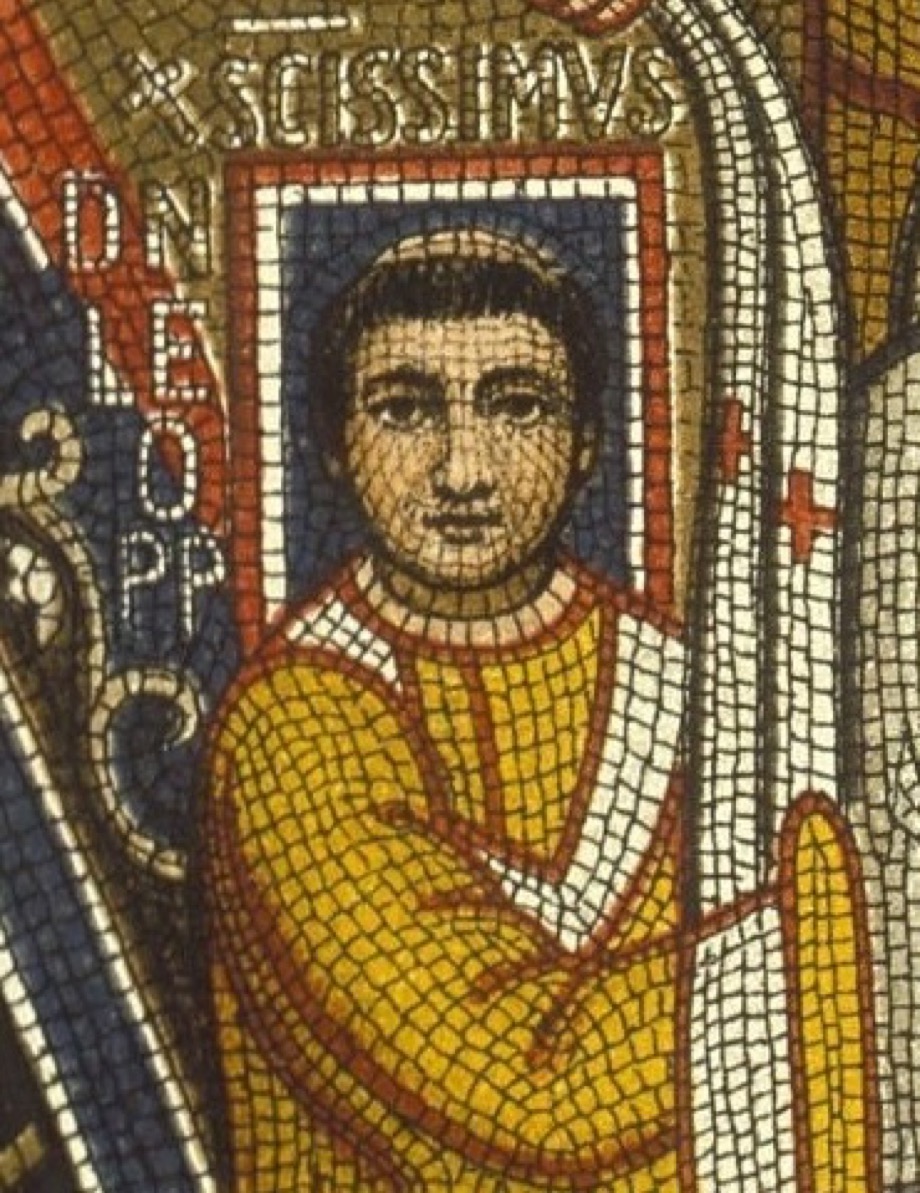
Pope Leo III — Triclinium Leoninum mosaic, original 798–799, restored 1743
A crown after a rescue
Before Leo III placed a crown on Charlemagne’s head, he had needed Charlemagne to help him retain his own office. An attack during a Roman procession in 799 drove the pope from the city and into the protection of the Frankish king. The imperial ceremony of Christmas 800 followed that crisis. Its splendor can conceal the vulnerable relationship from which it emerged.
An ENFJ reading is possible, at low confidence, because Leo repeatedly secured authority through public relationships and acts of recognition. The evidence concerns his political methods rather than his emotional disposition. Alliance and ceremonial skill were also requirements of papal survival; they cannot establish a type without qualification.
Elected in December 795 after Hadrian I died, Leo inherited a Roman Church whose protection and territorial claims were already bound to the Frankish dynasty. He did not invent that relationship. He gave it an extraordinary new expression at a moment when his own standing within Rome was contested.
Leo III is a tentative ENFJ: dominant Fe made alliances and public recognition instruments of authority.
Fe: making an alliance visible
At the beginning of his pontificate, Leo sent Charlemagne the keys associated with Saint Peter’s shrine and the banner of Rome. The gifts were not ornamental courtesies without political meaning. They presented the Roman Church and city to a protector whose acknowledgment mattered beyond the walls. Their significance depended on shared understanding of the objects and the offices they represented.
This provides a tentative basis for dominant Fe: Leo worked through an audience’s recognition of a relationship. Authority was communicated as a bond that could be seen, honored, and renewed. Yet the objects did not disclose whether he found company energizing or habitually subordinated personal judgment to others. The proposed function names a pattern in his public action, not a recovered private psychology.
Nor was the alliance a meeting of equal powers in every respect. The pope possessed sacred prestige and Roman legitimacy; the king possessed an army and a far larger territorial command. Leo needed to preserve a consequential place within the relationship rather than merely accept its protection. Recognition could be an instrument of agency for the more vulnerable partner.
The violence inside a sacred city
On 25 April 799 Leo was attacked by Roman opponents during the Greater Litany procession. Accounts describe attempts to mutilate his eyes and tongue, followed by his escape and rescue. The precise injuries and their later presentation as miraculous recovery require caution. The secure political facts are the assault, his displacement, and the intervention that enabled him to return.
He traveled to Charlemagne at Paderborn, where the king received him with conspicuous honor. Opponents brought accusations against the pope, and the case could not be resolved simply by declaring him admired abroad. Frankish assistance restored a position within Rome while also making the king central to the management of the dispute.
The crisis shows why a purely harmonious interpretation would be inadequate. Leo’s authority operated among enemies as well as supporters. The alliance that protected him could constrain him, and the ceremonies that affirmed his office could accompany investigation of his conduct. Religious leadership in this setting was not the absence of political struggle but one of its principal stakes.
Ni: a crisis given an imperial answer
Charlemagne came to Rome in November 800. The royal annals describe an arranged reception: banners, groups of citizens and visitors, clergy, and acclamations at Saint Peter’s. Leo subsequently swore an oath publicly clearing himself of the charges after no accuser came forward to prove them. The procedure affirmed his standing without leaving the allegations outside the story.
At Christmas mass Leo crowned the Frankish ruler emperor, and the Roman acclamation supplied a public response. The act joined protection of the Roman Church to a claim of imperial dignity. It was more consequential than another exchange of gifts because it supplied a name and ceremony around which the relationship’s meaning could be organized.
A tentative Ni interpretation sees the concentration of several problems into one symbolic settlement: Rome, papal security, Frankish power, and imperial legitimacy could be represented together. We cannot know that Leo privately conceived the entire future implied by the act. Its long consequences are evidence of historical importance, not proof that he foresaw later medieval arguments about who could make an emperor.
Se: the act and its disputed preparation
Einhard reports that Charlemagne later said he would not have entered the church had he known the pope’s intention. The passage is famous, but it is also politically useful to a biographer defending his patron. It cannot establish that Leo improvised the ceremony alone or that the king was simply an unsuspecting recipient. Preparation, expectation, and dissatisfaction about the form remain debated.
For a subordinate Se reading, the relevant point is the use of a particular occasion. A crown placed during a major feast before a Roman congregation made authority tangible in a way that correspondence could not. Leo’s political repertoire included acts performed in public space, whose force depended on their timing and physical enactment.
The eastern empire had a reigning sovereign, Irene of Athens. Western arguments that her sex made the imperial position vacant were claims serving the new arrangement, rather than neutral descriptions of Byzantium. The ceremony therefore solved no universally accepted vacancy. It introduced a title whose recognition required further diplomacy and whose meaning could differ for pope, Franks, and Romans.
Cooperation had boundaries
Leo continued to participate in the dynasty’s political arrangements. In 806 Einhard carried Charlemagne’s planned division among his sons to Rome for the pope’s signature. The annals record Leo’s assent. Papal participation extended the alliance into the anticipated succession, although the deaths of two sons later prevented that settlement from taking effect as designed.
The alliance also contained religious disagreement. After the Frankish council of Aachen in 809, envoys sought Leo’s response concerning the procession of the Holy Spirit. Leo accepted the theological position associated with the Filioque while resisting its insertion into the received creed. Cooperation with the emperor did not require assent to every Frankish alteration of inherited liturgical language.
He survived Charlemagne, who died in 814, and remained pope until his own death in 816. The imperial coronation did not make Roman politics permanently safe or define every boundary between ruler and church. His career is better understood as repeated work within an unequal partnership than as one splendid gesture that settled medieval government.
Why ENFJ Over ESFJ
Why not ESFJ?
ESFJ is a strong alternative because the objects, liturgy, and inherited relationship with the Franks all draw on established practice. ENFJ receives a slight preference from the concentration of those practices into an imperial settlement that reorganized the relationship’s public meaning. This is an inference from political conduct, and the limited evidence could reasonably support either reading.
A ceremonial office naturally supplies ceremonial evidence. The proposed type therefore remains especially vulnerable to confusing the requirements of Leo’s position with his preferences. His ability to seek protection, stage recognition, and preserve a doctrinal boundary is visible; the mental process joining those acts is only tentatively inferred.
Connected Figures
Further Reading
- Life of Charlemagne — Einhard; translated by Samuel Epes TurnerA courtier’s biography whose personal observation and dynastic loyalties must both be considered.
- Carolingian Chronicles: Royal Frankish Annals and Nithard’s Histories — Translated by Bernhard Walter Scholz with Barbara RogersThe dynasty’s narrative of its rise and rule, to be read as a politically interested account.
- The Carolingian World — Marios Costambeys, Matthew Innes, and Simon MacLeanA modern account of how dynastic power, religious reform, and regional societies shaped each other.
- The Filioque: A Church-Dividing Issue? — North American Orthodox–Catholic Theological ConsultationIts historical discussion explains Leo’s distinction between doctrine and changing the creed.
