 Historical Figure MBTI
#1284 · 9-23-26 · The Carolingian World
Lothair I
Emperor · King · Defender of Imperial Seniority
795–855
6 min read
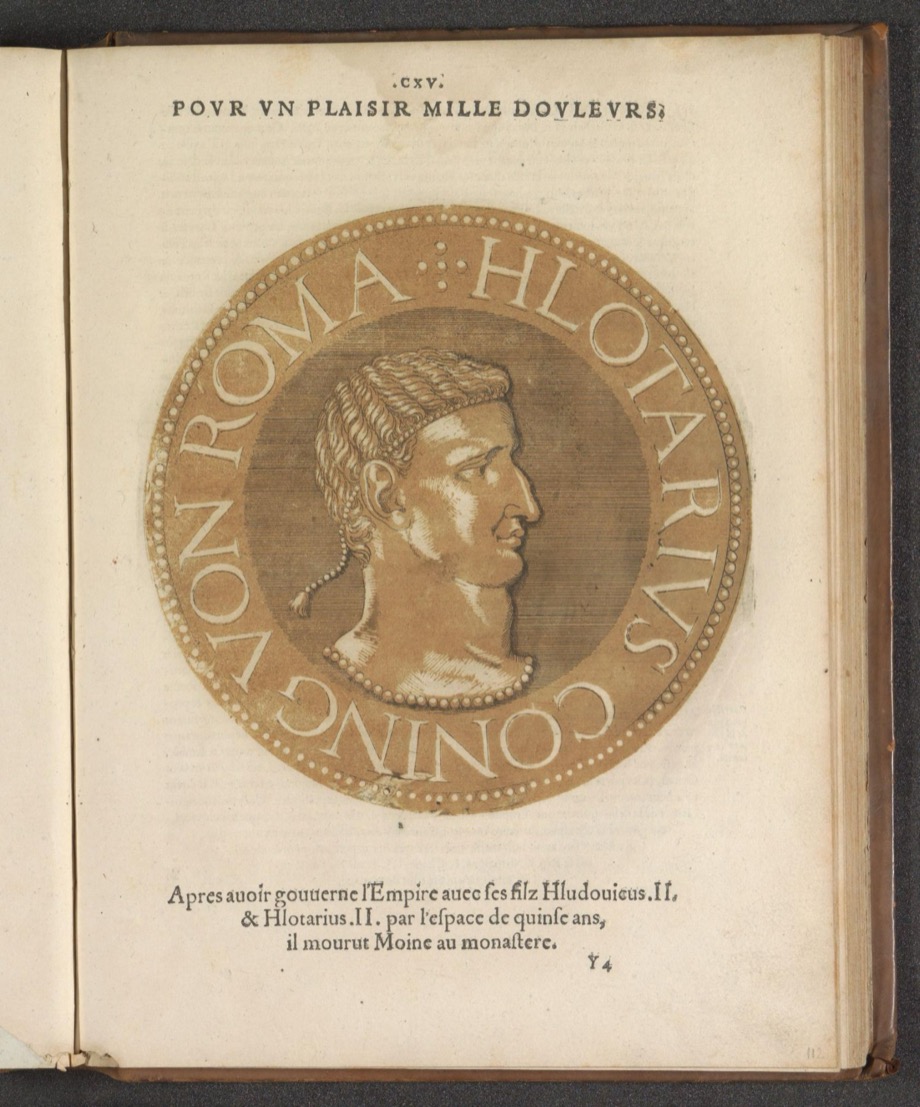
Printed coin-style portrait of Lothair I — 1557 (later depiction)
The crown above the other crowns
Lothair I had a document behind his claim. In 817 his father, Louis the Pious, made him co-emperor and senior successor, while assigning kingdoms to his younger brothers. The arrangement tried to preserve an imperial hierarchy within a dynasty that expected sons to inherit. Lothair’s authority was therefore more than a personal appetite for precedence. It had been proclaimed as an order meant to protect Christian unity.
A fourth son changed that order’s practical future. Charles the Bald was born in 823, and the provisions made for him unsettled earlier promises. Family conflict became a contest over the power to revise a settlement, the obligations of sons, and the authority of an emperor who was still alive. Lothair eventually fought both his father and his brothers in the name of a position whose legitimacy could be argued from several directions.
The tentative ESTJ reading concerns his recurring effort to make an established seniority effective through practical loyalties. It does not make inheritance itself a psychological trait. His opponents had claims and principles too, and their historians had reasons to describe him unfavorably. A useful portrait must separate the structure he defended from the ambition, force, and negotiation through which he pursued it.
The tentative ESTJ reading centers on dominant Te: Lothair sought to turn recognized imperial seniority into enforceable political authority.
A hierarchy had to produce obedience
The imperial settlement offered Lothair a role above the other kings, but a title could not move armies by itself. After his father died in 840, the question became whether his brothers and the aristocracies around them would accept that senior position in practice. Their refusal exposed the distance between a proclaimed hierarchy and the resources required to sustain it.
Extraverted Thinking provides a possible description of his emphasis on making authority operative. The claim had to be supported by followers, communication, military action, and bargains. To treat Lothair as merely ceremonial would miss that practical labor. To treat every act of command as proof of a function would be equally misleading: the political position required such action whatever his temperament.
The defeat at Fontenoy in 841 did not instantly end his cause. Conflict and negotiation continued, while Charles and Louis strengthened their alliance. The struggle shows determination and limits together. Lothair could claim that the imperial order entitled him to obedience; he could not compel all the people whose cooperation that order assumed.
An earlier settlement remained a reference point
The arrangement of 817 supplied a durable language for Lothair’s claim. It presented imperial unity and dynastic inheritance as compatible through ranked authority. The emperor would preserve a larger order while his brothers exercised kingship within it. That was a concrete precedent with political beneficiaries, not simply an abstract theory of monarchy.
The possible Introverted Sensing pattern lies in his continued orientation toward a recognized structure of seniority. Lothair’s case could be made by appealing to what had already been solemnly established. He was not inventing the expectation of an imperial head from nothing. The past mattered because commitments made in the past still shaped what supporters believed they were owed.
Yet precedent did not remove choice. A ruler defending an arrangement may also reinterpret it to enlarge his own power. Lothair’s conduct cannot be reduced to faithful preservation, and the succession document was his father’s public act rather than a record of Lothair’s mental habits. The proposed Si reading is an inference from a political pattern, with those qualifications kept visible.
The defeated brother in the victor’s account
Nithard fought for Charles and narrated the conflict as a participant. His account repeatedly frames Charles and Louis as defenders of justice against Lothair’s excessive demands. It is an indispensable source because it is close to events. It is also an interested source because the author’s loyalty helped determine which motives appeared reasonable and which appeared destructive.
This matters particularly when reconstructing character. A historian defending one side can supply accurate events while arranging them into a moral contrast. The defeated claimant then seems obstinate, while successful opponents seem compelled by necessity. Neither picture should be accepted as an unfiltered description of personality. Lothair’s claim can be understood without excusing the wars conducted in its name.
Verdun in 843 required accommodation. Lothair retained the imperial title and a middle kingdom, while Charles and Louis held western and eastern kingdoms. The settlement did not neatly create modern countries, nor did it preserve the supremacy imagined in 817. It distributed territories and authority among living claimants who had demonstrated their capacity to resist one another.
The middle kingdom’s long reach through different regions further cautions against reading the settlement as a single natural territory. Its ruler had to preserve connections among places with distinct interests and political traditions. Imperial status did not erase those differences. The division therefore created another field of practical negotiation rather than a final answer to the dynasty’s problems. Lothair’s reduced position still required active government, and his successors inherited its difficulties along with its dignities.
Making room inside a reduced position
Lothair’s later dealings with Hincmar of Reims reveal negotiation continuing after the great division. The archdiocese crossed a royal frontier, and its archbishop could not protect its interests through loyalty to Charles alone. Lothair, for his part, had reasons to deal with an ecclesiastical figure connected to another king. The situation demanded workable relations across a boundary that political conflict had produced.
Elina Screen’s study warns that the surviving evidence is often retrospective and sometimes falsified. It nevertheless makes the practical importance of improving relations clear. This is useful evidence against a caricature of Lothair as incapable of compromise. It offers much weaker evidence for tertiary Extraverted Intuition specifically: adapting to necessity is something circumstances can impose on anyone.
The proposed stack should therefore distinguish its stronger and weaker claims. His pursuit of operative senior authority and reliance on an established hierarchy provide the main argument. His capacity to negotiate helps make the portrait less rigid, but cannot independently prove a complete sequence of functions. Historical complexity is not a device for filling every slot.
Why this tentative reading?
Why not ENTJ?
Lothair pursued a broad imperial position and could act forcefully to secure it, which permits a Te–Ni alternative. ESTJ is preferred only tentatively because the organizing claim repeatedly refers to an already sanctioned hierarchy rather than an unmistakably new political design.
That contrast can easily be overstated. Imperial unity itself was a large vision, and an inherited structure can be pursued strategically. The available record supports a cautious preference, not a sharp psychological boundary. The distinction should remain less certain than the facts of his claims, alliances, defeats, and eventual accommodation.
Connected Figures
Further Reading
- The Ordinance of Louis the Pious, 817 — Louis the Pious; translated by Ernest F. HendersonPrimary succession arrangement establishing Lothair’s senior position; distinguish the document from Henderson’s dated introduction.
- Histories, Book III — Nithard; translated by Philippe LauerClose but partisan account of the conflict, written by a supporter of Charles.
- The Strasbourg Oaths — Nithard; Internet History Sourcebooks ProjectThe public alliance aimed against Lothair, including the followers’ reciprocal commitments.
- An unfortunate necessity?: Hincmar and Lothar I — Elina ScreenScholarly study of post-Verdun negotiations and the difficult evidence for imperial relations with Reims.
