 Historical Figure MBTI
#1285 · 9-23-26 · The Carolingian World
Louis the German
East Frankish King · Dynastic Negotiator
c. 806–876
7 min read
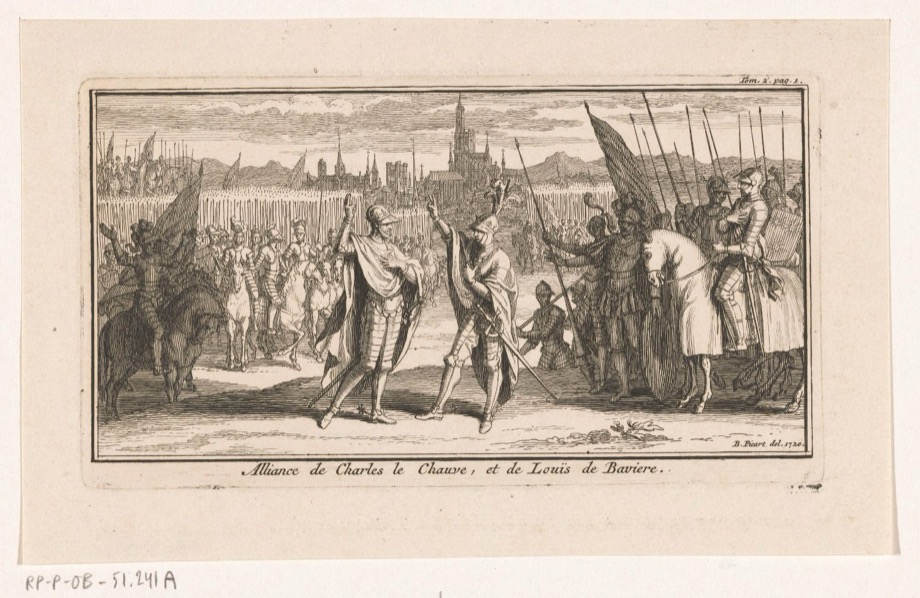
Louis the German with Charles the Bald at Meerssen — 1720 (later narrative depiction)
The brother who made his own base
At Strasbourg in 842, Louis the German spoke an oath in a language his brother’s followers could understand. Charles the Bald answered in the language of Louis’s men. The scene is famous in the history of languages, but its immediate purpose was political. Two kings needed their alliance to be intelligible to the people whose military support made it real.
Louis had received a Bavarian kingship under his father, Louis the Pious. Through the family conflicts of the following decades he pursued a larger eastern position, resisting arrangements that threatened his interests. His eventual kingdom was neither a modern German nation nor a passive inheritance. It was a Carolingian power base made durable through resources, supporters, and repeated accommodations.
The tentative ISTJ reading concerns his sustained effort to secure a dependable position through recognizable commitments and practical government. It should not be inferred from the later epithet German, from a supposed national temperament, or from the mere act of swearing an oath. The historical Louis was ambitious and adaptable as well as concerned with maintaining what he had obtained.
The tentative ISTJ reading centers on dominant Si: Louis sought a durable political base through commitments and arrangements that could be sustained over time.
Keeping a place in a changing settlement
The succession ordinance of 817 assigned Louis a kingdom centered on Bavaria within a hierarchy headed by Lothair. Later revisions and the birth of Charles changed the balance of the family. A prince’s future depended on arrangements that could be reopened while his father lived. Louis’s resistance belonged to that unstable world of promises, claims, and expectations.
Introverted Sensing is a possible interpretation of his recurring concern with making his own position durable. He did not treat a momentary agreement as enough if the resources and loyalties behind it remained insecure. A stable base offered continuity across changes in the imperial family. The proposed pattern concerns sustained political grounding rather than aversion to novelty.
The distinction matters because Louis was willing to challenge his father’s policies and his elder brother’s supremacy. Conservatism in the everyday sense cannot adequately describe a man whose conduct included rebellion and expansion. The tentative type does not mean obedience to whichever authority already existed. It describes a possible preference for securing a dependable order on terms he could maintain.
The oath came with conditions
Strasbourg made the alliance with Charles public and reciprocal. The kings promised assistance and rejected agreements with Lothair that would injure the other brother. Their followers also accepted obligations that limited what they would do if their own lord broke the compact. The commitment thus reached beyond a private exchange between two princes.
Auxiliary Extraverted Thinking offers one possible description of the practical form of that arrangement. A political intention became an announced rule for collective action. It defined what cooperation required and what would count as a breach. That does not prove a cognitive function, since formal oaths were common political instruments, but it supplies concrete evidence for how this alliance was organized.
Nithard’s preservation of the scene is itself part of the argument. As a supporter of Charles, he presented the allied brothers’ conduct as necessary and just. Readers can accept the existence and wording of the oaths while remaining cautious about the narrative’s moral framing. Louis’s useful appearance in Charles’s story should not be mistaken for an independent assessment of all his motives.
The eastern kingdom was not an island
Verdun in 843 recognized Louis’s eastern kingdom, but did not remove him from the politics of his brothers’ realms. Carolingian kingship depended on connections that crossed royal frontiers. Relatives, bishops, aristocrats, and rival claimants created opportunities and obligations beyond any one ruler’s territory. The division established a framework for further bargaining rather than sealing three worlds apart.
Louis’s western intervention in 858 is the clearest warning against making dependability into a moral compliment. Some opponents of Charles looked to Louis as an alternative king. He entered the western kingdom, confronting the brother with whom he had earlier cooperated against Lothair. The same man could honor an alliance under one set of conditions and challenge the ally when political circumstances changed.
This episode cannot simply be explained away as behavior outside his supposed type. It belongs to the portrait. A durable eastern base could support additional ambition, and kings were not bound to a modern rule of staying inside national borders. The proposed ISTJ reading must accommodate an active claimant whose pursuit of security sometimes threatened the security of others.
Duty had several claimants
Dynastic politics placed competing obligations before Louis. He was a son, brother, king, and lord of men whose interests did not always coincide. Religious language could sanctify a settlement, but did not ensure that everyone agreed on which settlement justice required. The public vocabulary of duty therefore records a conflict of claims as much as a common moral world.
Tertiary Introverted Feeling is only a tentative way to describe an element of personal commitment within this pattern. Louis defended a position he regarded as his own, and commitments could become more than temporary conveniences. Yet the sources do not let us isolate private conviction from the political benefits of asserting a right. A responsible account leaves that uncertainty intact.
What can be observed more securely is the persistence of his eastern kingship through a long career. The task involved preserving support while the dynasty’s arrangements changed repeatedly. That persistence matters without needing an invented account of his feelings. The proposed function language should clarify a possible pattern, not supply emotions that no witness recorded.
A long reign changed the scale of the problem
Louis outlived both his father and Lothair, and eventually faced disputes involving the next generation. His sons were political actors with expectations of their own. The problem that had shaped his youth returned in altered form: how could a ruler distribute authority within a dynasty while preserving an effective kingship? A long reign did not make that question disappear.
The continuity of the eastern kingdom should therefore be understood as an ongoing accomplishment, not a settled possession. Its ruler needed to manage aristocratic relationships, dynastic pressure, and neighboring powers over decades. The surviving public record gives stronger access to those tasks than to everyday habits or personal warmth. It permits a political portrait, but remains an incomplete basis for personality reconstruction.
Why this tentative reading?
Why not ESTJ?
Louis pursued practical control and could press his claims forcefully, so a Te-dominant reading is entirely plausible. ISTJ is preferred tentatively because the clearest recurring emphasis appears to be sustaining a grounded eastern position, with formal political action serving that continuity.
The difference remains uncertain. Narrative sources tell us when Louis acted, not how he privately processed information before doing so. Introversion cannot be established from distance from another king’s court, and administrative persistence is not unique to Si. The selection expresses a cautious weighting of the visible pattern, not a psychological verdict beyond dispute.
Connected Figures
Further Reading
- The Ordinance of Louis the Pious, 817 — Louis the Pious; translated by Ernest F. HendersonPrimary evidence for Louis’s original Bavarian kingship within the imperial succession plan.
- The Strasbourg Oaths — Nithard; Internet History Sourcebooks ProjectPrimary text of a reciprocal alliance and the obligations accepted by the kings’ followers.
- Histories, Book III — Nithard; translated by Philippe LauerA participant’s account whose support for Charles shapes its treatment of Louis and Lothair.
- Charles the Bald — Janet L. NelsonPlaces Louis’s western intervention within the political crises and opportunities of his brother’s reign.
