 Historical Figure MBTI
3 min read
#184 · 3-19-26 · Ancient Athens
Doris of Locris
The Quiet Anchor Behind Power
Classical Era noblewoman
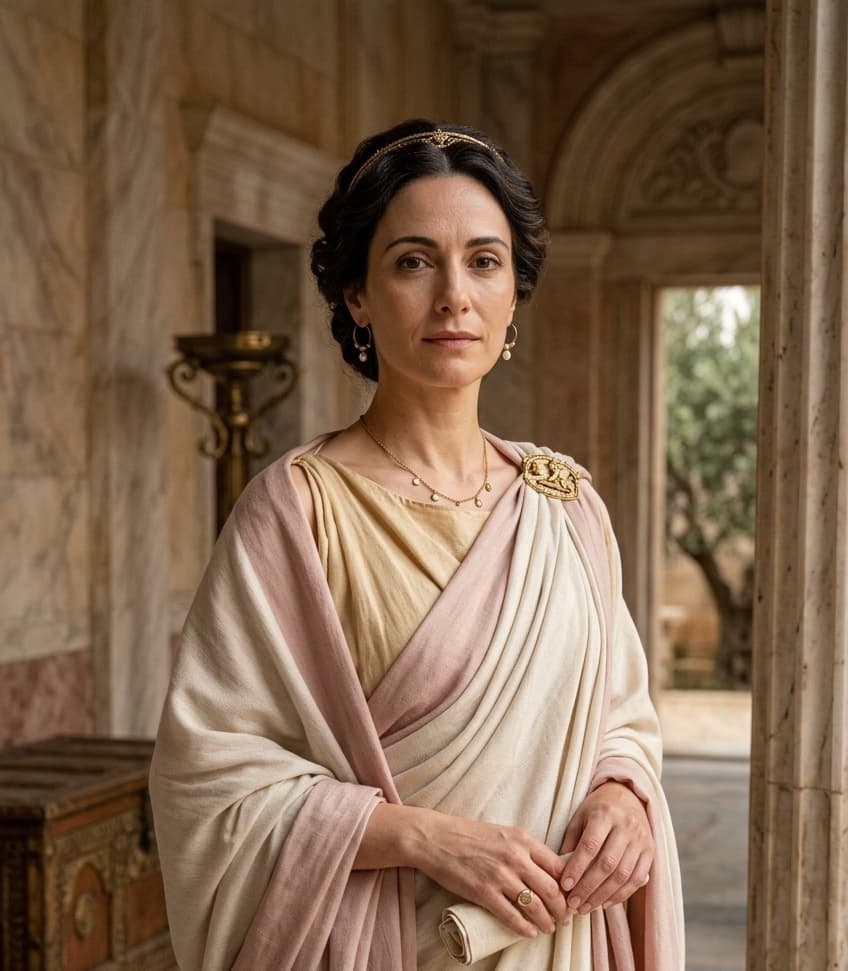
AI-assisted portrait of Doris of Locris
The Architecture of Continuity
Doris of Locris is not remembered for what she built. She is remembered for where she stood.
As the wife of Dionysius I, Doris existed within a world defined by ambition, warfare, and political consolidation. Syracuse under Dionysius was not a place of stillness—it was a system in motion, driven by strategy and control.
And yet, within that system, Doris represents something else. Not force. Not vision. But continuity.
She is not recorded as a political actor, nor as a philosophical figure. Instead, she appears in the historical record in relation to family, marriage, and lineage—her role embedded within the structure rather than imposed upon it.
She does not reshape the system. She stabilizes it.
The Psychological Verdict
Doris of Locris is a figure defined not by assertion, but by presence—a steady, relational orientation grounded in duty and continuity.
She reads most clearly as ISFJ.
Si — Dominant
Doris’ role reflects preservation. As part of a ruling household, her significance lies in maintaining continuity—of lineage, of social structure, of relational bonds within the political system. There is no indication of disruption or deviation; instead, her presence aligns with what is expected, what is established, what must be sustained.
This is Si: grounding identity in stability and tradition. Not expansion. Maintenance.
Fe — Auxiliary
Her position is inherently relational. As wife and mother within a ruling structure, Doris operates in a space defined by connection—supporting roles, maintaining harmony, and fulfilling expectations tied to family and social cohesion.
This reflects Fe: attunement to relational roles and the needs of the collective. Not individual assertion. Alignment.
Ti — Tertiary
There is a quiet internal order implied in such a role. To sustain stability requires an understanding—however unspoken—of what is appropriate, what is balanced, what maintains cohesion. This is not externally expressed analysis, but an internal calibration of structure.
This reflects tertiary Ti: subtle, supporting, and contained.
Ne — Inferior
What is absent is any push toward reinvention or expansion. Doris is not associated with exploration, disruption, or new possibilities. Her presence is consistent with maintaining what exists, rather than seeking what could be.
This reflects inferior Ne: a preference for the known over the uncertain.
Analysis
Why not ESFJ?
Given her relational role, ESFJ may seem plausible—a figure defined by social engagement and outward care. But the distinction lies in visibility.
ESFJs tend to express Fe outwardly—organizing, hosting, actively shaping the social environment. Doris, by contrast, is not recorded as socially directive or externally influential. Her role is quieter, more contained, and rooted in continuity rather than outward coordination.
This suggests Si–Fe over Fe–Si.
Not the organizer of the social world. But the one who sustains it from within.
The Presence That Endures
Doris of Locris does not stand at the center of history. She stands within it.
Her significance is not in transformation, but in continuity—in holding a role that allows larger systems to persist. In a world defined by ambition and instability, her presence represents something quieter.
Not power. But permanence.
Not the force that moves the system. But the one that allows it to hold.
Connected Figures
Further Reading
- Dionysius I: War-Lord of Sicily — Brian CavenCovers the dual-marriage arrangement that placed Doris alongside Aristomache in Dionysius I's household.
- Ancient Sicily — M. I. FinleyFrames the tyranny Doris married into and the succession pressures her son Dionysius II would inherit.
- The Age of Alexander — PlutarchPlutarch's Life of Dion sketches the court politics surrounding Doris's co-wife Aristomache and their shared descendants.
