 Historical Figure MBTI
#925 · 7-7-26 · The Second World War
Eleanor Roosevelt
First Lady · Conscience of the New Deal
1884 — 1962
7 min read
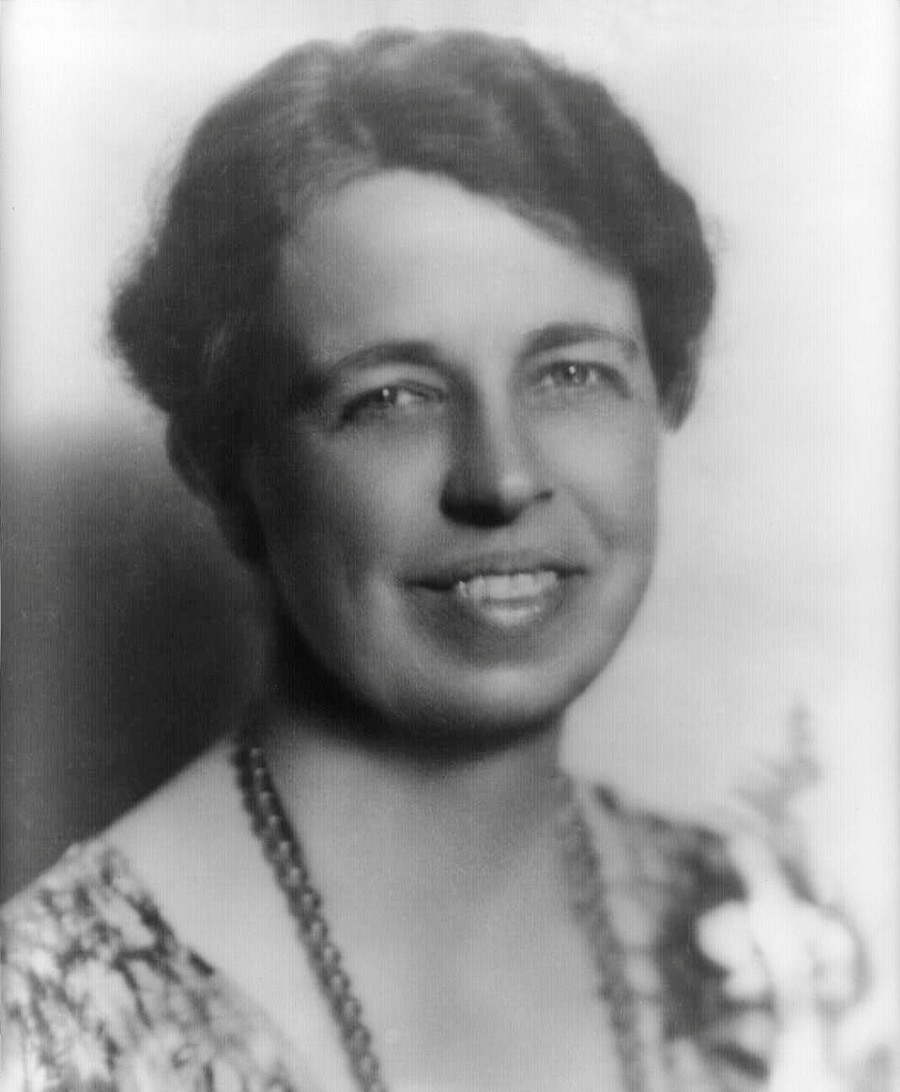
Portrait of Eleanor Roosevelt (Library of Congress, 1933)
The Shy Woman Who Would Not Stop Talking
She was a plain, anxious, badly mothered child who grew into a woman convinced she had nothing anyone wanted. Orphaned before she was ten, raised by a grandmother who thought warmth was indulgence, married in 1905 to a distant cousin whose mother ran the household for the next thirty years, Eleanor Roosevelt spent the first four decades of her life being told, by everyone including herself, that she was the dull one. She was still visibly nervous in front of a camera at sixty. And she became, by the end, the most consequential private citizen of the American century.
The turn came through work rather than temperament. When polio took her husband’s legs in 1921 she became his substitute in the world — his eyes in coal mines and tenement blocks and army hospitals, the one who went and looked and came back and reported. What began as service to his career became, quite quickly, a program of her own. As First Lady from 1933 she held her own press conferences and barred male reporters from them, forcing every wire service in Washington to put a woman on the White House beat or lose the story. She wrote “My Day,” a syndicated newspaper column, six days a week for twenty-seven years. She traveled without her husband, without an agenda cleared by anyone, and said things the administration could not afford to say.
Eleanor Roosevelt is an INFJ of the purest kind: a dominant Ni conviction about human dignity, held unchanged for forty years, executed through patient Fe advocacy one person and one column at a time.
One Idea, Held for Forty Years
Everything she did proceeds from a single premise: that human worth is not divisible, and that a political order which sorts people by race or origin or poverty is not merely unjust but incoherent. She did not arrive at it by argument and she never revised it. It simply organized her attention — which letters she answered, which invitations she accepted, which fights she picked with her husband’s political managers, who wanted her quiet on the South until after the next election and never got their wish.
In February 1939 the Daughters of the American Revolution refused to let Marian Anderson, the greatest contralto of her generation, sing at Constitution Hall because she was Black. Eleanor resigned from the organization, said so plainly in “My Day” without ever naming the DAR, and then quietly helped arrange for Anderson to sing instead on the steps of the Lincoln Memorial before seventy-five thousand people on Easter Sunday. The resignation was the gesture; the concert was the point. She had converted a private slight into a national image, and she did not attend, because her presence would have made the story about her.
The same faculty produced her last and largest work. Appointed a United States delegate to the new United Nations in 1946 by a president who expected her to be ornamental, she chaired the Human Rights Commission through two years of drafting and won the 1948 vote on the Universal Declaration of Human Rights. She had spent a lifetime arguing that dignity was a single indivisible fact; the Declaration is that intuition written out in thirty articles and ratified by the world.
Advocacy, One Person at a Time
Auxiliary Fe gave the vision a delivery mechanism, and the mechanism was almost always personal. She answered her mail — hundreds of thousands of letters across the New Deal years, from women asking for a winter coat or a job for a husband — and routed the ones she could act on to whichever agency could act. She learned the names of the young people in the National Youth Administration. She wrote about a specific miner, a specific schoolhouse, a specific refugee family, because she understood that a policy argument reaches almost no one and a person reaches everyone.
It was Fe in the strict sense — attention to the emotional facts of other people, deployed deliberately — and not charm. She was frequently poor company at large gatherings and knew it. What she had instead was an inexhaustible willingness to turn toward whoever was in front of her, which in a First Lady reads as saintly and in fact functioned as leverage: the letters and the column and the visits built a constituency of her own, one her husband’s advisers could complain about but never dismantle.
The Private Framework
Tertiary Ti shows in her seriousness about definitions. The drafting of the Universal Declaration was a two-year argument among delegates who agreed on nothing — the Soviet bloc wanted economic rights and no enforcement, the Western delegations wanted civil liberties, the colonial powers wanted the whole thing confined to Europe — and Eleanor chaired it line by line, holding sessions late, refusing to let the text soften into meaninglessness, and insisting the document be a declaration of principle rather than an unenforceable treaty precisely because she had thought through what each form could and could not do.
It shows too in her self-scrutiny. Her autobiographical writing is unusually cold-eyed about her own motives, her marriage, and the failures of her mothering, and she was capable of dropping the warmth entirely when a position needed defending. But Ti was never her first instrument. When it took the lead — in stubbornness about a formulation, in the flat refusal to be moved by an argument from expedience — it read to opponents as rigidity, which is what a third function looks like from outside.
The Body She Kept Sending Into the World
Inferior Se is the reason her physical courage looks so deliberate. She was self-conscious about her appearance to the end of her life, uneasy in a crowd, bad at the small sensory pleasures her husband handled effortlessly. And she made herself go anyway: down into a mine shaft in Ohio, through the tenements of Puerto Rico, across the Pacific in 1943 to visit hospital wards on Guadalcanal, where she walked every bed and wrote down the mothers to write to. Admiral Halsey expected a nuisance and afterward said no one else had done so much good.
That is the shape of a fourth function used on purpose: never fluent, never enjoyed, but pressed into service because the vision required a witness with a body. She flew when flying was dangerous and unfashionable for women. She showed up. It is the least natural thing she did and, arguably, the most useful.
Why INFJ Over ENFJ
Why not ENFJ?
The public record — press conferences, a daily column, a global constituency — invites the extraverted reading, and it is wrong. An ENFJ draws energy from the room and leads by presence; Eleanor was reserved to the point of awkwardness in person, shaped by an isolated childhood into someone who found large gatherings costly and preferred writing and one-to-one work. Her influence was built at a desk and in hospital wards, not from a podium, and she consistently arranged matters so the cause was visible and she was not — declining to attend the Lincoln Memorial concert she had helped make possible. That is Ni conviction reaching outward through Fe, not Fe leading.
The married contrast makes it plain. Her husband was an ENFJ who read a nation’s mood and moved it; she was an INFJ who held a position and waited for the nation to catch up, and was still holding it two decades after his death. He was the warmer public presence and the colder private one. She was the reverse, which is why the New Deal needed both of them.
Connected Figures
Further Reading
- Eleanor Roosevelt — Blanche Wiesen CookThe multi-volume standard biography, and the fullest account of her independent political life.
- No Ordinary Time — Doris Kearns GoodwinThe wartime White House, with the Franklin–Eleanor partnership at its center.
- The Autobiography of Eleanor Roosevelt — Eleanor RooseveltHer own account, unusually cold-eyed about her marriage and her early life — cite as primary source.
