 Historical Figure MBTI
#924 · 7-7-26 · The Second World War
Franklin D. Roosevelt
President · Architect of the Arsenal of Democracy
1882 — 1945
10 min read
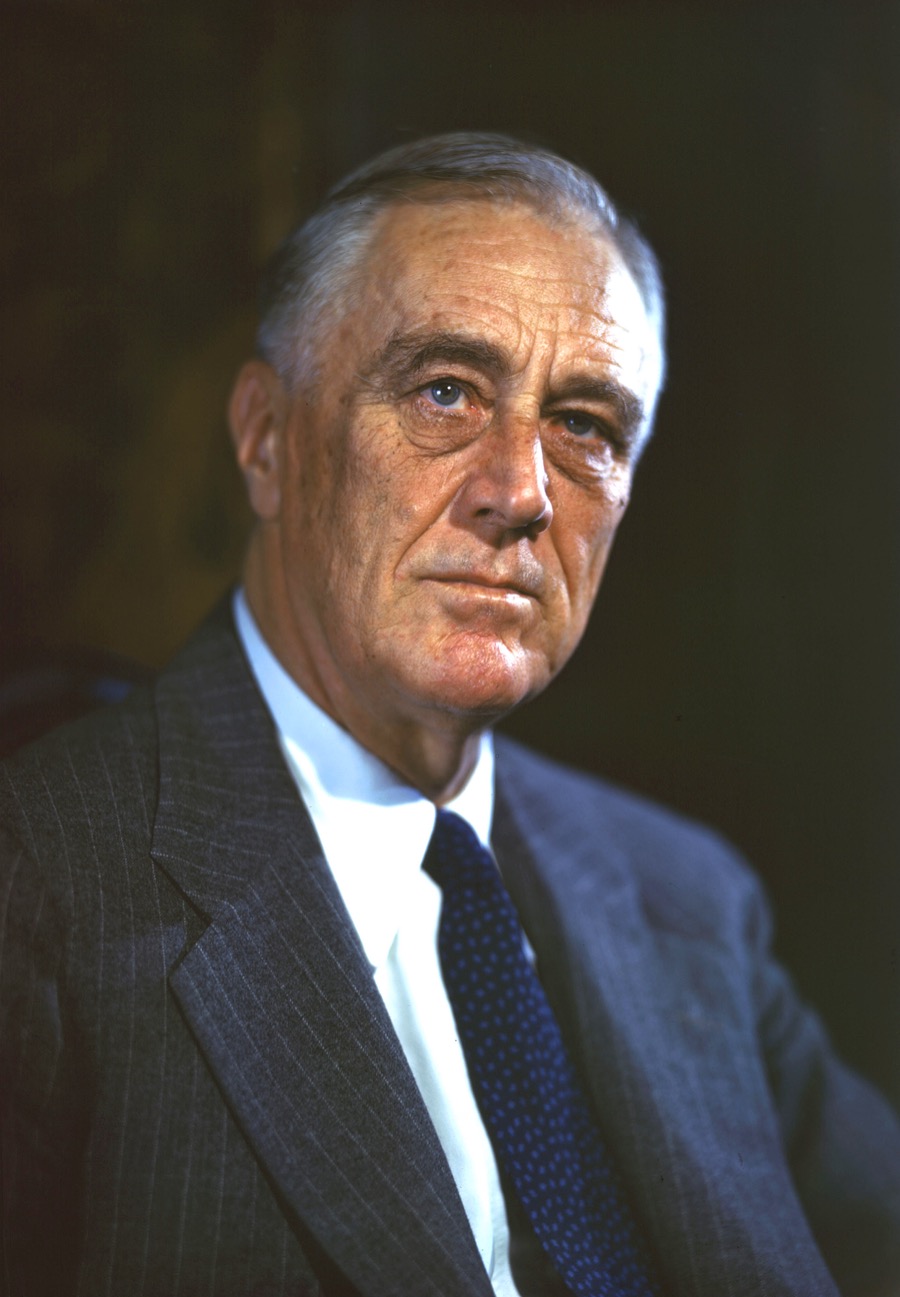
Portrait of Franklin D. Roosevelt (photo by Leon A. Perskie, 1944, CC BY 2.0)
The Man Who Could Not Stand, Teaching a Nation to Walk
He was, from the waist down, immobile. Polio had taken his legs in 1921, at thirty-nine, and for the remaining twenty-four years of his life every entrance into a room was an act of stagecraft — the heavy steel braces locked at the knee, the son’s arm gripped hard enough to bruise, the head thrown back, the grin fixed, the illusion of walking assembled inch by inch in front of photographers who had agreed, by an unspoken compact, not to photograph it. Franklin Delano Roosevelt spent a quarter of a century convincing a nation of its own strength from a wheelchair he refused to let it see. That is the essential fact about him, and almost every other fact is downstream of it.
He came from money and from confidence — born in 1882 to the Hudson Valley gentry, distant cousin to Theodore Roosevelt, raised with the assumption of consequence. Nothing in the early record suggests depth. He was charming, superficial, plainly ambitious, and widely regarded by better minds as a lightweight. Then illness rearranged him. What emerged in 1932, when he took the presidency of a country with a quarter of its workforce idle and its banking system in free fall, was a politician who had learned in his own body the difference between a problem to be solved and a morale to be sustained, and who understood — correctly, and before anyone else — that in 1933 the second was the more urgent emergency.
He would hold the office for twelve years and be elected to it four times, an unprecedented run no successor has been permitted to repeat. In that span he rebuilt the relationship between the American citizen and the American state, dragged an isolationist republic to the edge of a world war and then across it, and sat at Tehran and Yalta bargaining over the shape of the postwar world with Churchill on one side and Stalin on the other. He did almost none of it by force. He did it by talking to people — one at a time, sixty million at a time — until they came around.
Roosevelt is the archive’s clearest ENFJ: dominant Fe as an instrument of statecraft, warmth deployed at national scale with the precision of an engineer, over a long private Ni vision the public was not shown until it was ready.
The Fireside as an Instrument of State
Eight days into his presidency, with every bank in the country closed by executive order and no guarantee that any of them would survive reopening, Roosevelt sat down at a microphone and explained banking to the American people for thirteen minutes. He did not orate. He used the word “you.” He described what happens to a deposit after it leaves the counter, told listeners plainly that it was safer to keep money in a reopened bank than under a mattress, and thanked them for their “fortitude and good temper.” The following Monday, deposits exceeded withdrawals. A run that no law had been able to stop was stopped by a voice in the parlor.
That is dominant Fe doing work no other function can do. Roosevelt read the emotional temperature of a mass audience the way an engineer reads a gauge, and he intervened on it deliberately. The Fireside Chats — thirty of them across twelve years — were composed for the room the listener was actually sitting in. He pictured a specific man, he told his speechwriters, at a specific kitchen table; he insisted on plain nouns; he asked Americans to spread out maps before a 1942 broadcast so they could follow him around the Pacific, and the map sellers ran out of stock. The intimacy was manufactured and it was also entirely real, which is the paradox at the center of Fe: the performance is sincere.
The same faculty organized the New Deal itself. Social Security, the WPA, the banking reforms, the alphabet agencies improvised and discarded — these were not the product of a coherent economic doctrine, and Roosevelt never pretended otherwise. They were a response to a mood. The measure of a program, for him, was whether it put a man back to work and let him tell his children he had a job, and he cheerfully abandoned any policy that failed that test. Critics called it incoherence. It was Fe governing: the country’s morale was the variable being optimized, and the economics were instruments.
The Long Arc Toward the Arsenal
Behind the warmth ran a single, unwavering, privately held conviction: that the United States would have to fight, that Britain could not be allowed to fall first, and that the American public was years away from accepting either proposition. Roosevelt began acting on that reading long before he could say it. He built the Navy quietly through the late 1930s. He traded fifty aging destroyers for Atlantic bases in 1940 through an executive agreement that bypassed a Congress he knew would refuse. He called the country the “arsenal of democracy” in December 1940 and framed it, carefully, as the alternative to war rather than the road to it.
Lend-Lease, passed in March 1941, is the clearest artifact of that patience. He sold a program of unlimited material aid to a belligerent power with a story about lending a neighbor a garden hose while his house burned — a homely image doing the work of a strategic doctrine. He was, at that moment, roughly nine months ahead of public opinion and about eighteen months ahead of Congress, and he knew it, and he closed the gap by talking rather than by moving first and explaining later. Ni supplies the destination; Fe supplies the road.
The same long sight shaped the alliance. Roosevelt understood before Pearl Harbor that the war would be won by coalition and that the coalition would have to hold together across a chasm of ideology — that Churchill and Stalin were, respectively, an imperialist and a tyrant, and that both were necessary. At Tehran and Yalta he bargained not for the map of 1945 but for the institutions of 1950, spending political capital on the United Nations and on Soviet entry into the Pacific war. Whether he read Stalin correctly is one of the permanent arguments of the century. That he was playing a decade out, while advisers argued over the season, is not in dispute.
The Improviser in the Wreckage
For a man with a long private vision, Roosevelt was remarkably comfortable in the immediate. The Hundred Days of 1933 were pure tactical opportunism: fifteen major bills in three months, drafted at speed, several of them contradicting one another, some of them later struck down by a Supreme Court that could not follow the logic because there was no single logic to follow. “Take a method and try it,” he said. “If it fails, admit it frankly and try another. But above all, try something.” That is Se in the service of Ni — grab whatever is on the table, use it, discard it, keep moving toward the horizon.
It shows in his physical presence as well. Roosevelt was superb in the room: the tilted cigarette holder, the cape, the laugh that could be heard through a closed door, the practiced ease with a hostile press corps he met twice a week for twelve years and nearly a thousand conferences. He handled the theater of power with a showman’s timing, and he handled his own body — the braces, the car door, the ramp built quietly behind a stage — as a stage problem to be solved each morning with whatever was available.
The Cold Arithmetic Under the Warmth
The warmth was not the whole man, and the people closest to him knew it. Roosevelt habitually gave two subordinates the same assignment without telling either, and watched the friction produce information he could not have obtained by asking. He agreed, in the sense of nodding pleasantly, with visitors whose proposals he intended to ignore, so that men left the Oval Office certain they had won and learned otherwise from the newspapers. Even Eleanor said she never knew what he truly thought. It was a manipulative style, and it was effective, and it was lonely.
Inferior Ti surfaces most visibly when the warm approach stops working. Fresh off a landslide in 1936 and blocked by a Court that kept voiding his programs, Roosevelt in 1937 produced the court-packing plan: a proposal to add a justice for every sitting justice over seventy, presented not as what it was but as an efficiency measure to help overburdened elders with their caseload. The logic was technically airtight and politically insulting. Nobody believed the cover story; his own party revolted; the bill died, the conservative coalition in Congress was born, and his domestic momentum never fully recovered. It was the one moment he trusted a clever private argument over his read of the room, and it cost him more than any opponent ever did.
The same coldness appears in the darkest act of his presidency. Executive Order 9066, signed in February 1942, sent some 120,000 people of Japanese descent — two-thirds of them American citizens — into camps, on a security rationale his own intelligence services did not support. He did not agonize over it publicly. It was a wartime input, processed and disposed of, by a man whose enormous sympathy operated on the groups he had chosen to hold in view.
Why ENFJ Over ESFJ
Why not ESFJ?
An ESFJ reads the room and serves it — present-focused, consensus-seeking, anchored in established values and the visible needs of the moment. Roosevelt repeatedly went the other way. He was arming Britain while a large majority of Americans wanted no part of Europe’s war, and he pursued that policy for more than two years through executive agreements, redefinitions, and homely metaphors precisely because consensus did not exist and he intended to manufacture it. That is not a man following the crowd; that is a man moving one. His improvisational contempt for precedent — four terms, a court he tried to restructure, an administrative state built from nothing — is likewise the opposite of the ESFJ’s regard for the inherited order.
The distinction that settles it is direction of travel. Both types work through people and both are exquisitely sensitive to collective feeling; the question is whether that sensitivity is the source of the goal or the means to it. For Roosevelt it was always the means. The goal came from somewhere private and stayed there — often for years, often unshared with his own cabinet — while the public Roosevelt smiled, joked, listened, and waited for the country to arrive where he had already been standing. Fe over Ni: the warmest possible surface over the longest possible view.
Connected Figures
Further Reading
- No Ordinary Time — Doris Kearns GoodwinThe Roosevelt White House at war, and the Franklin–Eleanor partnership at its center.
- FDR — Jean Edward SmithThe standard single-volume life, strong on the political mechanics of the New Deal.
- Franklin and Winston — Jon MeachamThe Anglo-American friendship as both intimacy and instrument.
