 Historical Figure MBTI
#901 · 7-2-26 · The Second World War
Winston Churchill
Prime Minister · Orator · The Bulldog of Britain
1874 — 1965
10 min read
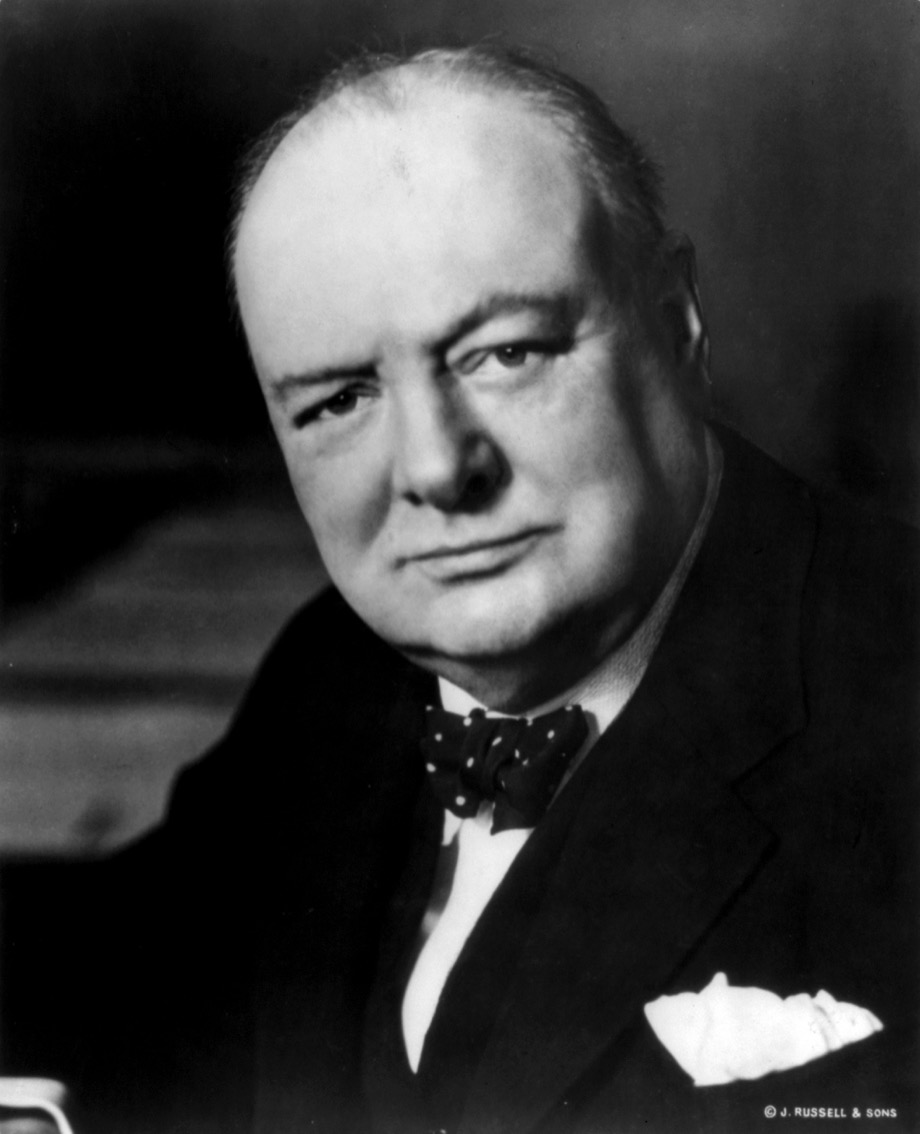
Portrait of Winston Churchill
The Man Who Could Not Stop Having Ideas
He was, by the summer of 1940, a sixty-five-year-old political failure. That is the fact the statuary tends to sand away. He had been blamed for Gallipoli and never fully forgiven; he had changed party twice; he had botched the return to gold; he had wrecked his standing over India and again over the abdication; and he had spent the decade before the war shouting into an empty chamber about German rearmament while the men who mattered treated him as a brilliant, exhausting, faintly ridiculous relic. Then Hitler crossed into the Low Countries, Chamberlain fell, and the one quality that had made Churchill unemployable — an imagination that would not sit still — became the only quality Britain had left.
What his colleagues recorded, over and over, in the private diaries where they had no reason to flatter him, was not wisdom. It was volume. Ideas arrived from him at a rate no staff system had been designed to absorb: minutes at two in the morning, schemes for floating airfields made of ice, plans to invade Norway again, again, and again, an order to the new Special Operations Executive to "set Europe ablaze" before anyone had worked out what that would mean in practice. Most were unusable. Some — the tank, which he funded as First Lord out of Admiralty money when the Army would not touch it; the artificial harbours towed to Normandy — were the war-winning exceptions that made it impossible to stop listening to the rest.
It is a temperament, not a talent. Churchill's life reads as a single unbroken argument for the proposition that generative minds are dangerous in peacetime and indispensable in catastrophe. He is an ENTP — a possibility-generator with a fighting intellect and an extraordinary ear for a crowd — placed, once, at the exact historical moment when a man who could imagine anything was worth more than a dozen men who could only manage what already existed.
An ENTP war leader: dominant Ne producing a scheme a week, defended by a stubborn Ti and sold by an Fe that could speak a frightened nation into believing itself brave.
A Scheme a Week — Ne as Weather System
Gallipoli is the honest place to start, because it shows the function at full power with nothing restraining it. In 1915 the Western Front had congealed, and Churchill, First Lord of the Admiralty at forty, refused to accept that the only available move was to keep feeding men into Flanders. Force the Dardanelles, knock Turkey out, open a supply line to Russia, bring in the Balkans: it was a genuinely imaginative reframing of a war everyone else had stopped trying to reframe. It was also, in execution, a catastrophe of muddled command and improvised landings, and it cost him the Admiralty. He resigned and went to the trenches to command a battalion — which is itself telling. The idea had failed; the appetite for the next one had not.
The pattern predates the war and never breaks. As a young man he manufactured his own opportunities with the same restless opportunism: talking his way to Cuba, to the North-West Frontier, to Omdurman where he rode in the cavalry charge, to South Africa where he was captured, escaped, and converted the escape into a book, a lecture tour and a parliamentary seat. He crossed the floor to the Liberals in 1904 and back to the Conservatives twenty years later, which the party men called treachery and which was closer to something else — an inability to treat an inherited allegiance as an argument. Ne does not experience "we have always done it this way" as a reason. That is precisely why it is untrustworthy in a cabinet and priceless in a crisis.
By 1940 the production line was running at wartime speed, and Alan Brooke's diaries become the best available instrument for measuring it: a Sumatra landing, a fresh Norway operation, an assault somewhere in the eastern Mediterranean, each proposed with total conviction and, when refused, replaced within days by another. Brooke's despair is the despair of a man watching a machine that cannot be switched off. But the same faculty produced the tank, the wartime coalition's willingness to gamble on unorthodox weapons and unorthodox men, and the strategic instinct — against every rule of prudence — that Britain should fight on alone in May 1940 when a negotiated peace was the reasonable option on the table. Reasonableness was the one move Churchill could not see the point of.
The Private Logic He Would Not Surrender
An ENTP is not a man of moods; he is a man of arguments. Churchill's ideas came fast, but they came attached to a reasoning he had built himself and would defend at three in the morning against professionals who had spent their careers on the subject. This is auxiliary Ti — an internal model, privately assembled, held with a tenacity out of all proportion to its accuracy on detail. He would interrogate a service chief on shipping tonnages and divisional strengths until the man cracked, not because Churchill had the better numbers but because he had a coherent picture and would not release it until the picture was disproved on its own terms.
The wilderness years are the vindication of that stubbornness. Out of office through the 1930s, with no departmental staff and no access to Cabinet papers, he assembled from sympathetic officials, journalists and his own reading a running analysis of German rearmament, and pressed it in the Commons year after year against a government that had every institutional advantage and a public that badly wanted him wrong. It made him a bore and then a prophet. The same faculty, aimed at the gold standard in 1925 or at Indian self-government, produced conclusions that were wrong and defended just as hard. Ti guarantees internal consistency; it guarantees nothing about the premises.
Which is why he needed adversaries who could out-argue him rather than obey him. The strategic record of the war is a record of Churchill proposing, being met with fact and logistics, and — usually, eventually, resentfully — conceding to a better case. He could be beaten by evidence. He could not be beaten by rank, by convention, or by the observation that everybody else already agreed on something else.
The Voice That Read the Room
The speeches are not decoration on the war effort; for a period in 1940 they were a substantial part of it. "Blood, toil, tears and sweat" on taking office; "we shall fight on the beaches" after Dunkirk; "their finest hour" as the Battle of Britain opened. What makes them work is not grandeur — grandeur was cheap in 1940 and other politicians had plenty. It is calibration. Churchill told a frightened country the bad news first, in flat and specific terms, and only then offered it a role to play. He understood, with something close to precision, exactly how much despair an audience could absorb before defiance stopped sounding like a lie.
Tertiary Fe is a performer's instrument rather than a diplomat's: powerful in front of a public, erratic in a small room. The same man who could move millions on the wireless could reduce a private secretary to tears at midnight and forget the incident by breakfast. He wept easily and in public. He courted Roosevelt with a persistence that verged on infatuation, crossing the Atlantic in wartime again and again to sustain a personal relationship he correctly judged to be worth more than any treaty, and he sat down with Stalin — a man he had spent twenty years denouncing — because the alliance required it and the room could be worked.
The limits of Fe showed the moment the crowd changed. In July 1945, weeks after victory in Europe, the electorate that had cheered him in the streets returned Labour with a landslide, and Churchill, who had read the national mood so exactly under bombardment, had entirely failed to read what it wanted afterwards. He could hear a nation in danger. He could not hear a nation thinking about housing.
Blenheim, Debt, and the Past as Costume
Inferior Si in an ENTP rarely looks like carelessness about the past — it often looks like the opposite, a romance with the past that is entirely unmoored from its practical obligations. Churchill was born at Blenheim Palace and spent his life narrating himself into a lineage of English greatness, writing histories of Marlborough and of the English-speaking peoples in prose that treats memory as an epic rather than a ledger. Yet the aristocratic house he identified with came with almost no money, and he was in debt for most of his adult life, repeatedly rescued by friends and by the earnings of his own pen. He revered continuity and could not personally maintain a balance sheet.
The same blind spot ran through his administrative life. Details of routine, sequence and supply — the unglamorous substance of Si — did not register unless somebody forced them in front of him, which is why so many of his best schemes arrived with no logistics attached and why the machinery around him had to be built specifically to catch them. Gallipoli failed less on conception than on everything Si would have supplied: timing, stores, the boring question of who lands where and with what.
Under strain it surfaced as raw nostalgia. His most reactionary positions — India above all, where he fought self-government with a ferocity that damaged him badly and reads now as indefensible — were Si in its inferior register, clinging to a remembered imperial order rather than examining it. The man who could imagine any future refused, on that one subject, to imagine any change at all.
Why ENTP Over ENTJ
Why not ENTJ?
The obvious reading of a great war leader is ENTJ, and it is the wrong one here. An ENTJ commands from the top down: he imposes structure, builds a system, and drives an organisation toward an objective he has already fixed. Churchill's genius ran the other way — generative and associative, throwing off possibilities faster than any structure could metabolise them, and changing direction when a new one arrived. The decisive evidence is that he required Alan Brooke. A dominant Te would have supplied its own discipline; Churchill had to have an external brake installed, a Chief of the Imperial General Staff whose daily function was to catch the ideas and sort them, because he had no such filter internally and knew it.
The distinction matters because it explains both halves of his career. A genuinely systematic leader would have been employable in the 1930s and merely competent in 1940. Churchill was the inverse: unusable in normal politics precisely because his output could not be administered, and irreplaceable in the emergency because the situation had no precedent to administer. Britain got the war leader it needed by finally, at the last possible moment, pairing an ungovernable Ne with the machinery — Brooke, the Chiefs of Staff Committee, a coalition cabinet — capable of governing it.
Connected Figures
Further Reading
- The Last Lion: Winston Spencer Churchill — William Manchester & Paul ReidThe three-volume narrative biography — the fullest account of the wilderness years and the 1940 crisis.
- Churchill: A Biography — Roy JenkinsA politician's life of a politician, unusually sharp on the parliamentary manoeuvring and the two floor-crossings.
- Churchill: A Life — Martin GilbertThe single-volume distillation by his official biographer, closest to the documentary record.
- The Splendid and the Vile — Erik LarsonThe Blitz year at close range, drawing on family and staff diaries for Churchill as colleagues actually experienced him.
- War Diaries 1939–1945 — Alanbrooke, ed. Alex Danchev & Daniel TodmanThe unexpurgated edition — the indispensable hostile witness to Churchill's flow of schemes.
