 Historical Figure MBTI
#929 · 7-8-26 · The Second World War
Charles de Gaulle
General · The Man Who Refused the Armistice
1890 — 1970
7 min read
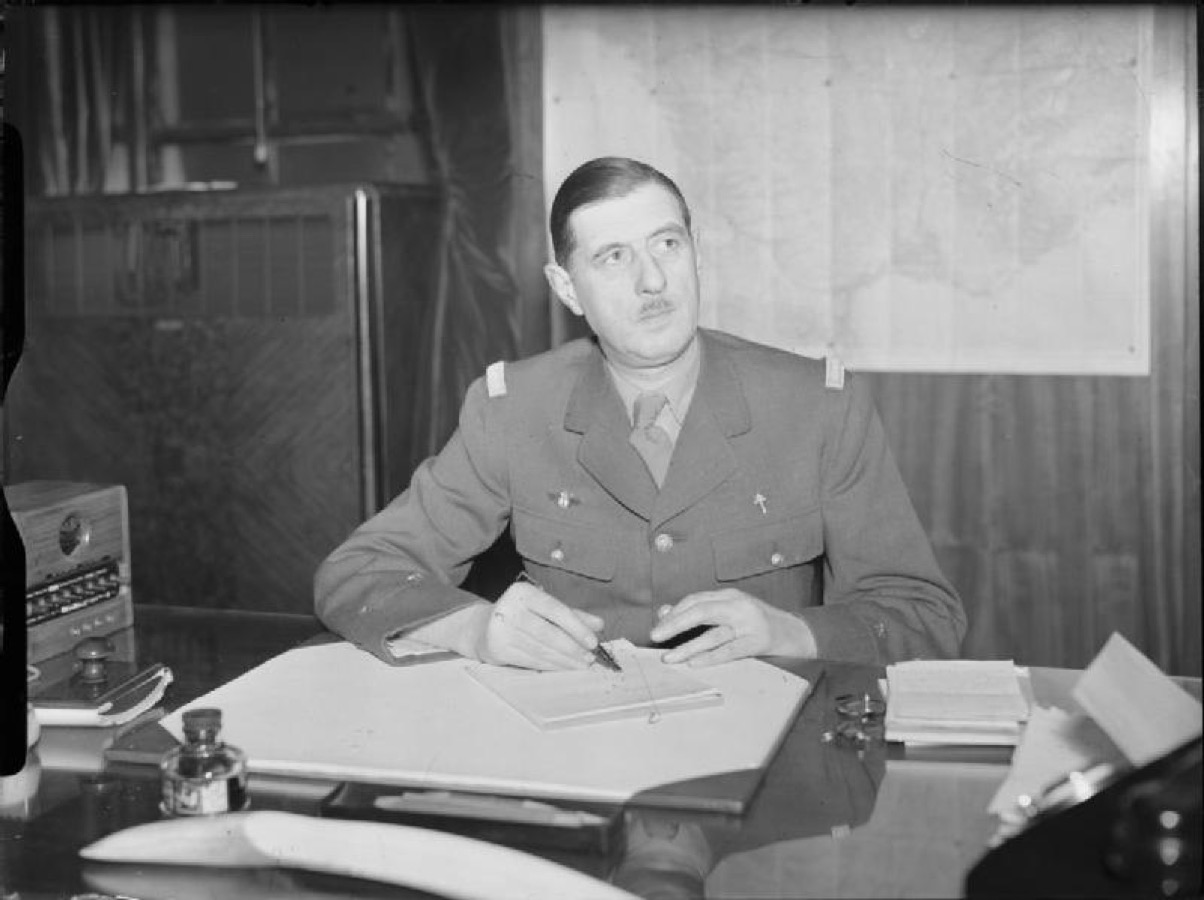
De Gaulle in his London office, c. 1940 (Ministry of Information / Imperial War Museums, public domain)
A Man Alone with a Country in His Head
On 18 June 1940 a forty-nine-year-old brigadier general with no government, no army and no mandate sat down in front of a BBC microphone in London and told a nation that had just been overrun that it had not been defeated. Almost nobody in France heard him. The men who mattered had already made the opposite calculation, and within days the legitimate government of France would sign an armistice with Adolf Hitler. De Gaulle had one asset, and it was neither military nor political: a conviction, formed long before the war, about what France essentially was — and a refusal to admit any evidence against it.
He was an unlikely vessel for it. A career officer wounded and captured at Verdun, he spent the interwar years as a difficult subordinate with an unfashionable idea: that the next war would be won by concentrated armored formations, not static fortification. He wrote it up in 1934 in Vers l'armée de métier, and a high command committed to the Maginot Line ignored him. The Germans did not. In May 1940 the theory he had failed to sell to his own army arrived as panzers; he counterattacked creditably at Montcornet, and was made a brigadier general and then undersecretary of national defense in Paul Reynaud's dying cabinet — a junior man in a government with days to live.
Everyone senior to him concluded that France's survival lay in accommodation. De Gaulle concluded that France, properly understood, could not surrender — and then spent four years constructing, from a rented office in London, the apparatus that would make that abstraction true. He was insufferable while doing it. That, too, was structural.
De Gaulle is the archetypal INTJ: a dominant Ni vision of France held with such totality that reality was treated as the thing needing correction, and a Te that built the institutions to correct it.
The Certain Idea — Ni
The opening line of his war memoirs is the cleanest statement of dominant intuition in modern political writing: all his life he had held "a certain idea of France." Not a policy — an idea, formed early, never revised, functioning less as an opinion than as a fixed point around which incoming facts had to arrange themselves. France, so understood, was not a territory or a population or a government but a vocation, and a France not in the front rank was simply not France, whatever the map said.
This is why the June 1940 argument was, for him, not close. Reynaud's cabinet debated whether to fight on from North Africa; the marshals answered with divisions and casualty projections, and by that arithmetic surrender was obviously correct. De Gaulle was not arguing with the arithmetic. He was arguing that it measured the wrong object: the Battle of France was an event inside a war that was global, industrial and long, and what had to survive was not the army but the continuity of French sovereignty. The Appeal of 18 June says exactly that, four years before the evidence arrived. The same faculty produced the tank writings, and would produce the decade after 1958 — Algerian independence, a French nuclear force, the veto on Britain — all of it perverse to contemporaries and obvious to successors. He arrived at positions somewhere private and defended them with reasons assembled afterward.
A State Built Out of Nothing — Te
What separates de Gaulle from every other Frenchman who privately thought the armistice shameful is what he did on 19 June and every day after. He began manufacturing the missing machinery of a country: a name (France Libre), a symbol (the Cross of Lorraine), a recruiting operation among the soldiers evacuated to Britain, Churchill's formal recognition, an intelligence service, and a claim on the French Empire — which is why so much of 1940–43 was spent fighting over Dakar, Chad and Syria rather than Europe. Territory meant sovereignty, and sovereignty meant a seat at the table in 1945.
He was also ruthless about institutional order. Finding the internal Resistance a scatter of rival networks, he did not romanticize it — he sent Jean Moulin home to consolidate it under London's authority, which produced the Conseil National de la Résistance in May 1943 and the claim that the Free French spoke for the nation rather than for an emigration. The same instinct disposed of Giraud, the general Roosevelt preferred, by patient maneuver inside the French Committee of National Liberation until there was only one chairman left.
He did it once more after the war: contemptuous of the party system that had produced 1940, he resigned in 1946, waited twelve years in deliberate exile, returned during the Algerian crisis in 1958 and wrote a constitution with an executive strong enough to make the paralysis of the Third Republic structurally impossible. The Fifth Republic is still standing. That is Te's signature: the vision is not argued for, it is instantiated in something that outlives you.
The Ingratitude of the Guest — Fi
He was, by universal testimony, exhausting. Churchill housed him, funded him and recognized him when there was no reason to, and also said that of all the crosses he bore the heaviest was the Cross of Lorraine. Roosevelt dealt with Vichy's Darlan and then with Giraud, and kept the Free French out of the D-Day planning for their own country. De Gaulle's response to dependency was never accommodation; it was to become more difficult, because a France that behaved gratefully had accepted client status.
Tertiary Fi in an INTJ is exactly this: an internal register of what is permissible to the self, non-negotiable, indifferent to the social cost of enforcing it. He would not thank people, would not charm, would not trade dignity for goodwill. The blind spot follows — he could not read the room and rarely thought it worth reading, which cost him allies and left him genuinely surprised in May 1968 when a country he had rescued turned out to have opinions of its own. He resigned in 1969 over a referendum he need not have called, retired to Colombey-les-Deux-Églises, and died the next year, on his own terms.
Theatre as a Weapon — Se
The inferior function shows up as something handled deliberately rather than naturally, and with de Gaulle that something was physical presence. He had no talent for spontaneity and knew it, so he engineered spectacle instead: the height, the plain uniform among decorated marshals, the archaic cadence of the broadcasts, the refusal to smile. He rehearsed speeches until they could be given without notes, then gave them as though the thought were arriving for the first time.
It also showed as a tolerance for risk that startled his staff. In August 1944 he walked down the Champs-Élysées at the head of a French column through a city his own troops had not taken, then stood upright at Notre-Dame with shots cracking off the vaulting while the congregation went flat. He did not enjoy danger the way an Se dominant might. He used it, because a leader visibly unafraid — and a France visibly liberating herself — was another brick in the construction.
Why INTJ Over INTP
Why not INTP?
The INTP case has a real starting point: in the 1930s de Gaulle was a theorist writing books nobody read about a doctrine nobody wanted. But Ti-Ne theorists keep the argument open — they refine models, entertain alternatives, and are drawn to the objection they have not yet answered. De Gaulle did the opposite. Once the certain idea was formed it was closed, and everything afterward was execution: a movement founded within a week of the collapse, an empire fought for province by province, a rival French government dismantled by committee procedure, a constitution written to specification. That is Te building in the world, not Ti clarifying in the head.
The distinction matters because 1940 was not a problem of analysis. Plenty of clever Frenchmen understood that Germany could not win a long war; understanding it changed nothing. What was scarce was a man who would treat a private certainty as a mandate to construct the institutions it required, then bully allies, subordinates and eventually his own nation into inhabiting them. INTJ is where those two things meet.
Connected Figures
Further Reading
- De Gaulle — Julian JacksonThe standard modern life in English — best on how the June 1940 refusal was made and then retroactively justified.
- The General: Charles de Gaulle and the France He Saved — Jonathan FenbyA brisk narrative biography, strong on the quarrels with Churchill and Roosevelt.
- The Complete War Memoirs of Charles de Gaulle — Charles de GaulleHis own account, opening with the certain idea of France — self-serving, and the clearest window into the vision.
- France: The Dark Years 1940–1944 — Julian JacksonThe occupation from the inside, and the best measure of how small the Free French looked at the time.
