 Historical Figure MBTI
#928 · 7-7-26 · The Second World War
Charles Lindbergh
Aviator · America First’s Reluctant Icon
1902 — 1974
9 min read
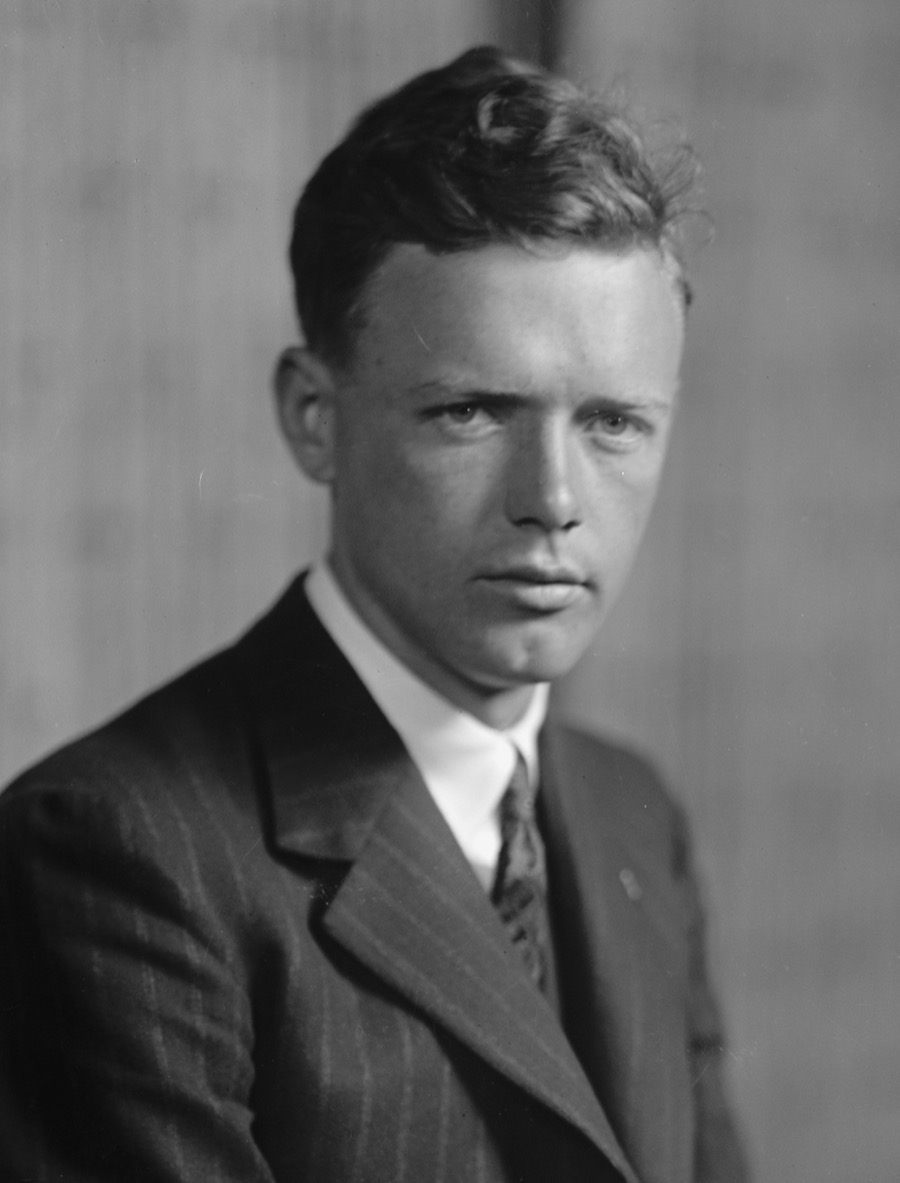
Portrait of Charles Lindbergh (Harris & Ewing, Library of Congress)
The Hero Who Kept Talking
Charles Lindbergh remains famous for thirty-three and a half hours in the spring of 1927, when he flew a single-engine monoplane alone from Long Island to Paris and became, overnight, the most celebrated human being on earth. He is filed here as infamous for what he did fourteen years later: as the leading public voice of the isolationist America First Committee, he stood up in Des Moines in September 1941 and named the Jews as one of the groups pushing the United States into war — a speech condemned then and since as antisemitic, and rightly so. This entry holds both facts, because both are his. The flight was real courage and real skill. The speech was real, too, and no amount of the first excuses the second.
The two are not unrelated, which is the argument of this profile. The qualities that made him extraordinary in a cockpit — total self-reliance, obsessive technical precision, indifference to what anyone else believed possible — were the same qualities he carried, unmodified, into a domain where they were catastrophic. He was a mechanic who became an oracle, and nobody, least of all Lindbergh, ever told him that the second job required a different instrument.
He grew up in Minnesota, dropped out of engineering school, barnstormed, and flew the St. Louis–Chicago airmail run through weather that killed most of his colleagues. He was twenty-five when he crossed the Atlantic. He was thirty when his infant son was kidnapped and murdered in the most publicized crime of the century, an ordeal that drove the family to Europe and left him with a permanent, grinding contempt for the press and the public that had made him.
Lindbergh is an ISTP whose dominant Ti — the private, self-verifying analysis that got him across the Atlantic — was never checked by anything, and whose inferior Fe left him unable to hear what his own words did to the people they named.
The Arithmetic of the Crossing
The 1927 flight was won on paper before it was flown. Every rival for the Orteig Prize built a large multi-engine aircraft with a crew; Lindbergh reasoned that extra engines multiplied the chance of failure and that extra men were weight, and specified a single-engine machine flown by one man. He deleted the radio. He deleted the parachute. He deleted the front windshield to make room for a fuel tank and flew looking through a periscope and out the side. He tore the unneeded margins off his charts and cut the excess leather from his boots. Every one of those choices was a private calculation he performed himself and then simply trusted.
That is dominant Ti: a self-built internal model, tested against its own consistency rather than against anyone’s authority, and acted on absolutely. It kept working for decades. He designed a perfusion pump with Alexis Carrel at the Rockefeller Institute in the 1930s, a glass device that kept organs alive outside the body — a serious contribution from a man with no biological training, arrived at by taking the problem apart mechanically. In the Pacific in 1944 he worked out fuel-mixture and engine settings that extended the combat radius of the P-38 by hundreds of miles, then flew missions himself to prove them.
But a self-verifying model has no error term for the things it cannot weigh. When Lindbergh turned the same apparatus on politics, history and race, it produced conclusions with the same air of settled certainty and none of the underlying competence. He was, in his own estimation, simply reasoning from evidence about air power and national interest. He never entertained the possibility that on this subject his private reasoning was worthless.
Thirty-Three Hours Awake
Calculation gets an aircraft off a muddy runway at Roosevelt Field; it does not fly it. What carried the Spirit of St. Louis to Le Bourget was the other half of the ISTP — an extraordinary tolerance for immediate physical risk and an ability to keep responding, hour after hour, to whatever the air did next. He flew through sleet over Newfoundland, climbed to ten thousand feet and dropped to ten above the waves, hallucinated in the twentieth hour, and held the machine level by hand the entire way. There was no autopilot. There was no one to relieve him.
The same appetite shows across his life: the barnstorming years, four bailouts from failing aircraft before he was twenty-five, the survey flights he and Anne Morrow Lindbergh made across the Arctic and the South Atlantic mapping routes for commercial aviation. Se is why he was never content to be an authority on flying; he had to be in the aircraft. After Pearl Harbor, stripped of his commission and shunned in Washington, he still managed to reach the Pacific as a civilian consultant for United Aircraft and flew roughly fifty combat missions he was not authorized to fly.
Se also accounts for the strangest feature of his celebrity, which is how badly he bore it. A man tuned to the concrete world in front of him was handed, at twenty-five, a life composed entirely of crowds, banquets, ticker tape and reporters standing on his lawn. He hated it immediately and never stopped hating it. The kidnapping and murder of his twenty-month-old son in 1932, and the circus the trial became, confirmed everything he already believed about the public: that its attention was a physical hazard, like weather, to be flown out of. The family sailed for England in 1935. The isolation of the years that followed — the private touring, the private conclusions, the absence of anyone with standing to contradict him — is a large part of why the man who came home in 1939 was so much worse than the one who had left.
A Private Vision of the Future
Tertiary Ni gave him a taste for grand civilizational forecasting that his training could not support. Touring Germany repeatedly in the late 1930s at the invitation of the Luftwaffe, he was shown the aircraft the Germans wished him to see, concluded that German air power was already unbeatable, and reported that conclusion to the American and British governments as settled fact. In October 1938, weeks after Munich, he accepted the Service Cross of the German Eagle from Hermann Göring at a dinner in Berlin — and then refused, through years of public pressure, to return it, on the grounds that giving it back would be a gratuitous insult.
The forecast hardened into a worldview. He wrote of aviation as a possession of the white races to be defended against the East, and of a Europe whose real enemy lay beyond its eastern border. It was the tunnel vision of an inferior-region intuition: one dramatic image of the future, arrived at privately, and thereafter treated as knowledge rather than as a guess that might need revising. His estimates of German strength were also, in the event, substantially wrong.
The Room He Could Not Read
On 11 September 1941, in Des Moines, Lindbergh told an America First audience that three groups were pressing the United States toward war: the British, the Jewish, and the Roosevelt administration. He went further, warning that Jewish ownership of the press and the cinema constituted a danger, and adding that he could understand why Jews wished to fight Germany — while insisting they should not be permitted to lead America into it. He appears genuinely to have believed he was being reasonable, even generous. The reaction was immediate and devastating: newspapers that had defended him for a year abandoned him, America First chapters repudiated the speech, and his own name became unusable.
This is inferior Fe in its most damaging form. Lindbergh could construct an argument; he could not model how it would land, whom it would license, or what it would cost the people he had singled out at the precise historical moment when singling them out was most dangerous. He had already been rebuked in April by Roosevelt, who compared him publicly to the Copperheads of the Civil War; Lindbergh, unable to absorb criticism as information, resigned his Army Air Corps commission in a fury and kept speaking.
The pattern predates the politics. Fe weakness explains the medal he would not return, the flat public affect that a grieving nation read as coldness during his son’s kidnapping trial, and the extraordinary revelation, decades after his death, that he had fathered seven children by three women in Germany and Switzerland and concealed them from his family for the rest of his life. He was never calibrated to other people. In an aircraft it did not matter. On a stage in 1941 it mattered enormously.
Why ISTP Over ISTJ
Why not ISTJ?
The ISTJ reading is tempting — the meticulousness, the reserve, the technical discipline — but an ISTJ works through institutions and defers to accumulated precedent, and Lindbergh did neither at any point in his life. He built his aircraft against the prevailing expert consensus, flew alone because a crew was weight, conducted his own foreign policy in Germany without any government’s sanction, and freelanced into a national political debate with no organization, no advisers and no vetting of his text. Compare George Marshall, a genuine ISTJ of the same generation, who subordinated his own ambition entirely to the institution he served.
The distinction is where authority sits. Marshall trusted the record; Lindbergh trusted Lindbergh. Every triumph and every disgrace of his life follows from the same source — a first-rate private analytical engine, running unchecked in domains where it had no business running at all, in a man who never developed the social instrument that would have told him when to stop.
Connected Figures
Further Reading
- Lindbergh — A. Scott BergThe authorized life and the standard account, unsparing on the isolationist years.
- Anne Morrow Lindbergh — Susan HertogThe marriage from his wife's side — indispensable on what living beside him cost.
- The Spirit of St. Louis — Charles LindberghHis own Pulitzer-winning account of the 1927 flight — cite as primary source, with his later politics in view.
