 Historical Figure MBTI
#927 · 7-7-26 · The Second World War
George Marshall
Army Chief of Staff · The Organizer of Victory
1880 — 1959
7 min read
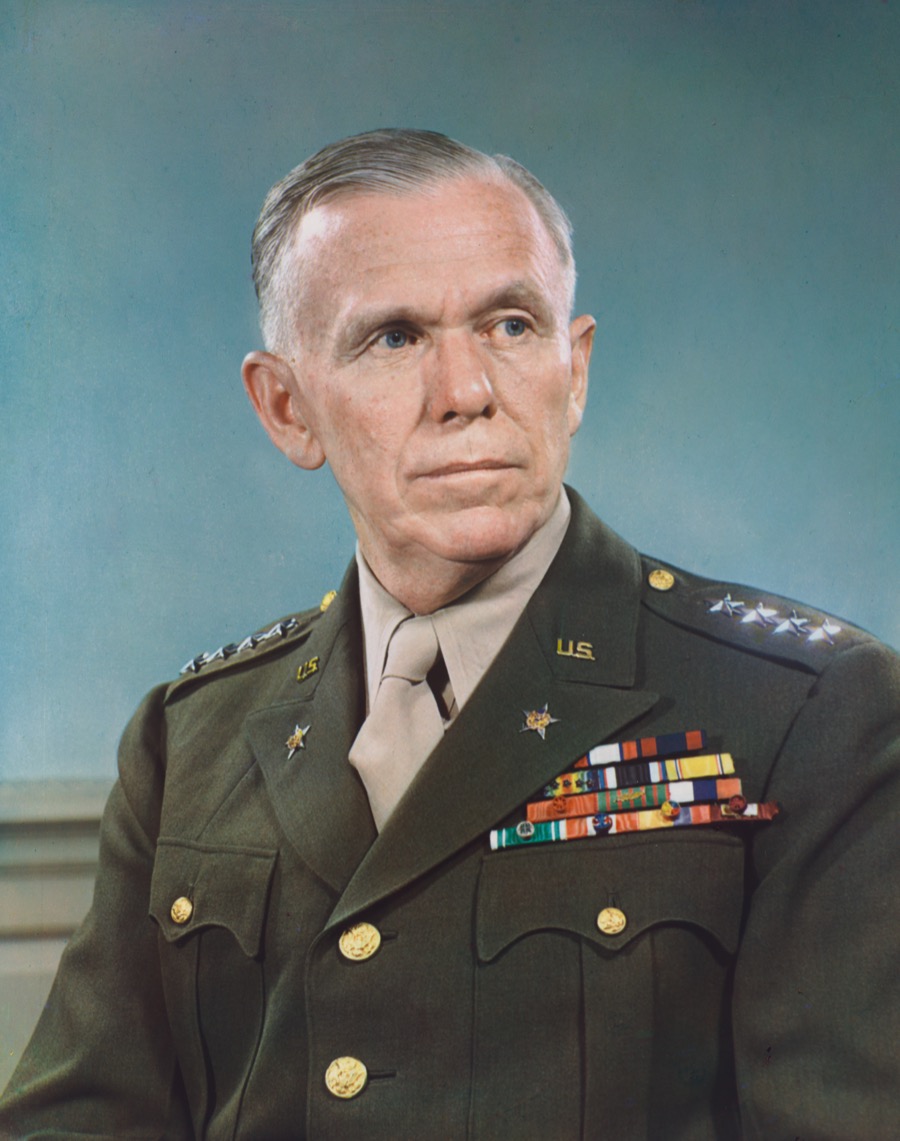
Official portrait of General George C. Marshall, 1940 (Marshall Foundation Archives, CC BY-SA 4.0)
The Man Who Never Got the Battle
He is the rarest thing in military history: a great soldier with no battle attached to his name. George Catlett Marshall commanded no army in the field, stormed no beach, appears in no photograph planting a flag. What he did instead was take an American army of fewer than two hundred thousand men in 1939 — smaller than Portugal’s, ranked somewhere below Bulgaria’s — and turn it, in under four years, into a force of more than eight million fighting a coordinated war on opposite sides of the planet. Churchill, who did not hand out compliments to Americans casually, called him the organizer of victory, and meant it as the highest available praise.
The manner was famously unyielding. A VMI graduate and a First World War staff officer who had planned the Meuse-Argonne movement of six hundred thousand men, he arrived in Washington with an aversion to charm and a refusal to laugh at the President’s jokes. He would not be called George. He declined to socialize with the men he might have to relieve. He told Roosevelt to his face, at their first serious meeting in 1938, that he disagreed with him entirely — and was appointed Chief of Staff the following year, on the day Germany invaded Poland, largely because of it.
Marshall is the archive’s model ISTJ: dominant Si turning accumulated institutional memory into doctrine, and Te turning doctrine into the largest logistical machine ever assembled.
The Little Black Book
For two decades before the war Marshall kept a notebook of officers. Names, observations, a line or two about how a man had handled a problem at Fort Benning or in the Philippines — a private accumulated record of who could be trusted with what. When mobilization came he opened it and staffed a global war out of it, jumping Eisenhower and Bradley and dozens of others past hundreds of seniors. That is Si in its purest professional form: the past stored not as nostalgia but as evidence, retrieved when the moment demands a decision that cannot wait for a new assessment.
The same memory made him ruthless about the officers who failed the record. In his first year he forced hundreds of aging colonels and generals into retirement, men he had served alongside, because the peacetime army had promoted by longevity and longevity is not a qualification. He had watched the same institution fumble mobilization in 1917 and had written down why. He was determined not to see it repeated, and the reforms he imposed — the reorganization of the War Department in 1942, the standardized division, the training programs that turned civilians into soldiers at industrial scale — were all corrections drawn from a remembered failure.
The Machine That Won
Marshall’s war was fought in schedules. Shipping tonnage against divisions ready; landing craft against the calendar; the competing demands of a Pacific theatre, a Mediterranean campaign he thought a distraction, a strategic bombing offensive, and the cross-Channel invasion he pushed for from 1942 and had to wait two years to get. He argued the case with Alan Brooke and the British staff at Casablanca and Quebec through sheer command of the numbers, lost the 1943 rounds, won the argument in the end, and never once resorted to theatrics.
Auxiliary Te also explains his method of dealing with subordinates. He required briefings compressed to their essentials, banned the padding of a report to flatter him, and made a practice of interrupting an officer the moment the officer started telling him what he wanted to hear. He delegated completely and then held the man accountable to the outcome — which is why Eisenhower, given SHAEF, was given it without a supervisor. The organization was the weapon, and Marshall built it to run without him in the room.
The Command He Would Not Ask For
He wanted Overlord. Every biographer agrees on it: the invasion of France was the operation he had argued for since 1942, and the command of it was the one thing his career still lacked. In late 1943 Roosevelt offered to let him decide. Marshall refused to state a preference — said only that the President must do what was best for the country — and Roosevelt, unwilling to lose him from Washington, gave the command to Eisenhower and told him he could not sleep at night with Marshall out of the country. Marshall then personally sent Eisenhower the notification cable and went back to work.
That is tertiary Fi in its characteristic ISTJ form: a private, absolutely rigid code, never articulated and never negotiable. He would not lobby for himself because a soldier does not lobby for himself. He refused, after the war, to write the memoir every publisher in America wanted, on the grounds that an honest one would have to criticize living men who could not answer. He declined to vote, for decades, so that the army would never be seen as partisan. The values were his own, held silently, and they cost him things he badly wanted.
The One Great Leap
Inferior Ne is what makes the Marshall Plan so extraordinary coming from this man. In a fifteen-minute Harvard commencement address in June 1947 the Secretary of State proposed that the United States finance the reconstruction of a Europe including, in principle, its recent enemy — and asked the Europeans themselves to write the program. It was a genuinely imaginative act, an inference about where the continent was heading rather than an extrapolation from any precedent, and it remade the postwar world. It won him the Nobel Peace Prize in 1953, the only career soldier ever to receive one.
It is also, tellingly, the exception. Marshall was uncomfortable with speculation and openly impatient with the political imagination — his mission to mediate the Chinese civil war in 1946 failed in part because the situation resisted every organizational instrument he had. Given a system to build, he was without equal. Given ambiguity, he reached for structure. The Plan works precisely because he put a structural machine behind a single visionary idea and then declined, in character, to attach his name to it. Congress attached it for him.
Why ISTJ Over ISTP
Why not ISTP?
Both types are reserved, unsentimental and intensely practical, and both are common among soldiers — but the ISTP wants his hands on the machine. Marshall spent the decisive years of his life running an institution from a desk in Washington, and when offered the chance to command the greatest amphibious operation in history he let it go rather than press for it. His instruments were procedure, promotion boards, training doctrine and shipping tables, not improvisation under fire. He is remembered as much for the systematic reconstruction of a continent as for the war, which is not an ISTP legacy.
The tell is what he trusted. An ISTP trusts his own reading of the situation in front of him; Marshall trusted the record, the standard, and the institution he had spent forty years correcting. He ran the machine rather than piloting it, and he built it so well that when he handed the fighting to Eisenhower, MacArthur and Nimitz, none of them needed him to tell them how.
Connected Figures
Further Reading
- George C. Marshall — Forrest C. PogueThe authorized multi-volume biography and still the indispensable source on his wartime command.
- George Marshall: A Biography — Debi and Irwin UngerA readable modern single-volume life, sceptical where Pogue is admiring.
- George C. Marshall: Soldier-Statesman of the American Century — Mark A. StolerShort, analytical, and the best account of his strategic arguments with the British.
