 Historical Figure MBTI
#904 · 7-2-26 · The Second World War
Alan Brooke
Chief of the Imperial General Staff · The Brake on a Restless Genius
1883 — 1963
8 min read
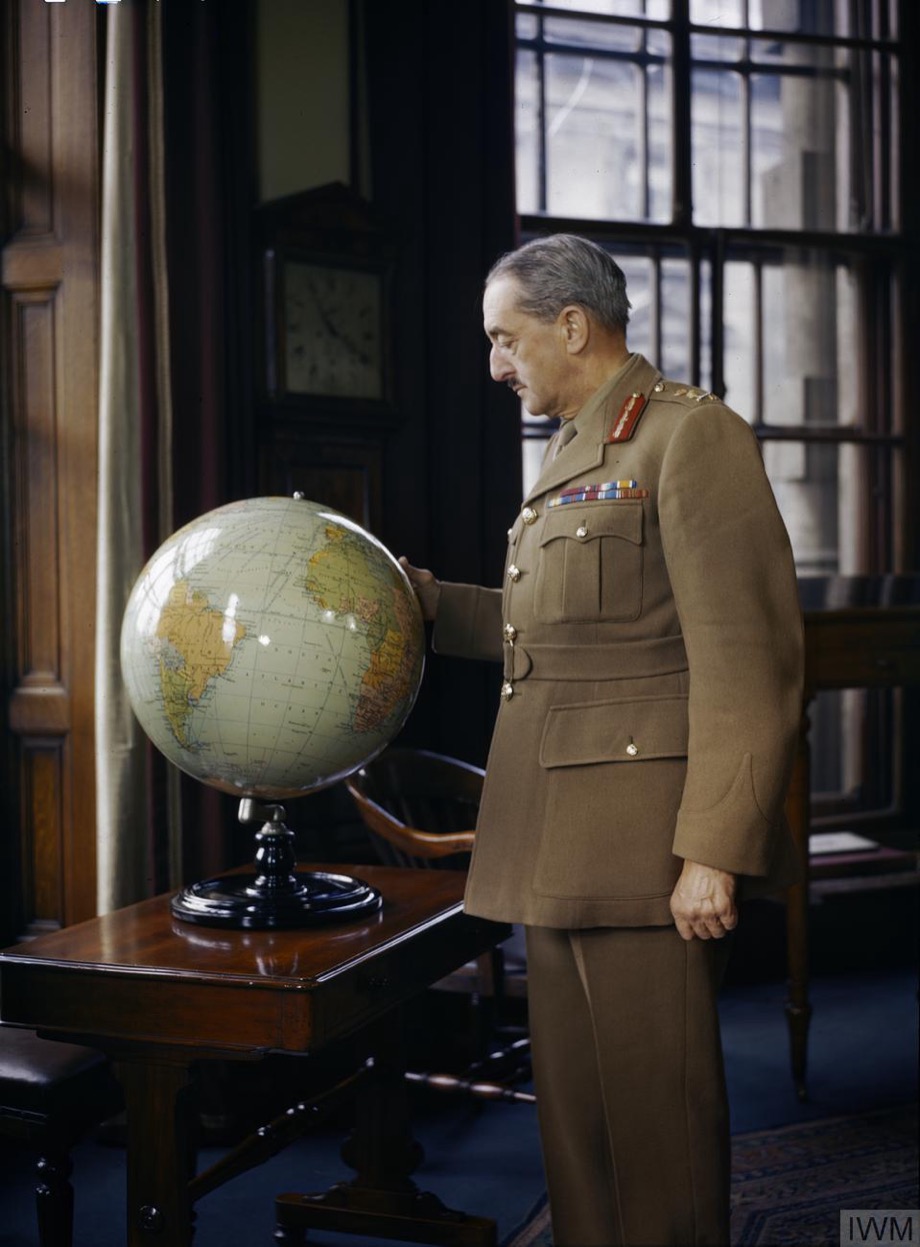
Portrait of Alan Brooke
The Man Who Said No, Every Day, for Four Years
Every night of the war, after the last conference had broken up and the Prime Minister had gone to bed still talking, a spare, clipped Anglo-Irish gunner sat down and wrote in a private diary what he had actually thought. He recorded the exhaustion, the wasted hours, the schemes he had spent an evening dismantling, the conviction — set down repeatedly and without softening — that the man he served was in some respects impossible to work with and in others irreplaceable. When the diaries were published in the 1950s, and far more completely in the 2001 unexpurgated edition, they caused a scandal precisely because nothing in Brooke's public conduct had ever leaked a word of it.
That gap between the private ledger and the public performance is the whole man. Alan Brooke became Chief of the Imperial General Staff in December 1941 and held the professional headship of the British Army for the rest of the war, chairing the Chiefs of Staff Committee and carrying British strategy into the Combined Chiefs of Staff with the Americans. His function in that job was not to have brilliant ideas. Churchill had those in surplus. Brooke's function was to be the fixed point against which they were tested — to know the shipping, the divisions, the training timetables, and to say, with total procedural calm and no visible temper, that Sumatra could not be invaded this year and Norway could not be invaded at all.
He is an ISTJ, and the war is one of history's cleanest demonstrations of why that type matters. Britain did not win because of the brake alone. It won because the brake was bolted to the engine.
An ISTJ built for exactly one role: dominant Si supplying the hard precedent and logistics that Churchill's imagination never carried with it.
The Gunner's Arithmetic
He came out of the artillery, which is the most mathematical branch of an army and the least romantic, and he helped pioneer the creeping barrage in the First World War — a technique that is pure Si in weaponised form: not inspiration, but the ruthless synchronisation of known quantities, shells falling a measured distance ahead of the infantry at a measured rate, worked out on paper beforehand and executed to the second. A man who has spent his youth timing barrages does not later mistake enthusiasm for capability.
In 1940 he commanded II Corps in the retreat to Dunkirk, and the record of that withdrawal is the record of a man managing a collapse by holding onto verified facts while everyone around him lost them: the positions actually held, the units actually in place, the road capacity actually available. He got his corps to the beaches. Then, sent back to France days later to salvage what remained, he told Churchill on the telephone — bluntly, at length, and against the Prime Minister's wishes — that there was nothing left to salvage and the remaining British troops should be evacuated. He was right, and the argument was won on facts.
As CIGS he institutionalised that habit. His authority in the Chiefs of Staff Committee rested on being the man in the room who had the numbers and the precedents — what a previous operation of this shape had actually cost, what landing craft existed, how long a division took to become fit to fight. Against Churchill's Ne, which experienced the world as an open field of options, Si supplied the closed set of things that were true.
Running the Machine
Brooke did not merely resist bad plans; he built the apparatus through which plans got made. The Chiefs of Staff Committee under his chairmanship became a genuine decision engine rather than a talking shop, and it was his handling of the Combined Chiefs of Staff — the Anglo-American body where British and US strategy had to be reconciled — that turned a coalition of two proud staffs into a single planning system. That is auxiliary Te at its most consequential: not brilliance, but the construction of process that produces good outcomes even on bad days.
His method with Churchill was equally organisational. He rarely refused a scheme outright in the moment. He absorbed it, staffed it, had the objections worked up in detail, and returned with a case that could not be talked around — and, where possible, with an alternative already prepared, so that the Prime Minister's energy had somewhere legitimate to go. The Mediterranean strategy the British pressed on the Americans owed much to that technique: Churchill's appetite for peripheral action, filtered into something the shipping tables could actually support.
It also made him formidable with allies. Against George Marshall's pressure for an early cross-Channel invasion, Brooke argued from readiness rather than ideology, and delayed until the arithmetic supported it. He paid for it personally: the price of British deference to the larger American contribution was that command of that invasion went elsewhere, and Churchill, who had twice promised him the post, had to take it back. Brooke recorded the blow in the diary and went back to work the next morning.
The Diary as Private Conscience
The diaries are the most revealing ISTJ artifact in the archive. They are not memoir and were not written for publication; they are a nightly discipline, kept without fail through four years of overwork, in which a man who permitted himself no public complaint deposited everything he could not say. The grievance is intense and the loyalty is absolute, and they sit on the same page without contradiction — which is exactly how tertiary Fi behaves. The values are private, deeply felt, and never bargained over in public.
Two personal facts colour the whole record. He had lost his first wife in a car accident he was driving, and he never wrote about it easily; and he escaped the war, nightly, into ornithology and bird photography, a hobby of patient observation that reads like the purest possible relief from Churchill. Those are the outlets of a man with no conversational route to his own interior. The diary belongs to the same family: a ledger of duty and feeling kept in the only place he trusted with it.
Their publication in the 1950s was therefore misread as disloyalty. It was closer to the opposite — the proof that a man had thought all of that, and had still turned up every morning and made the system work. Churchill was wounded by it, and the wound was real, but the honest reader comes away with a higher opinion of both men, not a lower one.
Working Beside His Own Weak Point
It is a strange arrangement of fate that put a man with inferior Ne in daily contact with the most Ne-dominant statesman of the century. Brooke could not generate possibilities at that speed and did not want to; what he experienced in the presence of Churchill's improvisation was the characteristic inferior-function response — not curiosity but dread, the sense of a world being made unstable faster than it could be secured.
The cost shows in the diaries as something close to catastrophising: the war repeatedly described as on the point of ruin, the Prime Minister as a danger to the whole enterprise, the future as a series of impending disasters. Read against the outcome, the pessimism is overdone. Read as inferior Ne under permanent strain, it is exactly what one would predict — a mind excellent at the known and correspondingly frightened by the unconstrained.
What redeems it is that he never let the fear become obstruction. He kept saying no to the specific plan while continuing to serve the man producing them, and he was capable of being persuaded when the case was made. That, and not the pessimism, is why the pairing worked.
Why ISTJ Over ISTP
Why not ISTP?
The reserved, technically expert soldier invites an ISTP reading, and the artillery background encourages it. But an ISTP is a tactical improviser — the man who solves the problem in front of him, elegantly, with whatever is to hand. Brooke's entire value was the opposite: institutional and procedural. He did not fix situations personally; he built and ran the machinery — the Chiefs of Staff Committee, the British half of the Combined Chiefs — through which situations were handled by other people according to a process. And the diaries settle it: a nightly written discipline sustained for four years, grounded in precedent and duty, is Si-Te bookkeeping, not Ti-Se improvisation.
The distinction is worth insisting on because it explains why he, and not a more gifted field commander, was the right man for the job. The CIGS post did not need a genius of the battlefield. It needed someone who could hold an entire war's worth of committed resources in mind, refuse the plans that did not fit, and keep doing it for four years without breaking or resigning. That is an ISTJ's work, and almost nobody else's.
Connected Figures
Further Reading
- War Diaries 1939–1945 — Field Marshal Lord Alanbrooke, ed. Alex Danchev & Daniel TodmanThe 2001 unexpurgated edition — the primary source, and the best inside account of Churchill as a working colleague.
- Alanbrooke — David FraserThe standard biography, written by a soldier and strong on the artillery years and the mechanics of the CIGS post.
- Masters and Commanders — Andrew RobertsChurchill, Roosevelt, Brooke and Marshall as a four-way argument — the clearest account of how Allied strategy was actually settled.
