 Historical Figure MBTI
#903 · 7-2-26 · The Second World War
Randolph Churchill
Journalist · Soldier · The Son Who Could Not Eclipse the Father
1911 — 1968
4 min read
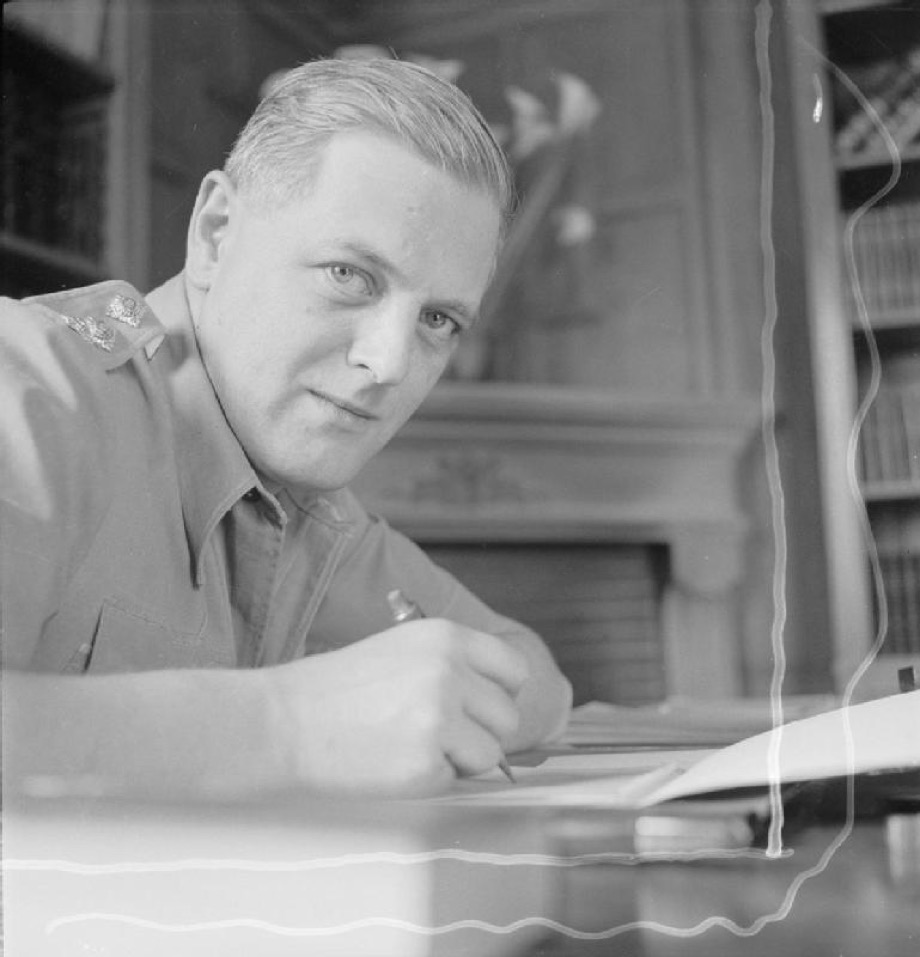
Portrait of Randolph Churchill
A Live Wire Looking for a Stage Big Enough
Every son of a great man inherits a comparison he never asked for, and few carried theirs as visibly, or as combustibly, as Randolph Churchill. He had his father's appetite for action and his father's gift for language, but not his father's patience, and certainly not his judgment about when to hold his tongue. He ran for Parliament repeatedly and lost more than he won. He drank heavily, brawled with journalists in print and occasionally in person, and burned through friendships with the same restless speed he burned through everything else. And yet he was also the man who, at thirty-three, parachuted into occupied Yugoslavia as a British liaison officer to Tito's partisans — a mission that demanded exactly the nerve and physical appetite for risk that defined him.
Randolph never found a stage as large as his father's, and it was not for lack of trying. He covered wars as a correspondent, served with the commandos, and later began what became the official multi-volume biography of Winston Churchill, a project so vast he did not live to finish it. What united all of it — the journalism, the soldiering, the parachute drop, the parliamentary campaigns, the drink, the fights — was a temperament built for immediate, physical, high-stakes engagement with the world in front of him, not for patient institution-building.
Randolph Churchill was an ESTP, and his dominant Se is the reason he kept leaping toward danger long after safer men would have stopped.
The Parachute Into Yugoslavia
Se is the appetite for immediate, sensory, high-stakes experience — the pull toward the thing happening right now rather than the thing being planned for later. Randolph's career is a catalogue of Se in action: the war correspondence filed from the front rather than the desk; the commando training; and, most vividly, the 1944 parachute drop into German-occupied Yugoslavia to serve as liaison to Josip Broz Tito's partisans, a mission that put him in genuine physical danger for months at a stretch with no guarantee of extraction. He did not merely tolerate this kind of risk — he sought it out, repeatedly, across three decades, in a way that a more cautious or theory-minded man never would have.
The same restless physicality showed up destructively in his personal life. His drinking, his brawling, his inability to sit still in a marriage or a career for long — all of it reads as Se unmoored from any steadying counterweight, an appetite for stimulation that never learned to discriminate between the battlefield and the dinner party.
A Debater Who Could Not Stop Cutting
Ti builds internal logical structures and tests everything against them, and it made Randolph a formidable journalist and debater — sharp, precise, capable of dismantling an opponent's argument in print with real skill. It is also what made him nearly impossible to work with. He applied the same cutting logical scrutiny to colleagues, editors, and friends that he applied to political opponents, and he rarely paused to consider the emotional cost. His combativeness was not random aggression; it was Ti wielded as a weapon, precise and often devastating, but deployed without the Fe-tact that might have preserved the relationships his career depended on.
That same rigor served him well as a biographer. The Churchill biography he began — later completed by Martin Gilbert after Randolph's death in 1968 — demanded exactly the kind of structural, source-testing logical discipline Ti provides, even if he did not live to see the project through to its conclusion.
Why ESTP Over ISTP
Why not ISTP?
An ISTP applies its Ti-Se pairing quietly, working things out alone before acting and generally avoiding the spotlight. Randolph did the opposite: he was combative in public forums, sought out journalism and politics as stages rather than avoiding them, and was constitutionally incapable of keeping an opinion to himself. That extraverted appetite for confrontation and visibility — Se leading, not Ti leading — is what places him as ESTP rather than the quieter, more introverted ISTP.
He needed an audience for his combativeness the way an ISTP never would, and it is exactly that need — for the room, the front page, the stage — that his father dominated so completely and that Randolph could never quite claim for himself.
Connected Figures
Further Reading
- Churchill: A Life — Martin GilbertCovers Randolph extensively; Gilbert completed the official biography Randolph began.
- His Father's Son: The Life of Randolph Churchill — Winston S. Churchill (grandson)A family biography written by Randolph's own son.
