 Historical Figure MBTI
#932 · 7-8-26 · The Second World War
Jean Moulin
Resistance Leader · The Man Who Unified France in Secret
1899 — 1943
8 min read
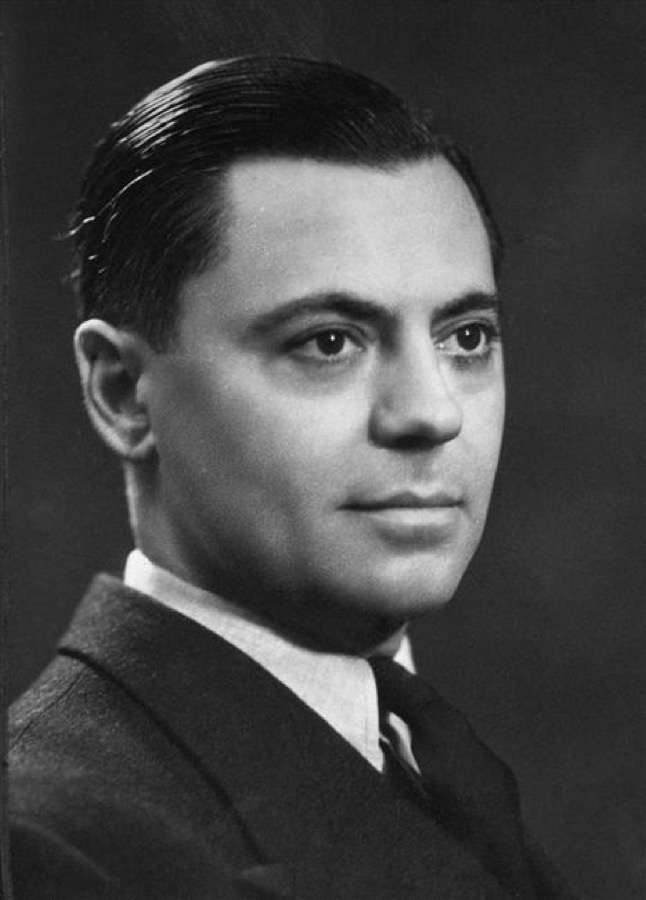
Jean Moulin, Studio Harcourt, 1937 (RMN, public domain)
The Scarf
In every photograph that matters, Jean Moulin is wearing a scarf. It is the most famous item of clothing in modern French history, and it is there to hide a scar. In June 1940, as prefect of Eure-et-Loir, he was ordered by German officers to sign a document blaming the massacre of civilians at La Taye on Senegalese troops of the French army. He refused. He was beaten and locked up for the night, and, afraid he would break before morning, cut his own throat with a shard of broken glass. He was found in time. Vichy dismissed him from the prefectoral corps that November for insufficient enthusiasm. He was forty-one, and had just established in a cell the exact limit of what could be taken from him.
Nothing else about him looked like a martyr. He was a career civil servant — the youngest sub-prefect in France, then the youngest prefect, a man of files and municipal budgets, with a private life of art dealing and cartoons published under a pseudonym. That ordinariness turned out to be the qualification. The French Resistance of 1941 was not an army but a quarrel: a scatter of movements — Combat, Libération-Sud, Franc-Tireur, the communist Front National with its own discipline and its own loyalty to Moscow — that duplicated each other's work, competed for scarce money and weapons, and in several cases regarded one another as the postwar enemy.
Moulin reached London in the autumn of 1941, met Charles de Gaulle, and was parachuted back into France on New Year's Day 1942 with an impossible brief: make these people one thing, answerable to a general none of them had elected. In seventeen months he did it. Six weeks later the Gestapo had him.
Moulin is the INFJ in its rarest working form: a dominant Ni certainty about what unity required, executed through patient, personal Fe diplomacy among people who trusted nobody — including him.
One France, or None — Ni
The report Moulin carried to London in 1941 was not a plea for arms. It was an analysis: the internal Resistance was real and growing, and would be worthless — militarily and politically — unless it became a single body with a single line of authority. He had worked this out largely alone, a dismissed prefect moving quietly around the southern zone with no organization behind him, and he held it with the totality that marks dominant intuition. Unity was not one option among several; it was the whole content of the task.
He saw further than the men he was persuading. The movement leaders wanted weapons, money and autonomy; Moulin understood that what was actually at stake was the shape of France after the liberation — that a Resistance arriving at the peace as a dozen armed factions would produce a civil war or an Allied military government, and that only one which had already declared for de Gaulle could hand the Republic back intact.
That certainty gave him an unusual tolerance for being disliked. He could absorb an enormous amount of friction — Henri Frenay of Combat accusing him of building a bureaucratic empire, the communists suspecting a Gaullist trap, everyone resenting that the man distributing London's money and radios was a civil servant who had never fired a shot. Ni does not require agreement to keep working. It requires only that the picture stay clear.
Diplomacy Underground — Fe
The achievement was social, not military. Living under false papers, moving between safe flats in Lyon and Marseille, holding meetings that could not last an hour and could not be minuted, Moulin talked the movements into merger. He began with what everyone wanted — a shared clandestine press, a shared air and sea operations service, a single Secret Army — and used control of London's funds not as a bludgeon but as a reason to keep coming back to the table. By January 1943 the three big southern movements had folded into the Mouvements Unis de la Résistance. That alone had been thought impossible.
Then came the step that required an extraordinary read of other people. On 27 May 1943, in an apartment on the rue du Four in Paris, sixteen men sat down at a table: delegates of eight Resistance movements, six political parties of the dissolved Third Republic including the socialists and the communists, and the two trade-union confederations. Men who had spent the 1930s denouncing each other, and in some cases fully intended to resume, agreed to constitute the Conseil National de la Résistance and to recognize de Gaulle. Moulin chaired it. The meeting lasted a few hours and settled the political future of France.
Auxiliary Fe is what makes that possible: attention to what each person in the room needs in order to say yes, and a willingness to give it — status here, autonomy there, a formula of words that lets a communist and a conservative sign the same page. He was courteous, unhurried and enormously patient with people he found tiresome. He was also, by every account, hard to know. Fe does the work outward; the man stayed behind the scarf.
The Architecture of a Secret — Ti
Unity was a vision; the CNR was a structure, and structures have to be designed. Moulin brought a prefect's precision to it: a Bureau d'Information et de Presse to run the underground papers, a Comité Général d'Études drafting the laws of a liberated Republic before there was one, a Service des Opérations Aériennes et Maritimes for drops and pickups, an accounting system for London's subsidies, and a chain of command separating military action from political representation. He argued constantly with Frenay over exactly that separation, because a Secret Army under movement control would have made the political body ornamental.
Tertiary Ti also shows in his tradecraft. Multiple identities — Rex, Max, Régis — compartmented contacts, meetings through cut-outs, an insistence on rules the movement leaders found fussy and frequently ignored. The Caluire disaster of 21 June 1943 happened in part because others broke them: too many senior people summoned to one doctor's house outside Lyon, a compromised intermediary, and the Gestapo waiting.
The Body That Held — Se
Everything Moulin did happened in the physical world at maximum risk — parachute drops, forged papers, night trains, the low-grade terror of a checkpoint — and none of it was where he was comfortable. He was a desk man and an aesthete running a clandestine life, and the strain shows in the cover he chose: an art gallery in Nice, opened in 1943, which let him be a dealer with reasons to travel. Inferior Se does not relish danger; it endures it because something else demands it.
Then came the last test, and it was purely physical. Arrested at Caluire, he was taken to Klaus Barbie's Gestapo at Lyon and tortured for days. He gave nothing: not a name, not a safe house, not the structure he had spent seventeen months building — the single most valuable body of information in occupied France, and one he carried entirely in his own head. He was moved to Paris and put on a train toward Germany, and died on or about 8 July 1943, almost certainly of the injuries. The scar under the scarf had been a promise made in 1940. He kept it.
Why INFJ Over INFP
Why not INFP?
The INFP case rests on the throat-cutting: a man who would rather die than sign a lie looks like Fi in its purest form. And Moulin was reserved, artistic, secretive even with colleagues. But the seventeen months that made him historically important were not an act of private integrity — they were relentlessly external. He brokered, chaired, merged, allocated, drafted charters and forced rivals into one room and one signature; the object was not a clean conscience but a functioning body built out of people who despised each other. INFPs hold the ideal; Moulin fabricated the institution that carried it. That is Fe serving Ni, not Fi serving Ne.
The two readings converge only in the cellars at Lyon, where the difference between private conviction and public construction stops mattering. But the reason there is a Jean Moulin in the archive at all is the rue du Four, not the broken glass: the CNR gave de Gaulle a mandate from inside France, and gave France a way to be liberated as a state rather than administered as a territory.
Connected Figures
Further Reading
- The Death of Jean Moulin: Biography of a Ghost — Patrick MarnhamA biography built around the unanswered questions of Caluire and the man's compartmented life.
- France: The Dark Years 1940–1944 — Julian JacksonThe essential context — how fractured the Resistance was before Moulin, and what unification actually bought.
- The French Resistance — Olivier WieviorkaA scholarly synthesis of the movements, their rivalries and the founding of the CNR.
- De Gaulle — Julian JacksonFor the London end of the relationship, and why the CNR mattered so much to Free French legitimacy.
