 Historical Figure MBTI
#933 · 7-9-26 · The Second World War
Hugh Dowding
Air Chief Marshal · Architect of Fighter Command
1882 — 1970
8 min read
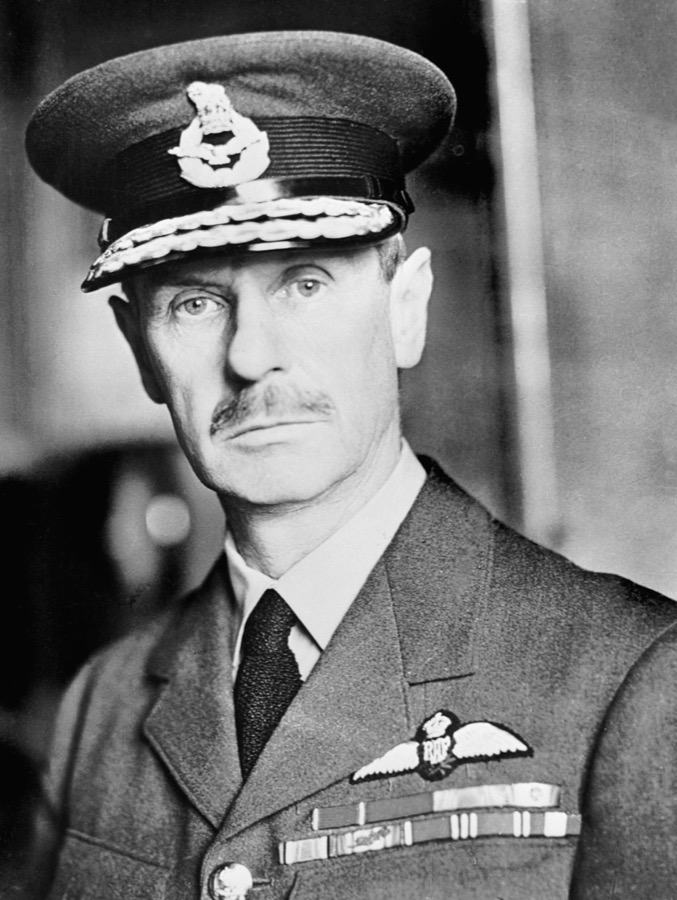
Photograph of Hugh Dowding, circa 1935 (Imperial War Museums, public domain)
The Man Who Built the Machine
He was called “Stuffy,” and the nickname was not affectionate. Hugh Dowding did not drink with his officers, tell stories in the mess, or cultivate the press. He was thin, austere, humourless in company, and content to be all three. In an air force that prized dash — the fighter pilot as duellist, the squadron as a cavalry troop with engines — he was the man in the corner drawing wiring diagrams. That is precisely why Britain survived 1940.
Everyone in the 1930s knew the bomber was coming; Baldwin had said aloud what the staff colleges believed, that it would always get through. Dowding’s answer was stranger than anyone else’s. He looked at a cluster of unrelated novelties — an experimental radio-ranging apparatus, civilian volunteers with binoculars, telephone lines, plotting tables, the new eight-gun monoplane fighters — and saw a single object that did not yet exist: a national nervous system that could detect a formation over the Channel and put the right squadron in the right patch of sky before it arrived. From 1936, as Air Officer Commanding-in-Chief of the new Fighter Command, he spent four years building it, over colleagues who thought the answer lay in aircraft rather than architecture.
In the summer of 1940 the thing he had imagined was switched on against the largest air force in the world, and it worked. Within weeks he was removed from his post. Both halves of that sentence describe the same man.
Dowding is the archetype of INTJ dominant Ni: a single long-range vision of a war not yet fought, held for years against institutional scepticism, then executed with Te machinery so cold it cost him his career the moment the emergency ended.
The War He Had Already Fought
Dowding had flown in the first war and came out of it with a conviction that set him apart from his generation: the next air war would be won by science, not by aces. From the Air Council seat responsible for supply and research he backed the unfashionable and unproven — the metal monoplane, the bullet-proof windscreen, and above all Robert Watson-Watt’s experiments in detecting aircraft by radio echo, funded while much of the service still called it a laboratory curiosity. These were not separate enthusiasms. They were components of a picture already assembled in his head.
That picture was the Dowding System, and its genius is that it is not about aeroplanes at all. Coastal radar reported bearings and strength; the Observer Corps took over tracking once formations crossed the coast; both fed by dedicated landline into the Filter Room at Bentley Priory, where contradictory reports were reconciled into one trusted picture of the air, and that picture went out simultaneously to Group and Sector operations rooms, where controllers vectored squadrons onto targets they could not yet see. It was the world’s first integrated air-defence network — a real-time command loop years before anyone else grasped that such a thing was the decisive weapon. The Germans had more fighters; they had nothing remotely like this. Radar was a fragile trick in 1935 and the system it served was complete and rehearsed by 1939 — built for a battle whose shape he had visualised before France fell, and before anyone could tell him he was right.
The Word No
In May 1940 the French front collapsed and the demands began. Hurricane squadrons were fed across the Channel into a battle already lost, and the French government, backed by Churchill’s instinct for the gesture, asked for more. Dowding did the arithmetic and refused. He went to the Cabinet on 15 May, laid a graph of Hurricane losses on the table, and said that at the present rate of wastage not a single Hurricane would be left in France or in Britain within a fortnight — then followed it with a letter naming the irreducible minimum number of squadrons for the defence of the island, and asking that the matter be settled now, because deferred until the fighters were gone there would be nothing left to decide.
It was insubordination-by-memorandum against a Prime Minister at the height of his authority, and it was correct. The flow was halted; the squadrons he held back were the margin by which Fighter Command survived August. This is Te in its least likeable form — the willingness to convert a conviction into a number, put the number in front of the people who outrank you, and accept what follows.
He fought the battle itself the same way, as husbandry rather than heroism. Spent squadrons were rotated out of 11 Group; pilots, not aircraft, were named early as the binding constraint; fighters went up in the smallest number that would break a raid, never in the glorious formations that burn a reserve for a headline. Fighter Command did not need to destroy the Luftwaffe. It needed to still exist in September.
“My Fighter Boys”
The cold administrator had a second self almost nobody at the Air Ministry saw. He called the pilots of Fighter Command his chicks, and the phrase, faintly ridiculous from a man of fifty-eight, was meant exactly. He had lost a wife young and raised a son who became one of his own fighter pilots, and fought a long, unglamorous campaign for armoured windscreens on the grounds that a pilot’s life was worth the weight. Tertiary Fi rarely looks like warmth. It looks like a private standard a man will not negotiate over and will not explain.
He never grasped that a conviction, however right, does not defend itself. He assumed the record would speak, and built no faction. The same inwardness runs through his later life: retired, uncelebrated and grieving, he turned to spiritualism and wrote books about contacting the airmen who had not come back — the same unbending private feeling that made him refuse Churchill, from a man who had decided alone what he owed his pilots and went on paying after the war stopped caring.
The Room He Could Not Read
Dowding won the battle and lost the argument. Through the autumn of 1940 a quarrel grew inside his own command over the Big Wing — the proposal, pushed from 12 Group by Trafford Leigh-Mallory and by Douglas Bader, that fighters be massed before engaging rather than sent up squadron by squadron as Keith Park was doing in 11 Group. The case against it was strong: assembling a wing took time the warning margin did not have, and its kill claims were wildly inflated. Dowding knew all this, and did nothing about the politics of it.
That is inferior Se — the blind spot for the immediate, atmospheric present. He could not feel a meeting turning, or notice that a dispute about formation size had become a proxy for a bid to replace him. On 17 October he sat through a conference at which a squadron leader was invited to explain tactics to his Commander-in-Chief, and failed to see it for the ambush it was. In November, the daylight battle won, he was told to relinquish Fighter Command. Park went too. The structure that let him build an invisible system left him without an ally in the room where its architect was disposed of: he spent four years making sure Britain would see the enemy coming, and never saw his own.
Why INTJ Over INTP
Why not INTP?
The INTP reading is tempting: the technical mind, the scientific enthusiasms, the social awkwardness, the indifference to glamour. But Ti-Ne would have kept the problem open — refining models, entertaining alternatives, resisting closure. Dowding closed. He fixed on one architecture years in advance and spent four years turning it into concrete, cable, rostered crews and rehearsed procedure: Te building, not Ti analysing. And at the decisive moment he did not weigh the case for reinforcing France on its merits — he produced a graph, named a number of squadrons, and refused a Prime Minister. That is auxiliary Te executing a fixed Ni vision under fire, not an analyst declining to commit.
The distinction explains both the victory and the sacking. An analyst threatens no one and can be tolerated indefinitely. Dowding bent an entire command permanently into the shape of his conclusion, with a bluntness that made enemies at every level above him. The Ni gave him the answer before the question was asked; the Te made the answer real and made him expendable. Strip out the Te and you have a clever officer with an interesting memorandum about radar — not the Dowding System, and probably not Britain in September 1940.
Connected Figures
Further Reading
- Dowding of Fighter Command — Vincent OrangeThe standard modern biography; strongest on the 1936–40 construction of the system and the politics of the sacking.
- The Battle of Britain: Dowding and the First Victory, 1940 — John RayA close study of the command dispute, the Big Wing controversy, and how the victor came to be removed.
- The Narrow Margin — Derek Wood and Derek DempsterThe classic operational account of the battle, and the best plain description of how the Dowding System actually worked.
- The Most Dangerous Enemy: A History of the Battle of Britain — Stephen BungayReframes 1940 as a contest between two command systems rather than two air forces.
- The Battle of Britain — James HollandWide-angle narrative that sets Fighter Command's warning network against German intelligence failures.
