 Historical Figure MBTI
#935 · 7-9-26 · The Second World War
Douglas Bader
Fighter Pilot · The Legless Ace
1910 — 1982
8 min read
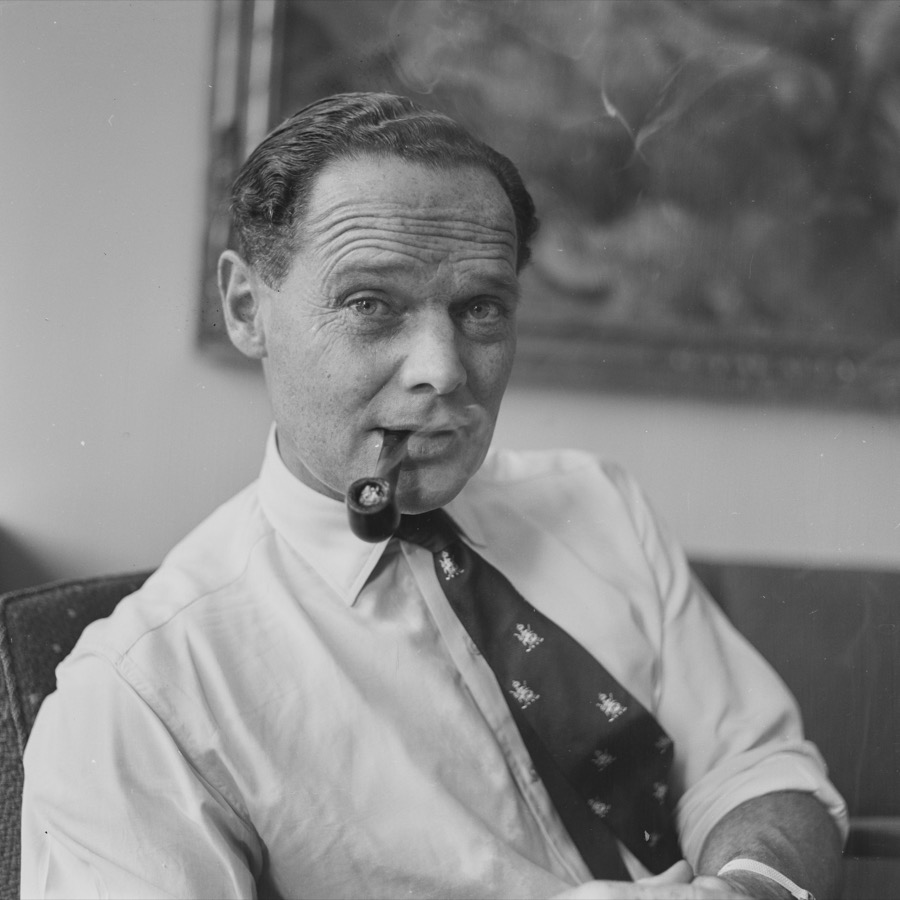
Photograph of Douglas Bader, 1955, by Ragge Strand (National Archives of Norway, CC BY 4.0)
The Man Who Refused the Verdict
In December 1931, showing off at low level over a Berkshire airfield, a twenty-one-year-old RAF pilot officer caught a wingtip on the grass and turned his Bristol Bulldog into wreckage. He wrote one line in his logbook afterwards: crashed slow-rolling near ground, bad show. He lost both legs — one above the knee, one below — and with them, by every rule the service had, his career. The RAF retired him as unfit for further duty.
What followed is why anyone remembers Douglas Bader. He learned to walk on tin legs without a stick, because a stick was an admission; learned to drive; played golf badly and then well; and pestered the Air Ministry relentlessly to be let back into a cockpit. In 1939, with a war on and pilots scarce, the door cracked open. He passed the medical by insistence, flew perfectly well — better than most, since a man with no legs does not black out from g-force as quickly as a man with blood to lose to them — and by the summer of 1940 was leading a squadron in the Battle of Britain. Within a year he was a wing leader and one of the most conspicuous aces in the RAF.
He was also loud, abrasive, contemptuous of caution, and convinced past argument that he understood how the battle should be fought better than the men running it. The same engine drove both halves.
Bader is ESTP with the volume fixed at maximum: dominant Se as raw physical will and appetite for contact, Ti sharpening it into a tactical doctrine, and no capacity whatever for the patience that doctrine required of everyone else.
Tin Legs and Sheer Body
Before the crash Bader was a boxer, a rugby player spoken of for England, and a cadet who flew as though the aircraft were an extension of his nervous system: Se in its untroubled form, the world met directly, through the body, at speed. The crash changed the terrain, not the method. He applied the same instrument — physical will against immediate physical resistance — to a pair of artificial limbs, refusing crutches, refusing a wheelchair, refusing the vocabulary of disability entirely, and hurting himself considerably in the process.
In the air it paid a dividend nobody had predicted. He flew close and aggressively, boring in to the short range where eight Brownings actually told, and tolerated violent manoeuvre better than his colleagues because he had fewer places for the blood to go. The same appetite explains his impatience with anything not happening now: sitting at readiness while plots were filtered and a controller decided where to send him felt like a waste of daylight. The most sophisticated command system in the world was, from inside his cockpit, an apparatus for making him wait.
The Doctrine of the Big Wing
Bader was not a thoughtless brawler, and the Big Wing was not a whim. He took the old dictum that height, sun and numbers decide a fighter combat and built from it a clean internal argument: if four or five squadrons could be assembled into one formation before contact, a raid could be met by overwhelming force instead of picked at by small units in turn. The logic is genuinely elegant. That is Ti — a private, self-consistent model held with real conviction and tested against his own experience of the moment of contact.
Its flaw was the thing his stack was worst at seeing: time. Forming a wing over Duxford took twenty minutes, and the warning margin from radar to interception over Kent was often less. What worked for 12 Group, with the luxury of distance, would have been ruinous for 11 Group, whose airfields were under the bombs; and the wings’ kill claims proved, against German records, inflated several times over. Bader conceded none of it — that men senior to him disagreed said something about them rather than the argument. Ti in an ESTP does not deliberate. It settles, fast, and then defends: the same faculty that told him in 1932 the medical board was wrong about his legs, where he happened to be right.
A Following, Not a Circle
Bader could galvanise a room in a way Fighter Command’s senior officers conspicuously could not. He took over 242 Squadron in June 1940 — a Canadian unit wrecked by the French campaign — and had it flying and believing inside a fortnight, by force of presence and by fighting the Air Ministry loudly over its spares. That is tertiary Fe at its best: broadcasting confidence, welding a group around a personality. Later it made him formidable in another register — walking into hospital wards on tin legs, better than any pamphlet at telling a newly maimed man his life was not over, an argument he made with his body rather than his voice.
What Fe in this position does not do is read the room upward. He was rude to superiors by habit and told his commanders they were wrong in terms that left no bridge behind him; at an Air Ministry conference in October 1940 he was invited, as a squadron leader, to lecture on tactics in front of an air chief marshal — an invitation whose real purpose he seems never to have examined. He was used as a weapon by Leigh-Mallory and others against Hugh Dowding and Keith Park, and he supplied the ammunition gladly, because from where he sat it was not politics at all. It was just the truth about tactics, said out loud.
Colditz, and the Long View He Never Took
In August 1941, leading the Tangmere Wing over occupied France, Bader came down near Le Touquet, losing an artificial leg as he escaped the cockpit, and fell into German hands. His war in the air had lasted barely fifteen months. The Luftwaffe, delighted with the prize, allowed a replacement leg to be delivered; he answered by climbing out of a hospital window on knotted sheets. He escaped, or tried to, repeatedly, until his captors confiscated his legs at night and shipped him to Colditz as incorrigible.
All of that is Se at full extension inside a prison. What it is not is foresight. Inferior Ni shows in the shape of the whole career: a man superb at the next thirty seconds and blind to the next thirty months. The 1931 crash was a low-level roll performed for an audience. The Big Wing was optimised for the engagement and indifferent to the campaign. The push against Dowding and Park was pressed with no thought for what would happen to Fighter Command if he won — which he did, at the cost of the two commanders who had just saved the country.
His memory of 1940 hardened rather than softened: he defended the Big Wing to the end and was scathing about Park’s method decades after the argument had been settled against him. Inferior Ni rarely arrives as reflection. It arrives as a conviction that sets into a story about oneself and stops moving.
Why ESTP Over ESTJ
Why not ESTJ?
The ESTJ case rests on the surface: a loud, commanding officer with strong opinions about how things ought to be done. But ESTJ Te is institutional — it defers to the chain of command and works the system from inside. Bader did the opposite. He spent 1940 pushing his own tactical preference upward against his superiors’ stated doctrine, allied himself with a rival Group commander against his own Commander-in-Chief, and treated a Fighter Command directive as an opinion he could overrule because his experience of combat said otherwise. That is Se-Ti combativeness answering to immediate reality and a private model, not Te answering to structure.
The deeper tell is the crash. An ESTJ told by a medical board that he is unfit to fly accepts a verdict the institution is entitled to make, and finds another way to serve. Bader treated the ruling as a physical obstacle rather than an authority — something to be worn down by walking, by argument, by turning up. Every distinctive thing he did, from the tin legs to the Big Wing to the fifth escape attempt, follows that pattern: an obstacle met head-on by a man constitutionally unable to believe that any rule outranked what he could do with his own body.
Connected Figures
Further Reading
- Reach for the Sky — Paul BrickhillThe classic 1954 biography that made the legend; admiring, close to its subject, and the source of the popular image.
- Bader's War — S. P. MackenzieA sceptical modern reassessment of the Big Wing claims and Bader's role in the command crisis of 1940.
- Fight for the Sky: The Story of the Spitfire and Hurricane — Douglas BaderBader in his own voice, still defending the tactics thirty years on.
- The Battle of Britain: Dowding and the First Victory, 1940 — John RaySets the Big Wing quarrel in the wider politics that cost Fighter Command its commanders.
- The Most Dangerous Enemy: A History of the Battle of Britain — Stephen BungayWeighs the tactical argument against the operational record and finds against the wings.
