 Historical Figure MBTI
#936 · 7-9-26 · The Second World War
R. J. Mitchell
Aircraft Designer · Father of the Spitfire
1895 — 1937
4 min read
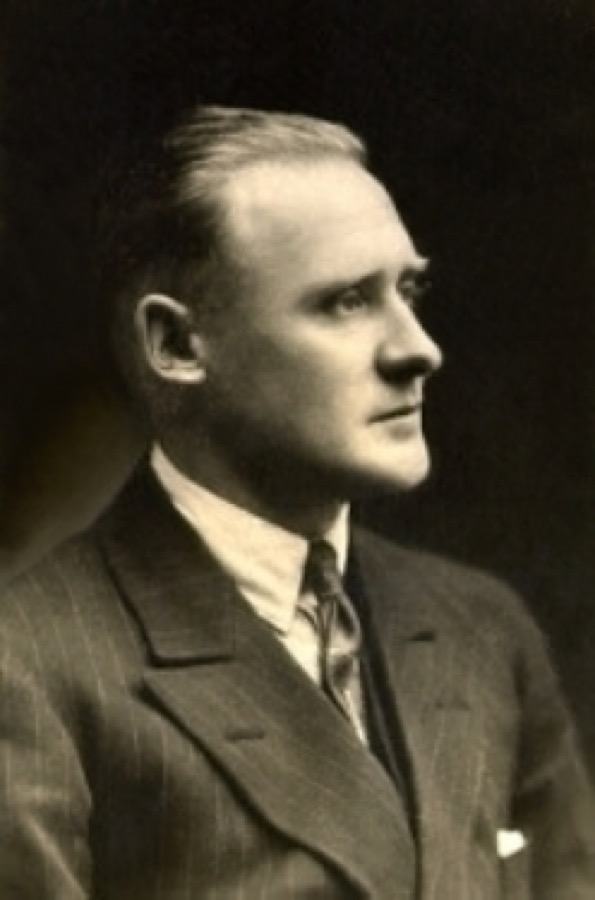
Photograph of R. J. Mitchell (public domain)
The Elegant Answer, Refined Until It Was Right
R. J. Mitchell never saw his most famous design fight. He designed the Supermarine Spitfire — first flown in 1936 — and died of cancer the following year, three years before it would help decide the Battle of Britain over the coast his aircraft had been built to defend. What he left behind was not a lucky guess but the endpoint of a decade-long argument he had been having with himself about what an airframe should be.
That argument ran through Supermarine's series of Schneider Trophy racing seaplanes in the late 1920s and early 1930s, each one pushing high-speed aerodynamics further than the last, until the lessons converged on the Spitfire's distinctive elliptical wing — a shape chosen for its theoretical aerodynamic efficiency even though it was markedly harder to manufacture than a simpler alternative would have been.
Mitchell was not chasing the fastest route to a working fighter. He was chasing the theoretically correct one, and the elliptical wing — elegant, efficient, expensive to build — is the signature of an INTP unwilling to trade Ti's internal standard for expedience.
The Theoretically Optimal Wing
Mitchell's defining trait as a designer was refusing to settle for "good enough" when he could work out what "correct" actually looked like. The elliptical wing is the clearest evidence: it minimized induced drag more effectively than the simpler tapered or rectangular wings other designers of the era favored, but it was a nightmare to tool and mass-produce. Mitchell chose it anyway, because his internal aerodynamic logic said it was the right answer, not because it was the easy one.
That is dominant Ti in its purest engineering form — a private, rigorously worked-out framework for what makes an airframe efficient, held to even when it made the designer's own life, and his factory's production line, harder.
From Racing Seaplane to Fighter Aircraft
Auxiliary Ne is what let Mitchell see the Spitfire inside a lineage of aircraft that, on paper, were built for an entirely different purpose. The Schneider Trophy racers were seaplanes, built purely to win speed records over water; Mitchell kept generating new possibilities from what each one taught him about high-speed airflow, until those possibilities pointed toward a fast, aerodynamically refined interceptor no one had commissioned yet.
He connected patterns across a decade of experimental designs rather than starting the Spitfire from a blank sheet — the auxiliary function supplying breadth of possibility that the dominant Ti then filtered down to one precise, defensible form.
Discipline Learned on the Factory Floor
Mitchell was self-taught, rising through Supermarine's design department rather than arriving with an elite engineering pedigree, and that grounding shows in tertiary Si: a respect for what had actually been built and flight-tested before, and a habit of refining known designs incrementally rather than leaping to untested concepts. Each Schneider racer improved concretely on the one before it; nothing was invented from nowhere.
A Design Meant to Serve, Not to Impress
Inferior Fe surfaces less in Mitchell's own words than in what the Spitfire quietly became: an aircraft designed, ultimately, to keep pilots alive and a country defended, not to make its designer's name. He worked in relative obscurity even as the aircraft he was racing to finish while ill would go on to carry enormous symbolic weight for people he would never meet.
Why INTP Over ISTP
Why not ISTP?
An ISTP designer would iterate through hands-on trial and error, testing variations directly against results until something worked. Mitchell's process ran the other way: theory-first and perfectionist, working out the aerodynamic principles behind each Schneider Trophy racer before committing to the next design, and arriving at the Spitfire's final form through successive refinement of a governing idea rather than trial-and-error tinkering.
The elliptical wing is the tell. An ISTP optimizing by feel would have gravitated toward whatever shape flew well and built easily; Mitchell held out for the shape his Ti reasoning said was aerodynamically correct, even at real manufacturing cost — Ti-Ne theory-building over Ti-Se hands-on iteration.
Connected Figures
Further Reading
- R.J. Mitchell: Schooldays to Spitfire — Gordon MitchellA personal account by Mitchell's son, drawing on family papers.
- Spitfire: The Illustrated Biography — Jonathan GlanceyTraces the Spitfire's design lineage back through Mitchell's Schneider Trophy racers.
