 Historical Figure MBTI
#937 · 7-10-26 · The Rise of Fascism
Benito Mussolini
Il Duce · Founder of Fascism
1883 — 1945
12 min read
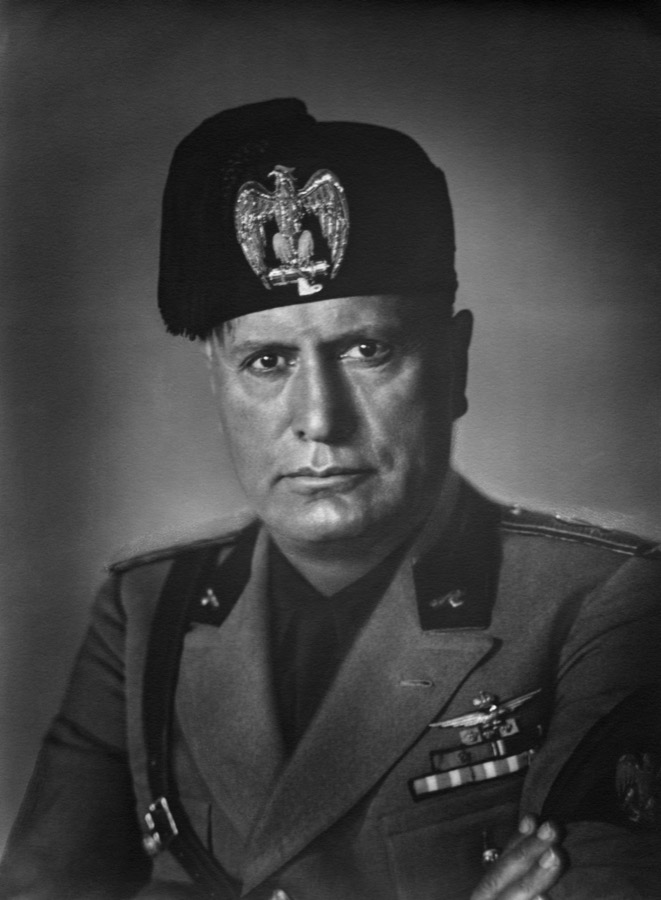
Portrait photograph, circa 1937-1940 (Keystone-France/Gamma-Keystone, public domain)
The Man Who Made Politics a Performance
Benito Mussolini founded Italian Fascism, seized power through the March on Rome in 1922, and built the first one-party totalitarian dictatorship in Europe. He suppressed political opposition through organized violence — the black-shirted squadristi who beat, tortured, and killed socialists, trade unionists, and priests across the Italian countryside — and in 1924 his regime murdered the opposition deputy Giacomo Matteotti, who had risen in parliament to accuse the Fascists of stealing an election by terror. In 1935 he invaded Ethiopia and had chemical weapons sprayed from aircraft onto villages, herds, and field hospitals. He allied Italy with Nazi Germany, enacted antisemitic racial laws in 1938 that stripped Italian Jews of their professions and citizenship rights, and in 1940 dragged an unprepared country into a war that destroyed it. In April 1945 he was caught by Italian partisans near Lake Como while trying to reach Switzerland in a German overcoat, shot, and hung by the heels in a Milan square.
None of this was the work of a systematic mind. That is the first thing to understand about him, and the last thing his own propaganda wanted anyone to notice. Mussolini began as a socialist journalist and street agitator, the editor of Avanti!, a man who had gone to prison for agitation and been expelled from the Socialist Party in 1914 for demanding Italian intervention in the World War. Five years later he invented Fascism — a movement whose program he rewrote whenever the room changed — and spent the next two decades governing by instinct, spectacle, and improvisation. The doctrine came afterward, ghostwritten in part by a philosopher, to explain what he had already done.
What he actually possessed was a physical genius for the present moment: an unerring feel for what a crowd in a square wanted to see, what a rival was about to do, where a weakness lay and how hard to hit it. He read the room, took the ground in front of him, and worried about the consequences when they arrived. It made him the most dangerous man in Italy for twenty years. It also meant that when the consequences finally arrived all at once, in North Africa and Greece and Sicily, he had nothing behind the performance to fall back on.
Mussolini is the archive's clearest case of ESTP power without limit — a dominant Se that treated politics as a physical contest to be won in the street, in the piazza, on the balcony, in the immediate moment, and never once as a structure to be built.
The Politics of the Body
Fascism's first political instrument was not an argument but a beating. From 1919 the squadristi — demobilized soldiers, students, farm overseers, thugs — travelled by truck into towns held by socialist councils and peasant leagues, burned the labor halls and cooperative offices, and forced castor oil down the throats of local organizers in front of their neighbors. The humiliation was the point, and it was designed to be watched. Mussolini did not invent political violence, but he was the first man in modern Europe to understand it as theater with a national audience, and to keep the trucks moving fast enough that the state never quite decided to stop them.
The March on Rome in October 1922 was the same instinct at the scale of a country. Militarily it was close to a bluff: tens of thousands of poorly armed Blackshirts converging on the capital in the rain, which the army garrison could have dispersed had the King signed the order for martial law. Mussolini himself waited in Milan, near the Swiss border, ready to run. Victor Emmanuel III blinked, and Mussolini arrived in Rome by overnight train — in a sleeping car, in a black shirt and spats — to be handed the premiership. He then spent twenty years insisting he had marched at the head of his legions. He had correctly read that the establishment wanted a reason not to fight, and he supplied one by simply standing there.
Once in power the body itself became the regime's message. He was photographed bare-chested threshing wheat in the harvest fields, fencing, riding, running with troops, swimming at Riccione, flying his own aircraft, standing on the balcony of the Palazzo Venezia with his jaw thrust forward and his fists on his hips. Journalists were forbidden to mention his birthdays or his stomach ulcer; the Duce was to have no age and no illness. This was not vanity in the ordinary sense. It was a governing theory — that authority is something you perform physically, in public, until the country believes it — and it worked on Italy for two decades and on a good many foreign observers besides.
The Argument for Whatever Is Needed
Mussolini was a formidably quick reasoner in the narrow, tactical way that auxiliary Ti allows: he could take any position and construct a case for it on the spot, and he could take the opposite position a year later and construct that case with equal force. He was a working journalist for most of his adult life, and he never lost the polemicist's habit of treating ideas as ammunition. In 1914 he was the revolutionary socialist who denounced the war as a capitalist crime; within months he had founded Il Popolo d'Italia and was denouncing the anti-interventionists as cowards. The logic in each case was clean. The premises had simply been swapped out.
The same faculty served him inside the machine of power, and there it was lethal. After Matteotti's murder in June 1924 — the deputy was abducted in Rome by Fascist thugs and his body found in a shallow grave two months later — the regime nearly fell. Mussolini disappeared from public view; the opposition walked out of parliament in protest and thereby walked out of the only arena where they could still have hurt him. On 3 January 1925 he came to the Chamber and, instead of denying responsibility, assumed it: he declared that if Fascism had been a criminal association, he was the chief of that association, and dared anyone present to act. It was a piece of nerve rather than a piece of doctrine, and it converted the scandal that should have ended him into the founding act of the dictatorship. Within a year the opposition parties were dissolved, the press licensed, and the secret police established.
What this thinking never did was build. Corporatism — the elaborate architecture of syndicates and corporations that was supposed to abolish class conflict and replace parliament — read impressively in pamphlets circulated abroad, and delivered almost nothing in Italy but jobs for loyalists. Mussolini could design a system on paper in an afternoon and lose interest in it by the following week, because the reasoning had always been in service of the immediate need: an explanation for what he wanted to do next.
Reading the Piazza
He was, by the testimony of people who loathed him, an extraordinary judge of a crowd. He learned to pause on the balcony until the noise below crested and broke; to ask the square a question and let it roar the answer back; to drop his voice so that a hundred thousand people strained forward to hear. He wrote his own speeches, edited the newspapers' coverage of them, and gave detailed instructions to editors about what the Italian public was to be permitted to feel that week. The diaries and letters collected by Christopher Duggan show ordinary Italians writing to him as though to a confessor — which is a measure of how precisely calibrated the performance was.
It was an instrument of manipulation, not of sympathy, and the distinction shows most sharply in 1938, when he introduced racial laws that expelled Jewish Italians from schools, universities, the civil service, and the professions — many of them Fascists of long standing, some of them the movement's own founders. He had spent years mocking German race theory as nonsense. He adopted it when the alliance made it useful, and he read the Italian public accurately enough to know that the laws would be met not with revolt but with a broad, shame-faced acquiescence. Being able to feel what a nation will tolerate is not the same as caring what happens to the people inside it.
The tertiary position also explains the brittleness underneath. Applause was not merely useful to him; he needed it, and he governed increasingly by what would land well rather than by what could be sustained. Ethiopia in 1935 was invaded partly because a colonial triumph would play magnificently at home, and it did — the popular ecstasy of May 1936, when he announced the return of the empire from the balcony, was the high point of his life. It was also the moment that isolated Italy from Britain and France and drove him into Hitler's arms, at a cost of a quarter of a million Ethiopian lives and mustard gas sprayed from the air onto people with rifles.
The Empire He Could Not See
Inferior Ni in an ESTP tends to appear as a grandiose vision borrowed rather than developed — held with total conviction, tested against nothing. Mussolini's was the New Roman Empire: mare nostrum, eight million bayonets, a nation of warriors remade in the image of Augustus. He gutted the center of Rome to drive an avenue between the Colosseum and his own balcony, stamped fasces on every public building, and told the Italians that they were being forged into a hard, martial people. He appears to have believed it. Nothing in his method could have told him otherwise, because he never built the institutions whose reports would have contradicted him.
The reckoning came in the war. Italy entered in June 1940 explicitly because France was already collapsing and Mussolini wanted, in his own phrase, a few thousand dead to sit at the peace table — a decision taken on the immediate read of a situation that turned out to be the beginning rather than the end. The army he sent to fight had no modern tanks worth the name, no heavy bombers, ammunition stocks measured in weeks, and divisions reorganized on paper so that the count would look larger. The invasion of Greece in October 1940, launched partly out of pique at not being consulted about German moves in Romania, was thrown back by a smaller army and had to be rescued by the Wehrmacht. North Africa went the same way. From 1941 Italy was effectively a German dependency, and Mussolini a junior partner who had lost the power to improvise.
In July 1943, after the Allies landed in Sicily, his own Fascist Grand Council voted him out and the King had him arrested and driven away in an ambulance. He offered no resistance whatever. German commandos lifted him from a mountain hotel in the Gran Sasso two months later and installed him as the head of the Salò Republic in the north — a puppet regime that executed the Grand Council members it could catch, including his own son-in-law Galeazzo Ciano, and assisted in deporting Italian Jews to Auschwitz. The vision had by then curdled into a grievance play acted out on a stage held up by someone else's army.
Why ESTP Over ESTJ
Why not ESTJ?
An ESTJ dictator builds. He constructs an apparatus — clear lines of command, functioning ministries, procedures that outlast the man — and governs through it. Mussolini's regime was the opposite underneath its totalitarian facade: a personalist court in which overlapping party and state bodies competed for his attention, appointments turned on loyalty and flattery, and he himself held a dozen ministerial portfolios at once while reading almost none of the files. He famously kept a light burning in his office at night so that passers-by would believe the Duce was working. That is a Se performance of administration, not administration. When the war demanded real institutional depth — supply, procurement, staff planning, intelligence — there was nothing there, and Italy's war effort collapsed within three years.
The ESTP reading also accounts for the career's shape in a way no judging type can. A systematizer does not go from revolutionary socialist to nationalist interventionist to Fascist founder in six years; a man who lives in the present, reads the room, and takes whatever ground is available does exactly that. Mussolini's gift was tactical and physical and almost entirely short-range — the coup timed to the hour of the King's nerve, the speech pitched to the mood of the square, the aggression aimed where resistance was weakest. Set against a war of production and attrition, it was worth nothing at all.
Connected Figures
Further Reading
- Mussolini — R. J. B. BosworthThe standard modern biography — sceptical of the myth and precise about how thin the machinery behind it was.
- Fascist Voices: An Intimate History of Mussolini's Italy — Christopher DugganBuilt from ordinary Italians' diaries and letters; the best account of how the cult of the Duce actually felt from below.
- Mussolini's Italy: Life Under the Fascist Dictatorship, 1915–1945 — R. J. B. BosworthCompanion social history of the regime, including the gap between corporatist theory and everyday practice.
- The Seizure of Power: Fascism in Italy, 1919–1929 — Adrian LytteltonThe classic study of the squadristi, the March on Rome, and the Matteotti crisis that made the dictatorship.
- The Ciano Diaries, 1939–1943 — Galeazzo CianoA primary source from inside the regime, recording the improvisation and vanity behind Italy's entry into the war.
