 Historical Figure MBTI
#939 · 7-10-26 · The Rise of Fascism
Italo Balbo
Air Marshal · The Aviator Fascism Loved to Watch
1896 — 1940
5 min read
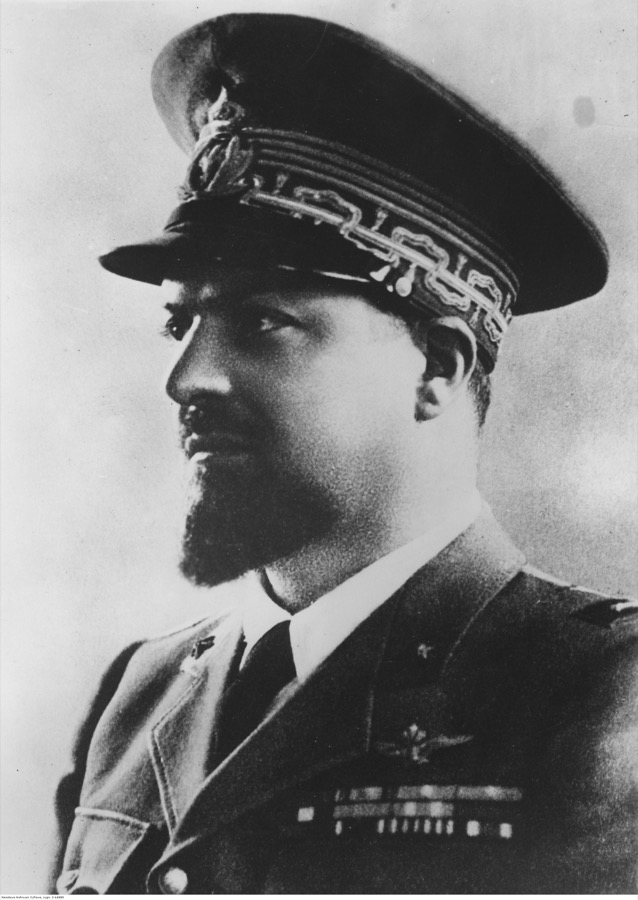
Portrait photograph, circa 1930-1940 (Narodowe Archiwum Cyfrowe, public domain)
The Man Rome Loved to Watch
Italo Balbo was fascism's most photogenic export. A World War I veteran turned squadrista leader, he helped organize the 1922 March on Rome and rose fast through the regime's ranks — but it was as Air Minister, building the Regia Aeronautica from nothing into a genuine air power, that he found his real medium. He didn't just want an air force. He wanted the world to watch it fly.
That instinct produced the defining act of his career: the 1933 Century of Progress flight, a twenty-four-plane transatlantic formation from Italy to the Chicago World's Fair, executed as pure spectacle and pure propaganda at once. It made Balbo an international celebrity — Chicago named a street after him — and it made him, uncomfortably for Mussolini, more popular abroad than the regime itself.
Balbo was an ENTP: dominant Ne restless for the next grand scheme, always thinking several moves past what a single plane or a single pilot could do alone.
Twenty-Four Planes Is a Bigger Idea Than One
What set Balbo apart from other pilots of his generation wasn't raw flying skill — it was scale of imagination. A solo transatlantic crossing had already been done, spectacularly, by others. Balbo's answer was to multiply the stunt by twenty-four: an entire squadron flying in formation across an ocean, landing together, a single feat turned into a coordinated demonstration of national capability. That leap from "impressive flight" to "orchestrated armada as geopolitical theater" is Ne's signature move — seeing the bigger possibility latent in a smaller one.
He repeated the pattern throughout his career: mass formation flights to Brazil, to Chicago, always bigger, always more elaborately staged than the last. Balbo was not content to be a great pilot. He wanted to invent the format other nations would then have to answer.
An Air Force Built to Actually Work
Behind the spectacle sat real technical seriousness. Balbo didn't simply commission the transatlantic flights and let subordinates handle logistics — he studied aircraft design, navigation, and formation flying with genuine rigor, and the Regia Aeronautica he built reflected that discipline. The mass flights succeeded, without catastrophic loss, because the underlying systems of training and engineering were sound.
This is auxiliary Ti in service of the vision rather than in competition with it: analytical enough to make the big Ne idea actually survive contact with an ocean crossing, but never so absorbing that it became the point in itself. Balbo cared about being right in the way an engineer cares about being right — because it was the precondition for the show going well.
Liked, Not Just Feared
Balbo's popularity was unusual for a senior Fascist official — unlike much of the regime's leadership, he was widely and genuinely liked, at home and abroad, for charisma rather than intimidation. He understood how to read a crowd, court foreign publics, and turn his own image into an asset for Italy's international standing. That is tertiary Fe: an attunement to how he and his projects landed with other people, deployed as a real strength rather than as an afterthought.
It also made him dangerous to Mussolini in a way pure competence never would have. A regime official who is simply effective is useful. One who is effective and beloved starts to look like a rival — and Balbo's warmth, his genuine popularity, is precisely what got him sidelined.
Exiled to the Desert, Killed by His Own Side
Inferior Si shows in what Balbo never developed: a wary, backward-looking caution about precedent and risk. Sent to govern Libya from 1934 — officially a promotion, in practice removal from Rome and from any position to challenge Mussolini directly — he seems to have accepted the posting with more restlessness than dread, treating it as another arena for grand schemes rather than the political demotion it was.
That same underdeveloped caution killed him. In June 1940, Balbo's own aircraft was shot down over Tobruk by Italian anti-aircraft gunners who mistook it for a British plane — a mistaken-identity death amid the chaos of a just-declared war, absurd and almost impossible to guard against, but also the kind of danger a mind more attuned to defensive caution might have weighted more heavily. The man who staged the world's most visible flying formation died invisible to his own side's guns.
Why ENTP Over ESTP
Why not ESTP?
An ESTP's fame would rest on individual daring — the best pilot in the room, proven in the moment. Balbo's fame rested on something else: the ability to conceive of a mass-formation transatlantic flight as propaganda theater, then organize dozens of pilots and aircraft into a single coordinated statement. That is strategic, big-picture scheme-building, not personal derring-do. An ESTP flies the plane. Balbo designed the entire spectacle the plane was one piece of.
It's the difference between a stunt and an institution. Balbo built the Regia Aeronautica and then used it to stage events no single flyer, however skilled, could have pulled off alone — Ne's appetite for the larger structure, not Se's appetite for the immediate physical act.
Connected Figures
Further Reading
- Italo Balbo: A Fascist Life — Claudio G. SegrèThe definitive English-language biography, covering the squadrismo years through the 1940 death at Tobruk.
- Mussolini's Italy — R.J.B. BosworthPlaces Balbo's aviation spectacles and eventual sidelining within the regime's broader personalist politics.
- The Ciano Diaries — Galeazzo CianoContemporary regime-insider observations on Balbo's standing as a potential rival to Mussolini.
