 Historical Figure MBTI
#940 · 7-10-26 · The Rise of Fascism
Gabriele d'Annunzio
Poet · The Man Who Invented Fascism's Aesthetic
1863 — 1938
9 min read
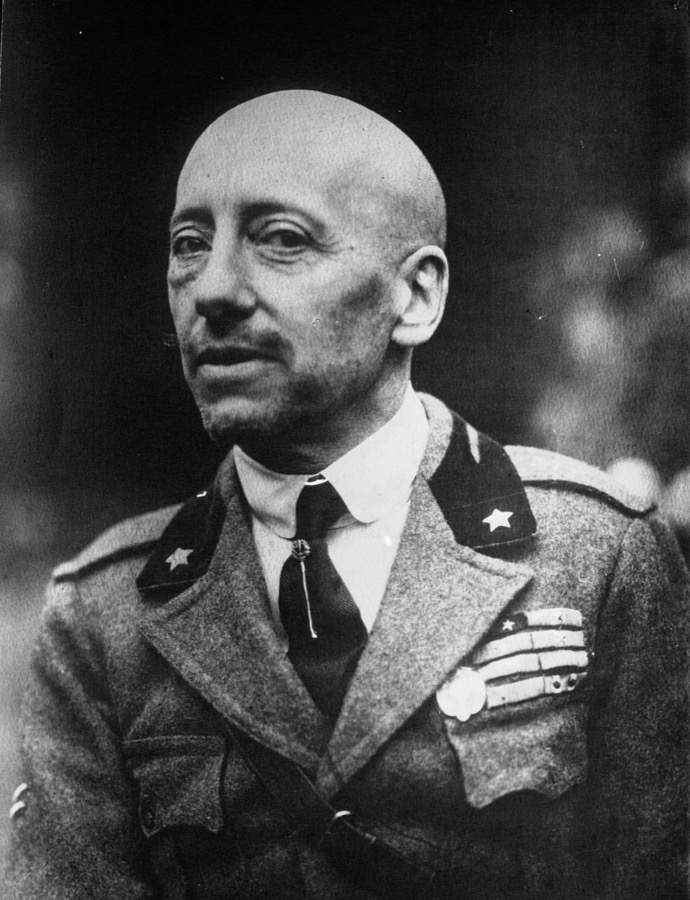
Portrait photograph, 1922 (Agence Meurisse, public domain)
The Poet Who Wrote the Script
In September 1919 a fifty-six-year-old poet with one eye, riding at the head of a column of mutinous soldiers, drove into the Adriatic port of Fiume and took it. He had no authorization from any government, no legal claim, and no plan beyond the gesture itself. He held the city for fifteen months, ruled it as his own statelet, gave speeches from a balcony to crowds of black-shirted legionnaires who answered him with a shout and a raised arm, and wrote it a constitution — the Charter of Carnaro — that organized the population by guild, made music a fundamental institution of the state, and was in roughly equal parts poetry and governance. Three years before the March on Rome, Gabriele d'Annunzio had staged the entire theatre of Fascism while its future Duce was still an obscure newspaperman with a failed movement.
He had come to it from literature. Before the war he was the most celebrated writer in Italy — a decadent poet and novelist of enormous technical gift and enormous appetite, famous for his verse, his plays, his affair with the actress Eleonora Duse, his greyhounds, and debts so spectacular that he spent five years in exile in France to escape his creditors. When Italy entered the World War he was past fifty and well beyond any draft, and he volunteered anyway. He flew, he raided, he lost an eye in a crash landing and spent months blind in a darkened room dictating prose on strips of paper. In August 1918 he led a squadron of aircraft over Vienna and dropped, instead of bombs, thousands of leaflets he had written himself.
D'Annunzio is ENFP at full volume — a dominant Ne that could not stop generating new selves to become, harnessed to a Fi conviction that his own life was a work of art the nation was obliged to admire.
A Life of Improvised Reinventions
The career reads like four or five careers held loosely in one hand. He published his first book of verse at sixteen and faked his own death in a riding accident to boost its sales. He wrote novels that scandalized Catholic Italy, plays for the greatest actress of the age, film intertitles for the epic Cabiria, and coined product names and slogans on commission. He sat in parliament, crossed the floor for the theatrical pleasure of crossing it, and announced that he was going toward life. Each new form was picked up with total conviction and dropped the moment the next appeared.
Fiume was the same faculty applied to statecraft, which is why it looked like nothing any government had seen. The occupation improvised its own currency, its own foreign policy — it recognized Soviet Russia, and drafted a league of oppressed peoples — its own festivals, uniforms, and rites. Anarchists, futurists, war veterans, deserters, and adventurers poured in from across Europe. The city ran, when it ran at all, on piracy: legionnaires seized cargo ships at sea to feed the population. It was a fifteen-month improvisation, and it never once resolved into an answer to the question of what happened next.
That is also why it ended the way it did. In December 1920 the Italian government, having signed a treaty settling Fiume's status, sent a battleship, which fired a few shells at the poet's residence. He surrendered within days. The Ne machine could generate a world out of nothing and hold a city's imagination for over a year; it could not produce the one thing that would have made the world durable.
The Mutilated Victory
Underneath the shape-shifting was one uncompromising conviction, and it was not an argument but a feeling: that Italy was owed a glory it was being cheated of, and that he personally was the vessel of that grievance. The phrase he gave it — vittoria mutilata, the mutilated victory — became the founding wound of Italian nationalism after Versailles. Italy had lost six hundred thousand dead and been denied the Adriatic territories it believed it had been promised. D'Annunzio did not analyze this; he felt it as a personal amputation, and the image of a body maimed was one his own missing eye let him carry with unanswerable authority.
The same intensity ran through the aesthetic he built at Fiume. The balcony dialogue with the crowd, the cry of Eia, eia, alalà! lifted from ancient Greek, the arm raised in a salute he claimed was Roman, the black shirts of the arditi assault troops, the commemoration of the dead by name with the crowd answering Presente! — none of it was designed to persuade anyone of anything. It was designed to make people feel what he felt. Fascism would inherit every piece of it.
Fi also explains why he was never a party man and never wanted to be. He would not subordinate himself to a movement, a doctrine, or another leader; the whole point was that the glory was his. After Fiume he refused to back Mussolini's bid for power and refused equally to lead the opposition to it, drifting instead toward a private grandeur that had no political address.
Enough Organization to Take a City
Tertiary Te gave him just enough executive competence to make the gestures real, which is what separates him from the many poets who dreamed of action. The Vienna flight was a genuine feat of planning: seven hundred miles over enemy territory in aircraft with the range barely to manage it, worked out with the pilots over months. The Fiume expedition began with him organizing mutinous grenadier officers, securing trucks, timing the march so that the Allied garrison would face him with no orders, and then daring the general sent to stop him to shoot him in the chest — which he did with his greatcoat thrown open and his medals showing.
Inside the occupied city he assembled a functioning apparatus of sorts: a command structure, a propaganda office, a fleet of requisitioned shipping, ministries of a kind. But the Te is third in the stack, not first, and it shows in the ledger. Fiume was always broke, always improvising its food supply, always one supply crisis from collapse, and the Charter of Carnaro devoted more thought to the role of music in civic life than to any mechanism for feeding the city through a winter.
The Museum of Himself
In inferior form Si arrives late and takes over completely, and in d'Annunzio's case it arrived as a house. From 1921 until his death he lived at the Vittoriale degli Italiani above Lake Garda, a compound he spent seventeen years converting into a shrine to his own past. He had the prow of a warship set into the hillside, the biplane from the Vienna raid hung from a ceiling, the speedboat and the coffin-shaped bed and thousands of relics arranged in darkened rooms he ordered kept at a fixed temperature. He wrote memoirs, catalogued his own life, and stopped generating anything new.
Mussolini paid for it. After 1922 the new regime, which had every reason to fear a rival with the poet's prestige and none of his obedience, gave him a princely title, a national edition of his complete works, and a state subsidy for the Vittoriale — and no power whatsoever. He was, Mussolini is supposed to have observed, like a rotten tooth: either extract it or fill it with gold. The gilding worked. D'Annunzio spent his last years in a cocaine-assisted haze among his own memorabilia, occasionally writing to warn against the German alliance, and died at his desk in March 1938, six months before Italy adopted the racial laws.
Why ENFP Over ENTP
Why not ENTP?
The restless invention and the appetite for provocation could read as ENTP, but the auxiliary is unmistakably Fi rather than Ti. An ENTP argues — builds a case, enjoys the dismantling of someone else's logic, holds positions lightly enough to take the other side for sport. D'Annunzio never argued. He proclaimed, and the proclamations ran on a private, non-negotiable sense of glory and grievance that admitted no counter-case. The Charter of Carnaro is the proof: asked to design a government, he produced a document that is half poetry, organizing the state around beauty and music because that was what he felt a state should be. That is Fi given an institution to write, not Ti given a problem to solve.
The ENFP reading also makes sense of the trajectory that an ENTP one cannot. He did not accumulate a body of thought; he accumulated identities — poet, seducer, deputy, aviator, war hero, city-taker, recluse — each entered whole and abandoned whole, all of them held together by a single feeling about himself and his country rather than by any idea. When the identities ran out, he built a museum of them and moved in.
Connected Figures
Further Reading
- The Pike: Gabriele d'Annunzio, Poet, Seducer, and Preacher of War — Lucy Hughes-HallettThe definitive English biography — sharp on how the literary self-invention became a political method.
- Gabriele d'Annunzio: Defiant Archangel — John WoodhouseA scholarly life with the fullest account of the writing career behind the public spectacle.
- The First Duce: D'Annunzio at Fiume — Michael A. LedeenA focused study of the occupation and the specific rituals Fascism later inherited from it.
- The Seizure of Power: Fascism in Italy, 1919–1929 — Adrian LytteltonPlaces Fiume and the legionnaires within the wider collapse that carried Mussolini to Rome.
