 Historical Figure MBTI
#941 · 7-11-26 · The Second World War
Alan Turing
Mathematician · Father of the Codebreaking Machine
1912 — 1954
10 min read
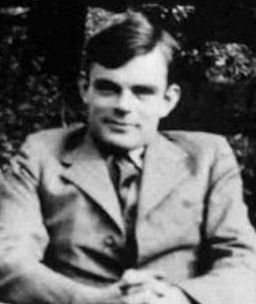
Alan Turing, circa 1930s (public domain)
The Machine That Existed Only on Paper
In 1936, a twenty-four-year-old Cambridge fellow published a paper with one of the least promising titles in the history of thought: “On Computable Numbers, with an Application to the Entscheidungsproblem.” It was an answer to an abstruse question posed by David Hilbert about whether mathematics could be mechanized — whether there existed a procedure that could decide, for any statement, if it was provable. To answer it, Alan Turing did something no one had asked him to do. He invented a machine. Not a real one; a machine made of definitions — an endless paper tape, a head that could read a symbol, write a symbol, and shift one square left or right, and a finite table of rules telling it what to do next. Everything a human calculator could do, Turing argued, this ridiculous device could do. And then he proved that even so, there were things it could never decide.
No electronic computer existed in 1936. There was no industry, no field, no word for what he had described. Turing had not set out to invent computing; he had set out to settle a question in mathematical logic, and computing was what fell out of the argument on the way to the proof. That is the shape of his whole life. He went at problems from underneath — stripping away the accumulated vocabulary until only the mechanism remained, then rebuilding the mechanism until it was provably correct. Three years later the British government put that same mind in a hut in Buckinghamshire and asked it to read the German Navy’s mail.
The pattern of his thinking is the clearest case in this archive of an INTP mind operating at the outer limit of its powers: introverted thinking as an instrument for cutting problems down to their skeletons, paired with an extraverted intuition that could not be kept inside any one discipline. Logic, cryptanalysis, machine design, the chemistry of animal markings, the question of whether a machine could think — Turing did not so much change fields as fail to notice the walls between them.
Turing was an INTP whose dominant Ti built systems from first principles and refused to accept any step it had not verified — including the step where a machine is declared incapable of thought.
Down to the Tape and the Head
Dominant introverted thinking is the drive to build an internal model so clean that every joint in it can be inspected. Its signature is the refusal of borrowed definitions. When Hilbert’s problem required a notion of “effective procedure,” the available mathematics offered several competing formalizations, and Turing accepted none of them. He asked instead what a person actually does when they compute: they look at a mark, they remember a state of mind, they write, they move their attention. He turned that observation into a machine specification of almost insulting simplicity, and the simplicity was the argument. A definition that spare could be trusted to be complete.
At Bletchley Park from 1939, that same instinct was pointed at Enigma. The German naval cipher was not vulnerable to cleverness applied at the surface; it needed an attack on the logic of the machine itself. Turing, leading Hut 8, designed the Bombe — an electromechanical device that did not try to guess a message but instead ran the consequences of an assumed setting at speed, chaining them until a contradiction appeared. The insight underneath is pure Ti: you do not search for the right answer, you build an apparatus that mechanically eliminates the wrong ones. A crib — a guessed fragment of plaintext — was fed in, and the Bombe rejected every rotor configuration inconsistent with it. What survived was, of necessity, correct.
He built it by extending the Polish work of Marian Rejewski, whose bomba had exploited a specific German indicator procedure, and he extended it not by borrowing the design but by going back to the cipher mathematics and re-deriving what an attack would need once that procedure was withdrawn. With Gordon Welchman’s diagonal board added to it, the Bombe made the naval Enigma readable — a breakthrough historians credit with shortening the war by a substantial margin and with keeping the Atlantic convoys alive. He would later contribute to the assault on the far more complex Lorenz cipher used for the German high command’s own traffic.
A Mind With No Respect for Fences
Auxiliary extraverted intuition supplies the Ti engine with material, and the material it supplies comes from everywhere. Turing’s career reads as a sequence of unrelated fields entered without credentials and left permanently altered. Mathematical logic gave way to cryptanalysis; cryptanalysis gave way, after the war, to the design of actual stored-program computers, where he wrote one of the earliest detailed specifications for a machine that would hold its instructions in the same memory as its data — the theoretical tape of 1936 finally cast in hardware.
Then, in 1950, the leap that most people now know him by. “Computing Machinery and Intelligence” opens by declaring the question “Can machines think?” too ill-defined to be worth answering, and replaces it with a game: an interrogator exchanging written messages with a human and a machine, trying to tell which is which. This is Ne doing what Ne does — reframing an unanswerable metaphysical dispute as an operational test anyone can run — with Ti immediately taking over to work through the objections one by one, theological, mathematical, and otherwise. He also sketched, decades early, the idea that the practical route to a thinking machine was not to program an adult mind but to build a child machine and educate it.
And then he changed fields again. His 1952 paper on morphogenesis asked how a uniform ball of cells could develop stripes, spots, and whorls, and proposed that two chemicals diffusing and reacting at different rates could spontaneously break their own symmetry into a pattern. It was mathematical biology before mathematical biology had a name, and it is still cited. A tidier career would have consolidated a single triumph. Turing kept walking out of rooms in which he had just won.
The Body Kept as Carefully as the Proof
Tertiary introverted sensing in an INTP is rarely social convention and almost never administrative order; it surfaces instead as a private, idiosyncratic relationship with physical routine, and Turing’s was famous around Bletchley long before it was famous anywhere else. He chained his mug to the radiator. He cycled to work in a gas mask during pollen season. He is said to have buried silver bars against a possible invasion and then been unable to recover them. These are not the habits of a man indifferent to the material world; they are the habits of a man who has built his own system for it and sees no reason to consult anyone else’s.
The clearest expression was running. Turing ran distances seriously enough to compete at national level, posting a marathon time within a few minutes of Olympic qualification, and he sometimes covered the forty miles to London on foot rather than take a train to a meeting. He was not building a public identity as an athlete. He ran because the repetition suited him — a body kept to a known standard, a stored physical record of effort, the pleasure of a thing done properly and repeatedly for its own sake. It is the same appetite that had him grinding through the internal details of a proof long after the result was secure.
The Function the State Used Against Him
Inferior extraverted feeling makes the social world legible only in fragments. Colleagues described Turing as awkward, abrupt, given to a nervous laugh, capable of great warmth with the few people who had earned his confidence and largely helpless with the rest. Joan Clarke, a cryptanalyst in Hut 8 and for a period his fiancée, was one of those few; he told her of his homosexuality himself and ended the engagement, and they remained friends. He served under a government led by Winston Churchill, who understood exactly what Bletchley was worth and intervened personally to get its codebreakers the resources they asked for, and Turing never learned to manage upward beyond that one letter.
In 1952 he reported a burglary at his home in Wilmslow and, in the course of explaining it to the police, described his relationship with a young man without dissembling. He was prosecuted for gross indecency. Offered prison or hormone treatment, he accepted the treatment: chemical castration, a year of injected oestrogen that caused breast growth and other physical effects. He lost his security clearance and with it any further role in the work he had helped invent. He was, by then, a man who had shortened the war and who could not be told so, being punished by the state he had saved for the fact of who he loved.
On 7 June 1954 he was found dead at home of cyanide poisoning. The inquest ruled suicide; a partly eaten apple lay beside the bed, and though it was never tested, the image has attached itself to him permanently. Some scholars have since questioned the ruling, arguing for accidental inhalation from his home electrolysis experiments. What is not in question is what the preceding two years had cost him. In 2013 he received a royal pardon — an instrument that pardons the man and quietly leaves the law that convicted him unexamined. It should be said plainly: Britain destroyed him, and the apology came fifty-nine years late.
Why INTP Over INTJ
Why not INTJ?
An INTJ builds toward an outcome: the vision is fixed early, and the thinking is organized outward to deliver it. Turing never once behaved that way. He entered logic, cryptanalysis, computer architecture, artificial intelligence, and biology in turn, took what interested him, and abandoned each field’s institutional rewards to whoever wanted them. The Bombe was not the execution of a strategic plan for machine intelligence; it was a correct solution to the cipher problem in front of him, reached by extending the underlying mathematics. He wrote the founding paper of computer science without noticing he had founded anything, and let others build the industry. That is Ti depth-first, following the structure of a problem wherever it leads, not Te deployment toward a chosen end.
The running settles it. A Te-organized mind runs to compete, to place, to hold a record. A near-Olympic marathon time acquired by a mathematician who ran because he liked running, and who once covered forty miles on foot to a meeting because it seemed reasonable, belongs to someone who pursues activities for their internal satisfaction rather than their external return. The same man chained his mug to a radiator, redesigned the question of machine thought because the old phrasing offended him, and then walked away to think about the spots on a leopard. Turing is what happens when an INTP is handed problems worthy of the machinery.
Connected Figures
Further Reading
- Alan Turing: The Enigma — Andrew HodgesThe definitive biography — mathematically serious and unflinching about the prosecution and death.
- The Man Who Knew Too Much: Alan Turing and the Invention of the Computer — David LeavittA shorter, more literary life, strong on the 1936 paper and on Turing as a gay man in his time.
- On Computable Numbers, with an Application to the Entscheidungsproblem — Alan Turing (1936)The founding paper of computer science; the Turing machine and the undecidability of the halting problem.
- Computing Machinery and Intelligence — Alan Turing (1950)The imitation game, and a point-by-point demolition of the standard objections to machine thought.
- Codebreakers: The Inside Story of Bletchley Park — F. H. Hinsley and Alan Stripp, eds.First-hand accounts from the people who worked the huts, including the mechanics of the Bombe.
