 Historical Figure MBTI
#942 · 7-11-26 · The Second World War
Gordon Welchman
Cryptanalyst · Architect of the Bombe's Traffic Analysis
1906 — 1985
6 min read
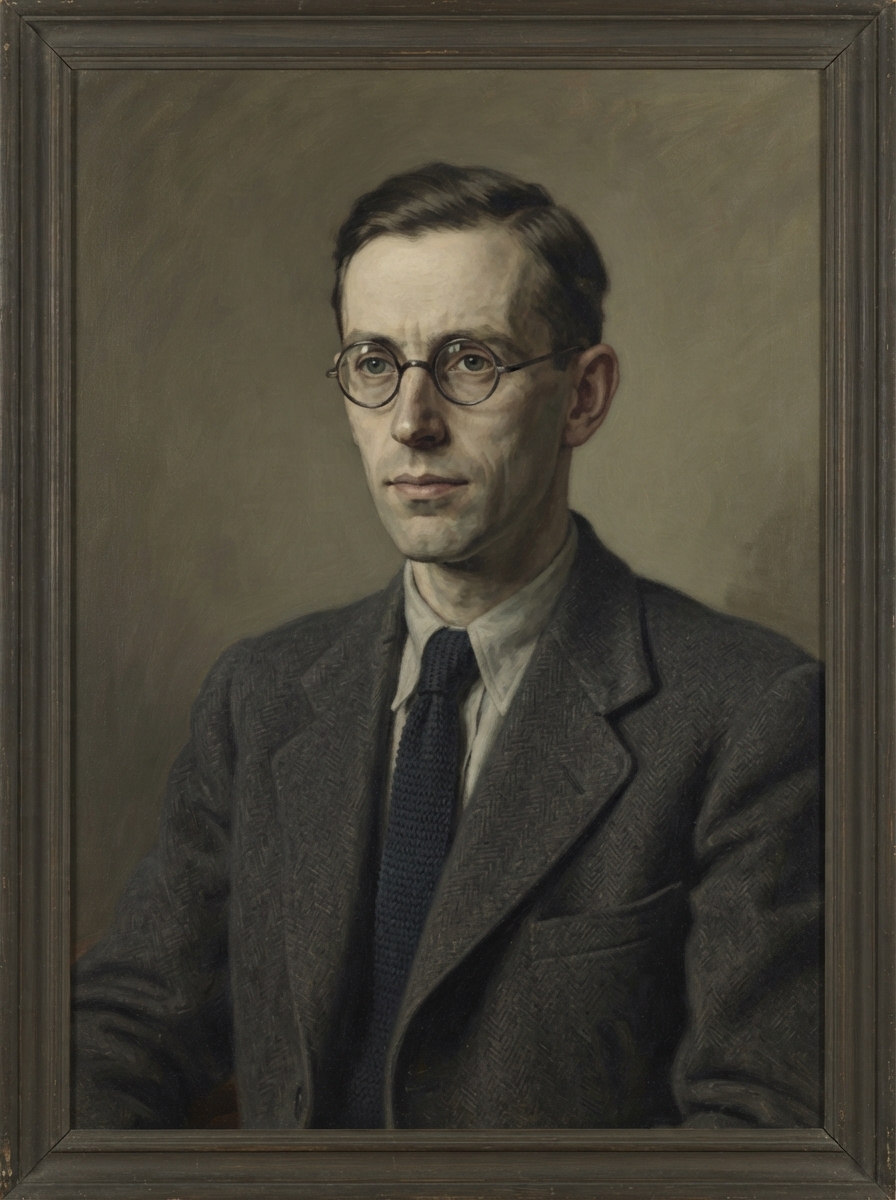
AI-assisted Portrait of Gordon Welchman
The Man Who Read the Traffic, Not the Cipher
Everyone remembers Bletchley Park for the moment the cipher broke. Gordon Welchman is remembered, when he is remembered at all, for noticing something nobody had thought to look at in the first place — that a German Enigma message was not just the scrambled text inside it. It was also a call sign, a preamble, an operator's habitual sloppiness, a network's daily rhythm. None of that required cracking a single letter. It just required someone to see the pattern sitting in plain sight and build a discipline around it.
Welchman arrived at Bletchley in 1939 as a Cambridge mathematician with no cryptanalytic training, and within months had effectively invented traffic analysis as a wartime intelligence practice. He then did something rarer than insight: he built the institution to run on it, heading Hut 6 and turning a fragile, one-off breakthrough into a repeatable industrial process that fed British intelligence for the rest of the war.
Welchman was an INTJ whose dominant Ni saw the exploitable structure hiding beneath the cipher, and whose auxiliary Te turned that private insight into a running, disciplined institution.
The Insight Nobody Was Assigned to Have
The official job at Bletchley was to break Enigma's cipher. Welchman's real contribution came from stepping back from that job entirely. He looked at the surrounding scaffolding of German radio traffic — call signs, message headers, the identifiable fingerprints of individual operators and their units — and recognized a second, independent layer of intelligence sitting there unexploited, one that didn't need the cipher broken at all. That is Ni in its purest form: not analyzing the data in front of you, but perceiving the shape of a system that the data only hints at.
It's telling that this insight arrived early and essentially unprompted. Nobody handed Welchman a brief that said "invent traffic analysis." He synthesized it himself from the periphery of the problem, the way Ni-dominant thinkers tend to solve the puzzle nobody assigned by noticing the pattern nobody else was looking at. The diagonal board he later designed for Turing's Bombe was the same instinct in mechanical form — an elegant structural improvement that came from seeing how the machine's existing logic could be made to do more with what it already had.
Hut 6 as a Production Line
A private insight is not intelligence output. Welchman's auxiliary Te is what separates him from a brilliant analyst who stays in the analysis. He took charge of Hut 6 and organized it as an efficient, repeatable process — standardized procedures, clear division of labor, a system built to run at wartime scale and survive the departure of any single genius, including himself. That is institution-building, not theorizing.
This is also the throughline of his postwar life. Rather than retreat into academic mathematics, he emigrated to the United States and kept working on applied, structural problems — early computing and military communications systems — the same instinct for turning a private structural insight into a durable, operating process, applied to new machinery.
A Private Reckoning With Secrecy
Welchman's tertiary Fi surfaces most clearly late in life, in the decision that cost him almost everything he had left. In 1982 he published "The Hut Six Story," laying out wartime codebreaking methods that had stayed classified for decades. It was not a bid for attention or profit so much as an internal conviction that the historical record deserved the truth — a quiet, personally held sense of what was right, defended even as it triggered the loss of his American security clearance and the threat of prosecution back in Britain under the Official Secrets Act.
He held that position under real pressure until his death in 1985, unrepentant about the book even as the institutions he'd served turned on him for it. That stubborn, unglamorous loyalty to his own sense of what was owed to history — rather than to any external audience — is Fi doing its quiet, tertiary work underneath a life otherwise built on structure and system.
Blind to the Political Terrain
Welchman's inferior Se shows up as a real blind spot for immediate, real-world consequence. He seems to have genuinely underestimated how the British and American security establishments of the early 1980s would react to a memoir revealing wartime methods — as though the passage of forty years and the obvious historical value of the account would simply carry the day on their own merits.
It didn't. The backlash was swift, concrete, and personally devastating, and there's little evidence Welchman saw it coming with the same clarity he'd once applied to German call signs. The man who could read an entire hidden intelligence system out of the margins of enemy radio traffic misread, badly, the immediate political ground directly in front of him.
Why INTJ Over INTP
Why not INTP?
An INTP would have stopped at the insight — content to have identified that traffic analysis was exploitable, and to keep refining the theory of it. Welchman didn't stop there. He took command of Hut 6, built its procedures, staffed it, and ran it as a functioning wartime institution that had to deliver results on a fixed schedule. That is Te in the driver's seat of a real organization, not Ti circling an elegant idea.
The diagonal board tells the same story in miniature: it wasn't published as a paper, it was built into the Bombe and put into production immediately because Hut 6 needed it to run faster. Welchman's entire career is judged by outputs delivered under institutional pressure, which is exactly the terrain where INTJ's Ni-Te pairing outperforms INTP's more purely theoretical Ti-Ne.
Connected Figures
Further Reading
- The Hut Six Story — Gordon WelchmanWelchman's own 1982 memoir — the controversial primary account of Hut 6's methods and organization.
- Station X: The Codebreakers of Bletchley Park — Michael SmithA broad narrative history situating Welchman's traffic analysis within the wider Bletchley operation.
