 Historical Figure MBTI
#910 · 7-4-26 · The Rise of Fascism
Adolf Hitler
Führer · Architect of the Holocaust · The Vision That Ended in Ruin
1889 — 1945
11 min read
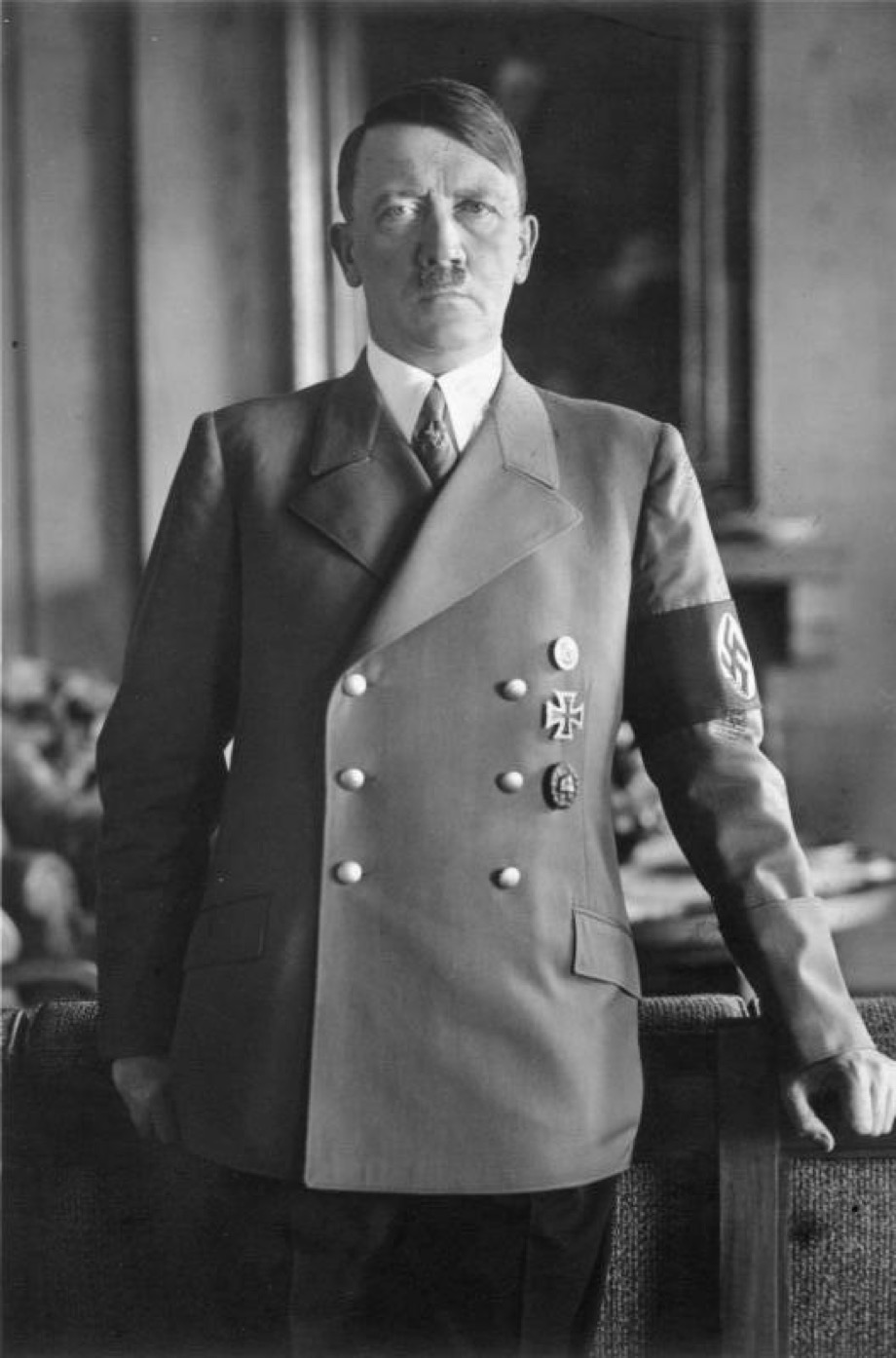
Portrait of Adolf Hitler (Bundesarchiv)
The Man Who Made a Vision Out of Murder
Adolf Hitler was the architect of the Holocaust. Under his direct order and with his continuous knowledge, the German state murdered six million Jews and millions of additional victims — Roma, disabled Germans killed under the T4 program, Polish civilians, Soviet prisoners of war, political prisoners, gay men. He initiated the war in Europe that killed tens of millions of people. He destroyed the country he claimed to be saving. None of this is in dispute, and nothing in the analysis that follows is offered as explanation in the sense of excuse. This archive types the psychology; it does not soften the crimes. Hitler is here because the machinery of his mind is historically consequential, not because it is admirable in any particular.
He was born in Austria in 1889, failed twice to gain admission to the Vienna Academy of Fine Arts, and drifted through the city selling painted postcards. The First World War gave him the first structure his life had ever held; he served as a regimental runner, was decorated, and was in a military hospital recovering from a gas attack when Germany surrendered. In 1919 he was sent by army intelligence to observe a fringe outfit called the German Workers' Party. He joined it instead. Within four years he had renamed it, seized control of it, and marched it into a failed putsch in a Munich beer hall. Prison gave him a manuscript — Mein Kampf, published 1925–26 — in which the entire subsequent program is already legible: racial hatred as cosmology, the Jew as metaphysical enemy, living space in the east taken by conquest.
What is psychologically striking is that the document written in 1924 by an obscure Bavarian agitator and the orders issued in 1942 by the master of a continent describe the same picture. Depression-era Germany gave him a mass constituency; Weimar's parliamentary paralysis gave him a door; President Hindenburg's conservative advisers opened it in January 1933. Everything after that — the Reichstag Fire Decree, the Enabling Act, the banning of every rival party, the murder of his own SA leadership in 1934, the Rhineland, Austria, the Sudetenland, Poland, the death camps, the bunker — was the execution of a vision he had already fixed, adjusted only in tempo and method. That fixity is the psychological signature the archive reads as dominant introverted intuition.
An INFJ whose dominant Ni fused into a single, unfalsifiable racial vision — and whose Fe was turned outward not toward people but toward crowds, as an instrument.
One Picture, Held for Twenty-One Years
Dominant introverted intuition converges. It does not survey options; it collapses the world into a single interpretive image and then treats that image as reality itself. Hitler's image was a racialized cosmic drama in which history was a struggle between peoples, the German people were being poisoned from within by Jews, and salvation lay in purification plus territorial conquest in the east. He did not arrive at this by argument and he could not be argued out of it. The 1924 text and the 1945 political testament dictated in the bunker make the same claims, in the same order, with the same enemy. Between them lie a global war and an industrialized genocide, and the picture never moved.
The tactical flexibility that historians rightly emphasize is not a counterargument; it is what Ni conviction looks like in a politician. He abandoned the putsch strategy after 1923 and adopted the path of legality, entering the Reichstag in order to destroy it. He signed a non-aggression pact with the Soviet Union in August 1939 while intending to annihilate it. He courted the German industrialists and the Reichswehr generals he privately held in contempt. Each of these was a route change, never a destination change. The people around him repeatedly mistook the first for the second, and each such mistake — Hindenburg's in 1933, Chamberlain's at Munich, Stalin's in 1941 — was catastrophic.
Ni also explains the quality of his decision-making that so frustrated professional staff officers: he believed his intuitions were prophetic. He spoke of walking with the certainty of a sleepwalker. When the Rhineland gamble succeeded in 1936 against the advice of his generals, the conviction hardened into a doctrine of infallibility that would later override the entire General Staff at Stalingrad. A dominant function that is never disconfirmed becomes a closed system, and a closed system in command of a state produces exactly the sequence Germany produced between 1933 and 1945.
Reading the Room as a Weapon
Auxiliary extraverted feeling is the capacity to sense the emotional temperature of a group and move it. In its healthy form it produces the teacher, the diplomat, the pastor. In Hitler it produced a machine for mass manipulation, and it is the function that made the vision politically operative rather than merely private. He was, before anything else, a speaker. He learned the craft deliberately: he rehearsed gestures before mirrors and had them photographed by Heinrich Hoffmann so he could study his own effect; he opened speeches slowly and quietly, letting the hall's tension build before releasing it; he studied which lines drew the roar and pruned the ones that did not.
The staging around him was engineered on the same principle. The Nuremberg rallies, the late-evening timing, the massed banners, the torchlight — all of it was designed to produce a specific emotional state in a crowd and then hand that state a target. Joseph Goebbels supplied the apparatus, but the instinct for what a German audience in 1930 actually felt humiliated by, and how to convert that humiliation into rage with a face on it, was Hitler's own. Contemporaries who despised him — including some who came to mock — described the disorienting experience of the room turning under them.
What Fe did not produce was connection. His relationships were thin, instrumental, and easily discarded: he had Ernst Röhm, one of his few early intimates and the only senior Nazi permitted to address him with the familiar du, shot in 1934 when the SA became inconvenient. Eva Braun was kept hidden from the public for over a decade because his political persona required the appearance of a man married only to Germany. This is Fe pointed entirely outward at the mass and starved at the individual level — a man who could move a hundred thousand people and had almost no one.
Internal Logic Sealed Off From the World
Tertiary introverted thinking builds a private architecture of reasons — consistent inside itself, indifferent to whether its premises are true. Hitler's was elaborate. He had absorbed a mass of half-digested material in Vienna and Munich — pseudo-scientific race theory, Social Darwinism, geopolitical writing on living space, the antisemitic pamphlet literature of the late Habsburg empire — and assembled it into a system that he could deploy at extraordinary length. He held forth on Gothic architecture, tank armor specifications, the tonnage of British shipping and the racial history of Europe with the same total assurance, and he retained technical detail well enough to intimidate specialists who had come expecting an ignoramus.
Under Ni, this is the danger case: the intuition supplies the conclusion and the thinking function supplies a scaffold of justification that never audits the foundation. The Nuremberg Laws of 1935 are the pattern in legal form — fastidious definitional machinery, degrees of Jewish ancestry rendered as tidy categories, all of it built on a premise with no basis in anything real. The Wannsee Conference of January 1942 is the same pattern applied to mass murder: an administrative meeting, minuted, with a table of populations by country, coordinating the logistics of extermination as if it were a transport problem. The bureaucratic surface of the Holocaust is not incidental to the psychology. It is Ti servicing a delusion.
It also explains a peculiar brittleness. Ti in the tertiary position argues; it does not revise. Confronted with contrary evidence — production figures, casualty returns, the map — Hitler did not update the model but attacked the person carrying the report. By 1944 the General Staff had learned to filter what reached him, which meant the closed system was now also blind.
The Gambler in the Basement
Inferior extraverted sensing shows up as an appetite for the irreversible physical stroke — the all-or-nothing bet placed in the present moment, made with a thrill rather than a calculation. Hitler's career is a ladder of them. In March 1936 he sent a token force into the demilitarized Rhineland with orders to retreat if the French moved; the French did not move, and he later admitted the following forty-eight hours were the most nerve-racking of his life. In 1938 he bluffed at Munich and was handed the Sudetenland. Each success taught the wrong lesson: that the stroke itself was the talent, and that caution belonged to lesser men.
The two decisions that destroyed him were both of this kind. On 22 June 1941 he invaded the Soviet Union — opening precisely the two-front war his own book had identified as Germany's historic fatal error — because the vision required living space in the east and because the string of gambles had so far always paid. On 11 December 1941, days after Pearl Harbor and under no treaty obligation to do so, he declared war on the United States, adding the world's largest industrial economy to his enemies at the moment his armies were stalling outside Moscow. Neither was compelled. Both were chosen.
In the last two years the inferior function ran unchecked: he moved divisions that existed only on paper, forbade every withdrawal, ordered the destruction of German infrastructure in the Nero Decree on the grounds that a people who had lost deserved to perish, and finally shot himself in a concrete room under Berlin on 30 April 1945 while the Red Army fought through the streets above. The picture had never changed. Reality simply arrived and removed the man holding it.
Why INFJ Over ENFJ
Why not ENFJ?
ENFJ is the live alternative, and the case for it is real: the public Hitler was a performer who fed on crowds, improvised alliances, and organized his entire political method around emotional command of an audience — Fe-Ni rather than Ni-Fe. But the private man was the opposite of an extravert. He was nocturnal, socially avoidant, chronically indecisive on personnel and administrative questions, incapable of the ordinary reciprocity of friendship, and he needed long withdrawals to Berchtesgaden between public appearances. A dominant-Fe leader builds and tends a coalition of people; Hitler let his subordinates fight each other for access and ruled a court of rivals. Above all, ENFJ subordinates the vision to the room, adjusting the goal to keep the group with it. Hitler did the reverse for twenty-one years: the room was adjusted, endlessly, to serve one unchanging picture. The oratory was the instrument; the vision was the man.
The archive lands on INFJ, and it should land there uncomfortably. The type is usually described in flattering terms — the counsellor, the idealist, the one who sees where things are going. What Hitler demonstrates is that dominant intuition guarantees nothing about the content of the vision, and that the same architecture which can produce a moral seer can produce an unfalsifiable hatred pursued to the annihilation of a continent. A type is a shape of cognition, not a verdict on character. The verdict on character here was delivered by the camps.
Connected Figures
Further Reading
- Hitler: 1889–1936 Hubris — Ian KershawThe standard scholarly biography; the first volume traces the fringe agitator to the consolidation of dictatorship.
- Hitler: 1936–1945 Nemesis — Ian KershawThe second volume follows the gambles from the Rhineland to the bunker.
- Hitler: A Biography — Volker UllrichA two-volume modern reassessment with more attention to the private man behind the public persona.
- The Third Reich Trilogy — Richard J. EvansThe regime rather than the man: how a modern state was converted into an instrument of genocide.
