 Historical Figure MBTI
#917 · 7-5-26 · The Rise of Fascism
Joseph Goebbels
Propaganda Minister · The Man Who Weaponized the Lie
1897 — 1945
10 min read
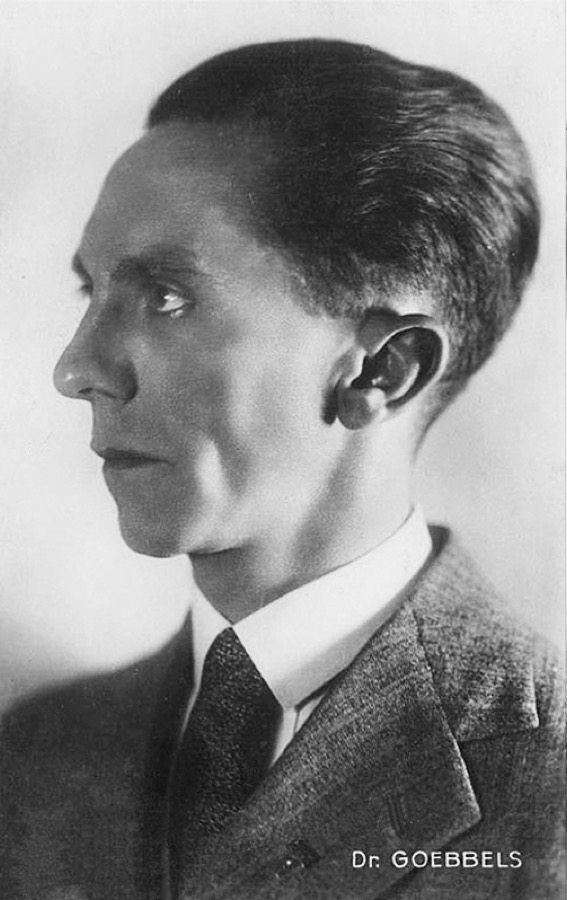
Portrait of Joseph Goebbels (Bundesarchiv)
The Engineer of the Lie
As Reich Minister of Public Enlightenment and Propaganda, Joseph Goebbels built the machinery of Nazi mass persuasion and ran it for twelve years. He orchestrated the book burnings of May 1933. He drove the antisemitic campaign in press, radio and film that made the exclusion, and then the murder, of German Jews thinkable to millions of ordinary people. On the night of 9 November 1938 he personally incited the Kristallnacht pogrom in a speech to party leaders in Munich, unleashing arson, looting, and killings across Germany and Austria. He commissioned and distributed the vilest antisemitic films ever made. He kept Germany fighting through the last ruinous year of the war with the doctrine of total war. And on 1 May 1945, in the bunker under the Reich Chancellery, he and his wife Magda murdered their six children before killing themselves.
He was not a thug who found his way into a ministry. He was a doctor of philosophy from Heidelberg, with a dissertation on nineteenth-century Romantic drama, a failed novelist and playwright, a compulsive diarist who left behind tens of thousands of pages. Born in 1897 in Rheydt to a Catholic working-class family, he was left with a deformed right foot after childhood illness — a condition that kept him out of the First World War, humiliated him among a generation defined by the trenches, and shaped a lifelong resentment he converted into ideology.
What he did with that resentment was not to rant. It was to build. Appointed Gauleiter of Berlin in 1926 — a city then hostile to the Nazis — he took a party of a few hundred and turned it into a mass movement by treating persuasion as an engineering problem: found a newspaper, stage confrontations that generate coverage, manufacture a martyr, repeat a slogan until it becomes furniture in the mind. By 1933 he had a ministry, and by 1934 every newspaper, film studio, radio transmitter, theatre and publishing house in Germany answered to it.
Goebbels is the archive’s coldest ENTJ: dominant Extraverted Thinking that treated an entire nation’s beliefs as a system to be organized, staffed, scheduled and measured — propaganda as industrial process rather than inspired demagoguery.
A Ministry Built Like a Factory
Dominant Extraverted Thinking organizes the external world: it builds structures, assigns responsibilities, sets metrics and enforces them. The Propaganda Ministry was a Te artifact from its first day. Goebbels divided it into departments — press, radio, film, theatre, literature, music, fine arts — and paired each with a chamber of the Reich Culture Chamber, membership of which was compulsory for anyone who wanted to work in that field. Exclusion from the chamber ended a career. In a single organizational move he had made the entire cultural economy of Germany a personnel file he controlled.
He ran it with a discipline nobody else in the regime matched. The daily press conference issued binding instructions to editors on what to cover, how to frame it, and what to leave out; the wording of headlines came down from his office. He pushed the Volksempfänger, the cheap mass-produced radio set, into millions of homes because he understood that distribution infrastructure mattered more than rhetoric, and he built loudspeaker networks in factories and squares so that a speech could reach people who had not chosen to listen. He measured results, reading the SD reports on popular mood and adjusting the message when the figures told him a line was not landing.
The same executive instinct produced the events themselves as designed products: the book burnings staged simultaneously in university towns with prepared student speeches and fire ritual; the Nuremberg rallies as filmed spectacle; the funeral of Horst Wessel turned into a national liturgy with a hymn attached; the total-war speech at the Sportpalast in February 1943, whose famous crescendo of questions to a hand-picked audience was rehearsed to the second. Goebbels did not improvise his effects. He specified them.
The Long View of Total Control
Auxiliary Introverted Intuition supplies the ENTJ with a single converging vision of where things are going, and the patience to work toward it across years. Goebbels’s vision was total: not censorship as suppression but an entire information environment so complete that no rival account of reality could form. He wrote in the 1920s about the necessity of capturing not merely opinion but imagination, and he pursued that aim methodically through the whole life of the regime.
He understood, ahead of nearly everyone, that entertainment was the more powerful channel. Most of the roughly eleven hundred feature films made under his ministry were comedies, romances and musicals, not overt propaganda, because he had reasoned that an audience relaxed by pleasure absorbs framing it would resist in a lecture. Where he deployed the poison directly — most infamously in the 1940 films that dehumanized Jews as vermin and as swindlers — it was calculated placement inside a media diet he otherwise kept palatable. That is not the thinking of a crowd-pleaser. It is the thinking of a strategist with a model of how belief forms over a decade.
Ni also gave him the darkest of his accurate predictions. He grasped earlier than Göring or most of the general staff that the war had turned, and reframed the whole message around endurance, Bolshevik terror and secret wonder-weapons rather than triumph. He told colleagues that the regime had burned its bridges and would be remembered either as the greatest statesmen or the greatest criminals in history — the clearest evidence anywhere in the record that he knew exactly what he was participating in, and had chosen it with his eyes open.
The Performer at the Microphone
Tertiary Extraverted Sensing in an ENTJ shows up as a feel for physical impact — the staged image, the timed pause, the room read from a stage. Goebbels was the most technically skilled speaker in a party built on speech, and unlike Hitler, whose oratory ran on sustained emotional improvisation, he constructed his effects. He rehearsed. He wrote and rewrote. He knew what a microphone did to a voice and adjusted his delivery for radio in a way his colleagues never bothered to.
It ran into his private life as vanity and appetite. He was a relentless pursuer of actresses under his own ministry’s control, and his affair with the Czech star Lída Baarová in 1938 became serious enough that Hitler personally intervened to end it and preserve the marriage as a propaganda asset. The theatricality that made him effective on a podium made him reckless and cruel off it.
Se also drove his taste for direct confrontation in the street-fighting years — deliberately marching SA columns into communist districts of Berlin because the resulting violence produced headlines, and then converting the casualties into martyrs. He was physically slight and lame, and he compensated by putting himself at the visible center of every confrontation he engineered. The Kristallnacht speech of November 1938 was the same instrument turned to atrocity: an evening address to party leaders, calibrated to produce a nationwide pogrom within hours while leaving the order technically unwritten.
The Fanatic Beneath the Technician
Inferior Introverted Feeling in an ENTJ is the buried, inarticulate value core — rarely examined, enormously powerful when it takes hold, and prone to expressing itself as absolute, unnegotiable loyalty. Goebbels is often written about as a cynic who believed nothing, and that reading is wrong. The diaries show the opposite: a man who believed in Hitler with something close to religious devotion from his conversion in 1926 to the last hours in the bunker, and whose antisemitism was not a professional pose but a conviction that intensified over decades.
That inferior Fi is also why the ending took the shape it did. When the other leaders scattered — Göring to Bavaria and a self-serving telegram, Himmler to secret talks with the Allies — Goebbels moved his family into the bunker. He accepted the chancellorship on Hitler’s death and held it for a single day, refused to leave, and then, with Magda, had their six children — aged four to twelve — drugged and poisoned because he could not tolerate their living in a world without National Socialism. It is the most horrifying act by any of the principal Nazis against people they claimed to love, and it is not explicable as calculation. It was inferior Fi in its final, totalizing form: a value held so absolutely that it consumed everything, including the children.
He also left, deliberately, the largest first-person record of any Nazi leader — some thirty thousand pages of diary written for posterity, dictated daily even as Berlin burned. The compulsion to document his own inner life sits oddly beside the ruthless external operator, and it is exactly what an underdeveloped, unexamined Fi produces when it finds a private outlet: enormous quantities of self-justifying feeling, recorded and never interrogated.
Why ENTJ Over INTJ
Why not INTJ?
INTJ leads with Introverted Intuition and works from behind the scenes, preferring to design the system and let others front it. Goebbels was congenitally incapable of that. He was a compulsive public performer who spoke several times a week for twenty years, ran the daily press conference in person, insisted on being seen in bombed districts, and treated the microphone as his natural habitat. Inside the ministry he was an aggressive line manager, not a recluse with a plan — hiring, purging, issuing directives, fighting turf wars with Ribbentrop, Rosenberg and Ley for control of channels he considered his. His intuition set the destination, but the daily reality was extraverted executive control asserted continuously over both the national narrative and his own staff. That is Te leading, with Ni in support.
Heydrich is the genuine INTJ of this cluster: an architect of structures who worked in shadow and needed no audience. Goebbels needed one constantly, and built a country-sized apparatus to guarantee he would always have it. The distinction is not vanity versus modesty — both men were ruthless system-builders — but where the energy is aimed. One designed the instrument of terror and disappeared behind it. The other stood in front of Germany every day and told it what to think.
Connected Figures
Further Reading
- Goebbels: A Biography — Peter LongerichThe definitive modern life, built on the complete diaries.
- Goebbels — Ralf Georg ReuthThe earlier standard biography, especially good on the Berlin Gauleiter years.
- The Nazi Conscience — Claudia KoonzOn how propaganda constructed a moral universe in which persecution felt righteous.
- Nazi Propaganda: The Power and the Limitations — David Welch (ed.)Essays assessing where the ministry's machinery actually worked and where it failed.
