 Historical Figure MBTI
#918 · 7-5-26 · The Rise of Fascism
Reinhard Heydrich
Chief of the RSHA · The Architect of the Final Solution
1904 — 1942
11 min read
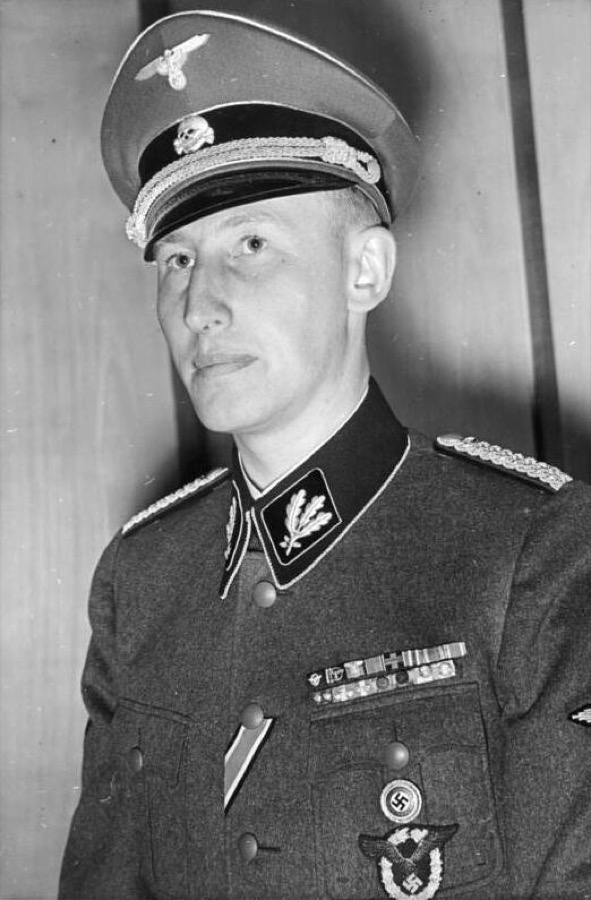
Portrait of Reinhard Heydrich (Bundesarchiv)
The Man With the Iron Heart
On 20 January 1942, in a lakeside villa at Wannsee outside Berlin, Reinhard Heydrich chaired a meeting of fifteen senior officials at which the bureaucratic machinery of the Final Solution was coordinated across the ministries of the German state. The killing had already begun; what Wannsee did was settle the question of authority and logistics — who would supply the trains, who would define the categories, who would answer for the property, and above all that Heydrich’s office would run it. The minutes, kept by Adolf Eichmann and surviving in a single copy, tabulate eleven million Jews by country as an inventory to be worked through.
Heydrich by then commanded the Reich Security Main Office, the RSHA, which he had built by fusing the Gestapo, the criminal police and the SS intelligence service into a single apparatus of surveillance, arrest and murder. Its Einsatzgruppen — whose operational orders he wrote — shot well over a million people in the occupied Soviet territories. As acting Reich Protector of Bohemia and Moravia from September 1941 he ran an occupation of executions and deportations efficient enough to earn him the name the Czechs still use: the Butcher of Prague. He was assassinated there in May 1942 by Czechoslovak agents parachuted in from Britain, and the Germans answered by razing the village of Lidice, murdering its men, deporting its women to Ravensbrück and taking its children.
Almost nothing in his origins predicted it. Born in 1904 in Halle to a professional musician who ran a conservatory, Heydrich was a gifted violinist who reportedly wept when he played, a champion fencer, tall and athletic and awkward, with a high voice that other boys mocked and persistent schoolyard rumours of Jewish ancestry that followed him for life. He served as a naval signals officer until 1931, when a court of honour dismissed him over his conduct toward a woman he had promised to marry. Unemployed in a depression, he was introduced to Heinrich Himmler, who was looking for someone to build an intelligence service, and who mistook the naval signals man for a naval intelligence man. Heydrich sketched a design on the spot and got the job.
Heydrich is the archive’s most chilling INTJ: dominant Introverted Intuition that saw, years ahead of the men around him, the shape of an integrated apparatus for total surveillance and elimination — and then built it, office by office, until it existed.
Seeing the Apparatus Before It Existed
Dominant Introverted Intuition converges: it discards alternatives early, fixes on a single unfolding pattern, and works backward from an end state that nobody else can yet see. Heydrich’s first act in the SS was exactly that — asked in 1931 to describe an intelligence service, he produced within twenty minutes a blueprint for an organization that did not exist and would not for years, and then spent a decade making it real. The Sicherheitsdienst began as a handful of men in a Munich flat with a card index. By 1939 it was the nervous system of a police state.
He thought in terms of the whole system and its future states rather than the immediate task. Where the party’s street fighters saw enemies to beat up, Heydrich saw a problem of categories, files and coverage: opponents were to be identified, indexed, monitored and neutralized before they became opposition. He anticipated the utility of holding compromising material on the regime’s own leadership, and the SD accumulated dossiers on Nazi grandees as readily as on communists. The Venlo incident of 1939, in which SD men posing as anti-Hitler conspirators lured two British intelligence officers to the Dutch border and abducted them, was the same instinct in operation: several moves ahead, patient, and entirely willing to spend months constructing a deception.
The darkest expression is the trajectory from the Einsatzgruppen orders of 1941 to Wannsee. Heydrich did not decide the Holocaust alone — that authority came from Hitler, and the written commission came from Göring in July 1941 — but he understood earlier than almost anyone that mass shooting could not scale, that the problem was interdepartmental rather than military, and that whoever convened the ministries would own the programme. Wannsee was ninety minutes long and produced no new decision; its purpose was jurisdictional. That is Ni-Te thinking at its most efficient and most monstrous.
Merging the Instruments of Terror
Auxiliary Extraverted Thinking turns the vision into an organizational chart with names in the boxes. In September 1939 Heydrich amalgamated the Gestapo, the Kripo and the SD into the RSHA, a single body under his command with departments for ideology, foreign intelligence, domestic surveillance, criminal police and — from 1941 — Amt IV B4 under Eichmann, the office that organized the deportations. Before him, German security work had been split between party organs and state ministries with overlapping mandates. He made them one instrument, and he made himself its handle.
He was a working executive, not a distant strategist. He drafted the operational guidelines for the Einsatzgruppen, staffed them deliberately with educated men — lawyers, doctors of philosophy, economists — on the reasoning that professionals would carry out killing more systematically and with less institutional breakdown than brawlers. He required reporting: the Ereignismeldungen, the daily incident reports tallying executions by place and category, compiled and circulated in Berlin. In Bohemia and Moravia he ran the same method against an occupied economy, combining martial law and rapid executions with wage increases, extra rations and social insurance for armaments workers — terror and incentive as two levers on the same machine, calibrated to raise output.
It also drove his relentless accumulation of jurisdiction. Heydrich took work nobody had assigned him, produced results, and kept the resulting authority. He supplied the forged evidence that destroyed the Soviet marshal Tukhachevsky and helped Himmler assemble the dossiers used in the Blomberg-Fritsch affair to break the army leadership. He staged the fake Polish attack on the Gleiwitz radio station in August 1939, complete with concentration-camp prisoners killed and dressed in Polish uniforms as props, to furnish the pretext for the invasion. Every one of these operations enlarged his office.
A Core of Ice and Injury
Tertiary Introverted Feeling in an INTJ is a small, hard, private centre: not warmth, but an intensely personal sense of what must be proved and what cannot be borne. Heydrich’s was organized around humiliation. The taunts about Jewish blood — almost certainly baseless, but never fully dispelled and used against him by rivals — the naval dismissal, the mocked voice, the mother’s beatings recorded in the biographies: these produced a man who reportedly investigated his own genealogy and who pursued proof of hardness with the intensity of someone answering an accusation nobody had formally made. Hitler is said to have called him the man with the iron heart, and he took it as the highest possible commendation.
What that core did not contain was any restraint of the ordinary human kind. There is no episode in his record of hesitation, no equivalent of Himmler’s nausea at Minsk, no private grumbling of the sort that fills Goebbels’s diaries. He kept a family, played chamber music at home, and went to the office to sign deportation schedules. Colleagues who disliked and feared him agreed on the coldness; Carl Jacob Burckhardt described him as a young evil god of death.
Fi at this position also explains the ferocious personal loyalty running upward and the absence of it running sideways. He was faithful to Himmler while systematically acquiring the capacity to replace him, and he held files on virtually every senior figure in the regime. He served the ideology as an absolute, not as a career, and the distinction matters: a careerist can be bought or deflected, and there is no evidence anyone ever deflected Heydrich from anything.
The Recklessness That Killed Him
Inferior Extraverted Sensing gives the INTJ an uneasy relationship with the physical present: usually neglected, occasionally seized upon as something to conquer. Heydrich’s version was compulsive physical proof. He fenced at national level. He trained as a pilot and flew combat missions in Norway and over the Eastern Front, against explicit instruction, until he was shot down behind Soviet lines and had to be recovered — an absurd risk for the head of the Reich’s security apparatus, taken because a man who had been dismissed from the navy for dishonour needed to be seen to be brave. He drank, chased women, and pushed himself at every physical test available.
The same blind spot killed him. In Prague he drove an open-topped green Mercedes, unescorted, on a fixed route between his villa at Panenské Břežany and Hradčany Castle, because he judged that visible fearlessness was itself a form of rule and that the Czechs had been sufficiently terrorized to be safe. On 27 May 1942, at a hairpin bend in Libeň where the car had to slow, the Operation Anthropoid agents Jan Kubiš and Jozef Gabčík were waiting. Gabčík’s Sten gun jammed; Heydrich, instead of ordering his driver on, stood up and drew his pistol to fight, and in that pause Kubiš threw a modified anti-tank grenade against the rear of the car. Splinters and upholstery debris drove into his spleen. He died of sepsis on 4 June.
The reprisals were the regime’s worst act of collective punishment in the west. On the strength of a false connection, the village of Lidice was destroyed on 10 June 1942: 173 men shot, the women sent to Ravensbrück, most of the children gassed at Chełmno, the buildings demolished and the site erased from maps. The village of Ležáky followed. Thousands more were killed across the Protectorate. The extermination camps of Bełżec, Sobibór and Treblinka were named Operation Reinhard in his memory, which is the most honest epitaph anyone ever gave him.
Why INTJ Over ISTJ
Why not ISTJ?
ISTJ works from precedent: it maintains, standardizes and improves what already exists, and it draws authority from the established procedure. Himmler is that type, and the contrast between the two men is the clearest evidence for reading Heydrich differently. Heydrich did not inherit institutions and administer them; he invented them. The SD was designed on a blank sheet in 1931. The RSHA merged bodies that had never been merged, cutting across party and state lines that everyone else treated as fixed. Wannsee convened ministries that had no precedent for meeting. He routinely acted where no procedure existed and no one had authorized him, then made the result permanent. That is long-range Ni system design, not procedural maintenance.
The pairing is instructive precisely because both men were murderers of the desk. But Himmler needed a template to replicate and a rule to follow; Heydrich generated the templates and left the following to others. It is the difference between the man who runs the machine and the man who conceived it — and it is why the historians who study the two agree that had Heydrich lived, he, not Himmler, would very likely have been the more dangerous survivor.
Connected Figures
Further Reading
- Hitler's Hangman: The Life of Heydrich — Robert GerwarthThe definitive scholarly biography, and a careful dismantling of the demonic-genius myth.
- Heydrich: The Face of Evil — Mario R. DederichsA shorter portrait, strong on the early years and the naval dismissal.
- The Wannsee Conference and the Final Solution — Mark RosemanA concise account of what the January 1942 meeting did and did not decide.
- The Killing of SS Obergruppenführer Reinhard Heydrich — Callum MacDonaldThe standard narrative of the Prague operation and the Lidice reprisals.
