 Historical Figure MBTI
#919 · 7-5-26 · The Rise of Fascism
Albert Speer
Minister of Armaments · The Architect Who Claimed He Never Knew
1905 — 1981
11 min read
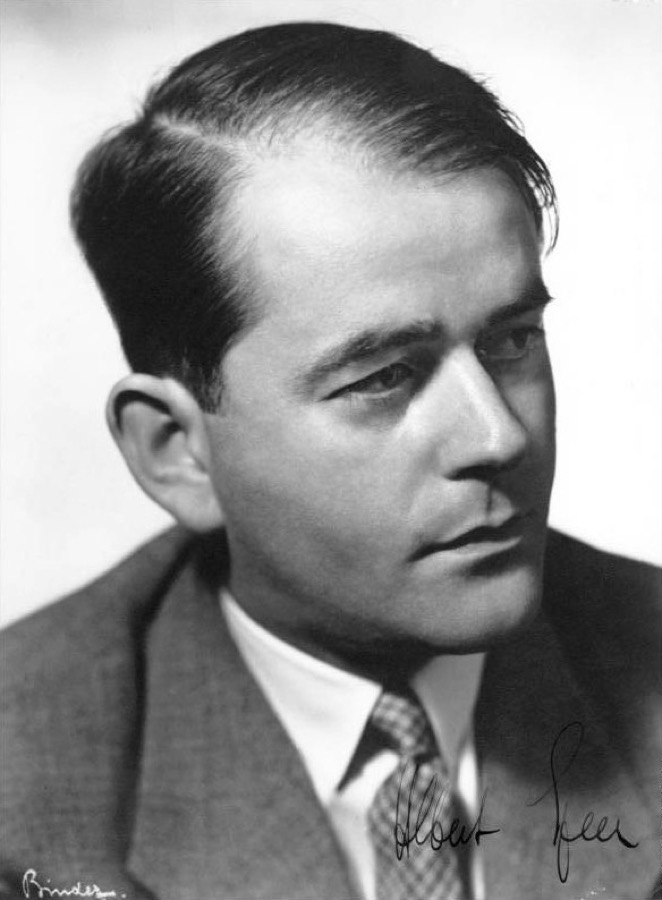
Portrait of Albert Speer (Bundesarchiv, 1933)
The Longest Lie He Ever Built
As Reich Minister of Armaments and War Production from 1942, Albert Speer ran German war industry on the backs of slave and forced labourers on a scale of millions. Under his ministry, foreign civilians seized in the occupied countries, prisoners of war and concentration-camp inmates were worked in quarries, aircraft plants and underground tunnels under conditions designed to consume them. At the Mittelbau-Dora complex, where V-2 rockets were built inside a mountain, roughly one in three of the prisoners who passed through died. Speer’s reorganization of production kept German armaments output climbing through 1943 and into 1944, in the teeth of Allied bombing — which means, plainly, that his competence prolonged the war, and every month it was prolonged was another month of the camps operating.
He then spent thirty-five years constructing a second, more successful product: the figure of the good Nazi. At Nuremberg he alone among the defendants accepted a general responsibility for the regime while denying any specific knowledge of the extermination of the Jews. It worked. He escaped the gallows with twenty years in Spandau, and after his release in 1966 his memoirs made him internationally famous as the cultivated technocrat who had served evil without understanding it. That account is false. The Chronik kept by his own office, the record of his attendance at the Posen conference of October 1943 where Himmler described the extermination programme to assembled officials, his ministry’s direct involvement in clearing Jewish apartments in Berlin for redevelopment, and letters that surfaced after his death in which he acknowledged having been present at Posen, all show a man who knew. The archive files the myth as part of the crime, not as an extenuation of it.
Born in 1905 in Mannheim to a prosperous architect’s family, Speer was cool, reserved and intellectually capable, trained in architecture in Karlsruhe, Munich and Berlin under Heinrich Tessenow. He joined the party in 1931 after hearing Hitler speak, was noticed for the speed with which he executed commissions, and became by the mid-1930s the regime’s favoured architect: the Nuremberg rally grounds with their cathedral of light, the New Reich Chancellery built in a year, and the plans for Germania, a rebuilt Berlin of domed halls and triumphal avenues designed to overawe for a thousand years. He was also, for a decade, the closest thing Hitler had to a friend.
Speer is the archive’s most self-serving INTJ: dominant Introverted Intuition that first designed a war economy and then, with the same cool detachment, designed the exculpatory story that let him outlive it.
Designing for a Thousand Years, and for the Verdict
Dominant Introverted Intuition works from a single imagined end state backwards. In Speer’s architecture this produced the theory of ruin value: buildings deliberately specified in stone and proportion so that in a thousand years their remains would still impress, like Roman aqueducts. It is a startling idea for a man in his twenties — a design brief written for an audience that will not exist for millennia — and it is the purest available demonstration of how his mind worked.
Applied to industry from February 1942, when he replaced Fritz Todt after an air crash, the same faculty saw what the professional economists had missed: that German production was not constrained by resources so much as by fragmentation. Speer envisaged one integrated system in place of competing service procurement offices, and he pursued it with a consistency that took two years to fully realize. Armaments output roughly tripled between early 1942 and mid-1944. Historians now argue that much of the increase was built on foundations laid before he arrived and on the exhaustion of slack capacity, and that Speer’s own postwar statistics were curated to flatter him — but the strategic reading of the problem was genuinely his.
The third and most consequential application was the trial. Speer worked out, months before the tribunal convened, what the others never did: that a defence of denial would fail against the documents, and that the only survivable position was to accept collective responsibility loudly while conceding nothing specific. He rehearsed it with his lawyer. He offered the prosecutors cooperation, provided them with a narrative of the technocrat appalled by the machine, and even supplied a late-war story of a plan to assassinate Hitler with nerve gas through the bunker ventilation — an episode for which the evidence is thin and the timing suspiciously convenient. He was, in the most literal sense, designing his own reception. It was the most effective piece of work he ever did.
The Ministry That Ran on Human Beings
Auxiliary Extraverted Thinking is the executive hand, and Speer used it hard. He built the Zentrale Planung, a central planning board that allocated raw materials across the whole economy; he devolved decisions to committees of industrialists who actually knew their sectors — the so-called industrial self-responsibility — while keeping targets and allocation in his own office; he standardized components, cut model variants, and pushed serial production. He collected offices the way Heydrich collected jurisdictions, absorbing construction, then most of war production, then in 1943 much of civilian output too.
The input that made it work was people, taken by force. Speer sat on the Zentrale Planung when it demanded labour from Fritz Sauckel, the plenipotentiary who rounded up some five million workers from occupied Europe; the surviving minutes record Speer pressing for numbers and complaining about workers who evaded conscription, with explicit reference to coercive measures. He negotiated directly with Himmler for the use of concentration-camp prisoners, and his ministry drove the underground dispersal programme that put aircraft and rocket production into tunnels dug by camp labour. At Dora he visited in December 1943, saw conditions his own staff described in writing as unspeakable, arranged some material improvements to preserve the workforce as an asset, and continued.
That is the shape of his guilt, and it is a Te shape. Speer did not order massacres or write racial doctrine. He optimized a system whose fuel was human lives, treated the mortality rate as a supply problem, and never once asked a question outside the frame of output. The Nuremberg tribunal convicted him on the counts of war crimes and crimes against humanity for precisely this, while acquitting him on conspiracy and crimes against peace, and sentenced him to twenty years.
The Conscience He Performed
Tertiary Introverted Feeling gives the INTJ a private moral register that is real but poorly examined and easily conscripted by the dominant function. Speer’s postwar life is the study in what that looks like when it goes to work on its owner. In Spandau he wrote secretly on scraps smuggled out by a sympathetic orderly, and the resulting books — Inside the Third Reich and Spandau: The Secret Diaries — present a man in genuine, sustained anguish. Gitta Sereny, who interviewed him over years, concluded that the anguish was not fabricated but was permanently prevented from reaching the one admission that mattered.
Everything in his confession was calibrated to be large in the abstract and empty in the particular. He accepted responsibility for the regime; he denied knowledge of the Holocaust. He described looking away from the Jewish question; he insisted he had never been told. When Sereny pressed him toward Posen he came close and stopped, and only in a 1971 letter published after his death did he write that he had in fact been present when Himmler spoke. That is not the psychology of a cynic who knew he was lying throughout. It is the psychology of a man who had built a structure to live inside and could not demolish it without demolishing himself.
It is also why he was so persuasive, and therefore so damaging. A cynic would have been caught. Speer’s partial sincerity — the real discomfort, the willingness to condemn the regime, the cultivated, self-critical manner — made him the acceptable face of a system that had no acceptable face, and gave two postwar generations a story in which competent professionals could be swept along without ever choosing. He was the alibi of the German professional classes, and he knew what the role was worth.
Not Seeing What Was in Front of Him
Inferior Extraverted Sensing is the weak channel to concrete present reality — the capacity to register the thing physically in the room. Speer’s entire self-defence rests on the claim that he possessed almost none of it, and the ugly truth is that this was partly true and wholly insufficient. He genuinely lived in models, blueprints, quotas and schedules. He walked through Dora and saw a production bottleneck. He visited construction sites cleared of their previous inhabitants and saw sightlines. The abstraction was real. It was also a choice he renewed daily for twelve years.
The inferior function surfaced, as it does, in flashes of the physical that he could not process and therefore fled. He described being warned by a friend, Karl Hanke, never to accept an invitation to inspect a camp in Upper Silesia — and, by his own account, deliberately not asking why, then not going, then not thinking about it. He wrote later that this refusal to look was the true offence, which is the closest to honesty he ever got in print. In an inferior-Se profile, that is exactly where the damage happens: not in a decision to do evil, but in a decision not to look at the room.
The end of the war caught the same weakness. Speer countermanded, in part, Hitler’s Nero Decree of March 1945 ordering the destruction of German industry, and toured the country persuading officials to disobey — a real act, and one he spent the rest of his life spending. But the accounting is straightforward: he had spent three years making the war last, and then preserved some factories in its final six weeks. He served his full twenty years, walked out of Spandau in 1966 into a crowd of reporters, made a fortune from the memoirs, and died in London in 1981, still the good Nazi, still not having said the sentence.
Why INTJ Over INTP
Why not INTP?
INTP leads with Introverted Thinking: analytical, exploratory, more interested in understanding a system than in running one, and typically reluctant to command. Speer’s postwar self-portrait deliberately invites the INTP reading — the detached intellectual who just built things — and that is precisely why it should be resisted. He was one of the most powerful administrators in wartime Europe, holding the allocation of an entire continent’s raw materials, forcing structural reorganization through against entrenched service bureaucracies, seizing rival ministries’ competencies, and issuing quotas that determined how many people would be worked to death. That is applied Te executive control, not abstract analysis. The detachment was real; the passivity was a story he told afterward.
He shares the INTJ file with Reinhard Heydrich, and the two together make the point the archive most wants to make about this type. The same combination of long-range vision and executive drive that builds cathedrals and integrated economies will, pointed at the wrong end state and stripped of any obligation to look at what it costs, build tunnels full of dying men and then a memoir explaining that it never noticed.
Connected Figures
Further Reading
- Albert Speer: His Battle with Truth — Gitta SerenyThe definitive dismantling of his self-narrative, drawn from years of interviews with him.
- Speer: Hitler's Architect — Martin KitchenDemolishes the armaments-miracle claim and documents his role in forced labour.
- Inside the Third Reich — Albert SpeerHis own memoir — a primary source for how he wished to be seen, and unreliable on every point touching his knowledge of the Holocaust.
- The Wages of Destruction — Adam ToozeThe authoritative economic history of the Nazi war machine, and of what Speer's figures actually show.
