 Historical Figure MBTI
#920 · 7-6-26 · Stalin's Soviet Union
Joseph Stalin
General Secretary · The Bureaucrat Who Outlasted the Revolution
1878 — 1953
10 min read
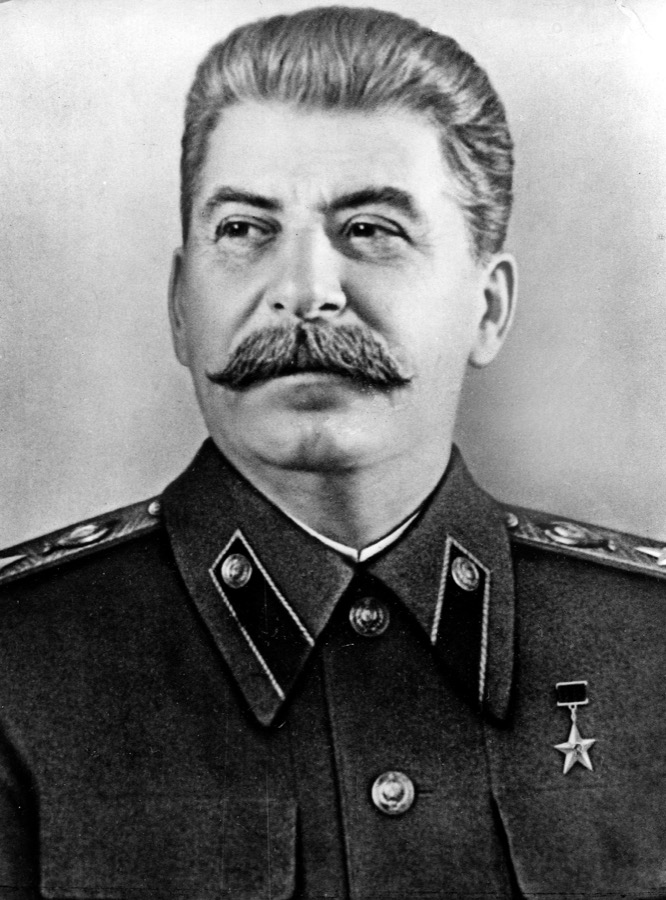
Official portrait photograph of Joseph Stalin
The Man Who Won by Reading the Files
Joseph Stalin's rule killed millions of the people he governed. The forced collectivization of Soviet agriculture in the early 1930s stripped the countryside of grain and of the peasants who grew it, producing a man-made famine that consumed Kazakhstan and Ukraine — the Holodomor — while the state kept exporting food and sealed the borders of the starving districts. The Great Terror of 1936 to 1938 arrested and shot hundreds of thousands on quota, gutted the officer corps of the Red Army, and fed a labour-camp system that swallowed millions more. Around all of it grew a personality cult so total that his own name became a category of truth, sustained not by persuasion but by the continuous removal of anyone who might one day disagree. These are not the excesses of a policy. They are the policy.
What makes him strange, psychologically, is how ordinary the instrument was. Stalin did not seize the Soviet Union with a vision, a manifesto, or a coup. He seized it with a card index. Appointed General Secretary of the Communist Party in 1922 — a clerical post the party's brilliant men regarded as beneath serious attention, a job for someone willing to keep the membership records straight — he spent the years around Lenin's death in 1924 quietly deciding who was appointed to which committee, which delegate went to which congress, whose file said what. By the time Trotsky and the rest understood what the office had become, every room they walked into was already full of Stalin's people.
He is therefore not the archive's grand visionary. He is its archivist: a former seminary student from provincial Georgia, a bank-robbing fundraiser for the Bolshevik underground who never lost the underground's habits of secrecy and suspicion, and a methodical accumulator of procedural control whose grudges had the same permanence as his paperwork. That combination — patient administrative machinery driven by a rigid, grievance-storing inner world — is why this entry reads him as an ISTJ, and why the terror that followed took the specific shape it did.
Stalin was an ISTJ whose dominant Si turned memory into a permanent ledger of slights, and whose Te turned the party's filing system into an instrument of absolute power.
The Ledger That Never Closed
Dominant introverted sensing builds a world out of stored particulars — precedents, routines, faces, the exact wording of an old insult — and treats that store as the reliable measure of the present. Stalin's formation loaded it early and heavily. The Tiflis seminary gave him years of surveillance, rote discipline, informers among the students, and an ordered daily round he never really left behind; the Bolshevik underground gave him aliases, dead drops, and the working assumption that anyone might be an agent. He was a Georgian in a Russian party, a provincial among cosmopolitans, a man of the committee rooms among men who had argued theory in Zurich cafés. Those conditions did not create his cruelty, but they set the shape of his attention: downward, inward, and toward the record.
He remembered everything, and the remembering was the danger. Contemporaries describe a man who could produce, years later, the precise sentence a colleague had spoken at a 1917 meeting, the vote someone had cast against him, the letter Lenin had written in 1922 doubting his fitness for the General Secretaryship. The show trials of the late 1930s were, among other things, an exercise in retrospection: old Bolsheviks were destroyed not for what they were doing but for opposition recorded a decade or more earlier, dragged forward with the dates and minutes attached. A visionary purges to clear ground for the future. Stalin purged to settle a backlog.
Si also explains what he did once the machinery of the 1930s was built: he kept it running the same way. Arrest quotas were issued to regions as numerical targets and fulfilled like grain deliveries. The Terror had the texture of an established procedure rather than an eruption — a routine that, once entered into the record as normal, could be extended, renewed, and applied to fresh categories of people almost indefinitely. His inner ledger of enemies never closed, because in Si logic nothing filed is ever finished.
Power as Personnel Files
Auxiliary extraverted thinking is the drive to order the outside world into working systems — structures, chains of responsibility, measurable outputs. Stalin's genius, such as it was, lay entirely here, and it was administrative rather than intellectual. In the succession struggle after 1924 he did not out-argue Trotsky, Zinoviev, Kamenev, or Bukharin; he out-appointed them. The Secretariat controlled who staffed the provincial party organisations, who was promoted, who was transferred, and who sat in the hall when a vote was taken. Every one of those decisions was small. Assembled over four years, they were the state.
The same machinery ran the catastrophes. Collectivization was executed as a targets-and-deliveries problem: hectares consolidated, kulaks identified as a class and deported by category, grain procurement quotas set from Moscow and enforced against districts that had nothing left to give. When the countryside starved, the response was not a change of course but an audit — sabotage must explain the shortfall, therefore more arrests. The Terror was likewise administered, complete with lists countersigned at the top, regional allocations, and paperwork that survives precisely because a bureaucrat kept it. Te at its worst does not lose sight of the human cost; it never took the human cost as a variable in the first place.
The war years show the same function in a less monstrous register. After the shock of June 1941 he settled into a punishing routine of production figures, transport schedules, and the physical relocation of Soviet industry east of the Urals, and he was, by the accounts of the men who briefed him, a relentless and well-prepared questioner of detail. He learned, slowly, to let Zhukov and the professionals run operations. That was Te doing what it does best: identifying which system works and enforcing it — an efficiency that had cost the army its own commanders four years earlier.
The Private Court of Grievance
Tertiary introverted feeling in an ISTJ is a hidden, unarticulated value system — intensely felt, rarely explained, and almost never available for negotiation. Stalin never argued his emotions; he acted on them and supplied a procedural reason afterwards. His sense of having been slighted, patronised, or doubted was the most consistent motive in his political life, and the slights he nursed were personal before they were ideological. Trotsky's condescension, Lenin's late reservations, his own wife Nadezhda's suicide in 1932 — each was absorbed, unshared, and converted into a permanent negative entry against someone.
This is what turned a bureaucrat into a killer of intimates. Fi under threat draws a line between the loyal and the false and then treats the line as a moral fact requiring no evidence. Old comrades who had shared exile with him were confessed and shot. Subordinates were promoted, flattered, and destroyed in cycles. Relatives by marriage went to the camps. He appears to have believed his own suspicions in a way that a purely cynical operator would not have bothered to; the paranoia was not a tactic layered over calm calculation but a felt conviction that the calculation then served.
It also explains the cult. A confident visionary does not need his portrait in every schoolroom. Stalin's endless, humourless self-monumentalising — the rewritten party histories in which he stands at Lenin's shoulder, the airbrushed photographs from which the executed disappear — reads as an unstable inner valuation demanding external repair, over and over, with no amount of adulation ever settling the account.
Every Possibility Was a Plot
Inferior extraverted intuition is the weak spot: an inability to hold open, unresolved possibility comfortably, and a tendency for it to return in distorted form as dread. Stalin could not generate futures; he could only generate conspiracies. The alternative outcomes his mind produced were never opportunities but threats — networks of wreckers in the factories, Trotskyite cells inside the General Staff, doctors poisoning the leadership as late as 1953. Ne that cannot play forward plays sideways into suspicion, and in a man with unlimited police power that is a death sentence issued to abstractions.
June 1941 is the sharpest demonstration. Warnings of the coming German invasion arrived from his own intelligence services, from British intercepts, from defectors giving the date. Stalin, who had signed the Molotov-Ribbentrop Pact with Hitler in August 1939 and built his whole near-term calculation on the paper it produced, dismissed every one of them as provocation and disinformation. His stored model said the pact was holding and the timetable ran later; a functioning Ne would have taken the reports as live possibilities to prepare against. He punished the messengers instead, and the Red Army was destroyed in its forward positions in a matter of weeks.
The pattern held to the end. Successful and unchallenged, ruling half of Europe, he spent his last years inventing new enemies — the Leningrad Affair, the Doctors' Plot, a purge apparently gathering against his own closest circle — because the only future his imagination could supply was betrayal. He died in March 1953 on the floor of his dacha, unattended for hours, because the guards were too frightened of him to open the door.
Why ISTJ Over INTJ
Why not INTJ?
The INTJ reading imagines a long-range strategist who saw the end state of the Soviet project and built toward it. That description fits Trotsky far better — the theorist of permanent revolution, the man with a picture of the future — and Trotsky lost. Stalin's victories were procedural, not conceptual: he took an unglamorous clerical office and converted it into control of appointments, then used that control to isolate opponents one committee at a time. His ideological positions moved with convenience, from "socialism in one country" to the pact with Hitler, while his methods never varied. And the INTJ hallmark, Ni foresight, is exactly what failed him in June 1941, when he refused to imagine a scenario his files did not already contain.
The distinction matters because it changes what the twentieth century teaches. If Stalin were a dark visionary, the lesson would be about dangerous ideas. He was not. He was the diligent administrator nobody thought worth watching, who understood before anyone else that in a one-party state the real power sits with whoever keeps the personnel records — and who then applied ordinary bureaucratic thoroughness to extraordinary crimes. Trotsky, out-manoeuvred, exiled, and finally murdered by an agent with an ice axe in Mexico in 1940, learned the difference too late.
Connected Figures
Further Reading
- Stalin: Paradoxes of Power, 1878–1928 — Stephen KotkinFirst volume of the definitive biography; the fullest account of how the General Secretaryship became absolute power.
- Stalin: Waiting for Hitler, 1929–1941 — Stephen KotkinCollectivization, the Terror, the pact, and the catastrophe of June 1941, told through the paperwork.
- Stalin: The Court of the Red Tsar — Simon Sebag MontefioreThe inner circle up close — the dachas, the drinking, the signed lists, and the men who survived him.
- Red Famine: Stalin's War on Ukraine — Anne ApplebaumThe Holodomor reconstructed from Soviet and Ukrainian archives.
- The Great Terror: A Reassessment — Robert ConquestThe classic account of 1936–38, revised after the Soviet archives opened.
