 Historical Figure MBTI
#922 · 7-6-26 · Stalin's Soviet Union
Lavrentiy Beria
NKVD Chief · The Terror Made Efficient
1899 — 1953
10 min read
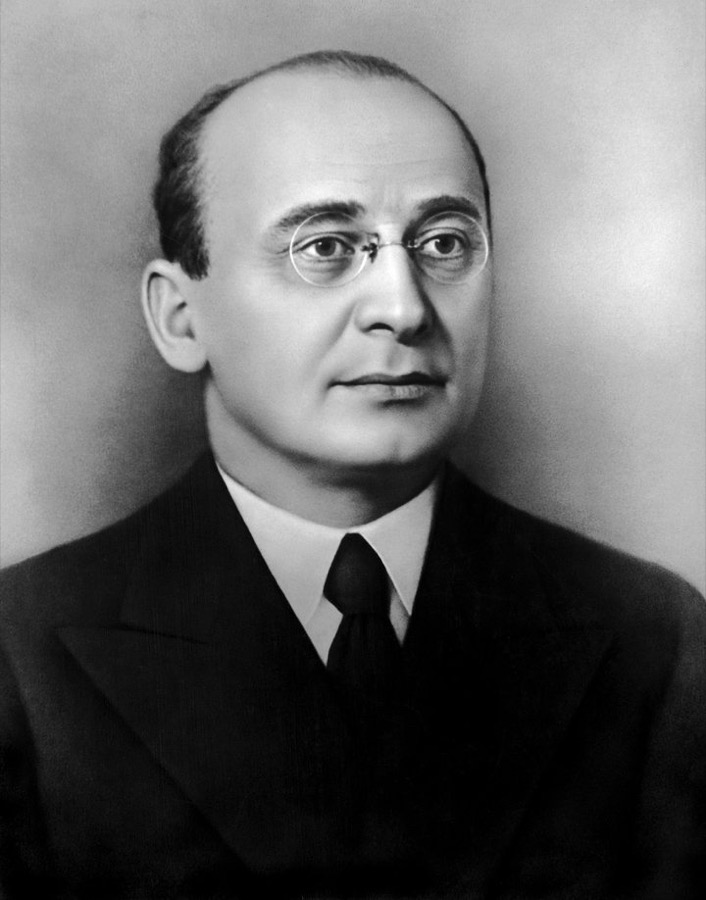
Portrait photograph of Lavrentiy Beria
The Hands-On Killer
Lavrentiy Beria ran the secret police of the Soviet Union. As head of the NKVD from 1938 he inherited the machinery of the Great Terror and drove its later phase, presided over the Gulag — a labour-camp economy holding millions of prisoners whose deaths were an accounting line in the plan — and put his signature to death sentences in numbers that run into the tens of thousands. In March 1940 he wrote the memorandum proposing that some 22,000 captured Polish officers, policemen, and members of the educated classes be shot without trial; Stalin and the Politburo approved it, and the corpses went into the pits at Katyn, Kalinin, and Kharkiv. Beria was also a sexual predator who used the resources of the secret police to select, coerce, and rape women, some of them adolescents, with the implicit threat of arrest behind every advance. His bodyguards procured for him. This entry types his psychology; it does not mitigate any of that, and the crimes are not incidental to the type — they are where it shows most clearly.
He is easy to picture wrongly. The pince-nez and the ministerial suit invite comparison with Himmler: the pedantic clerk of genocide, killing at a desk's distance. Beria was not that man. He was physically present in his own terror — in the interrogation rooms, sleeves up, with a rubber truncheon; in the cars that idled outside the Bolshoi to collect a woman he had seen from a box; in the direct, personal, bodily exercise of power over people who could not refuse him. His victims were abstractions on paper and objects in the same room, often on the same day.
That combination — a hunger for immediate physical control fused to a quick, cold, tactical intelligence for surviving Stalin's court — is why the archive reads him as an ESTP. He was born in Georgia in 1899, climbed the Transcaucasian secret police in the 1920s, arrived in Moscow as the Terror's manager, and ended in 1953 in the same manner he had dispensed to others: seized without warning, tried in secret, shot in a cellar.
Beria was an ESTP whose dominant Se made terror a physical appetite — the state's power over bodies converted into his own, exercised in person and enjoyed.
Power He Could Put His Hands On
Dominant extraverted sensing lives in the immediate physical world: what is present, available, and can be seized now. In an ordinary life it produces the tactician, the athlete, the operator with fast reflexes and an appetite for stimulation. Installed at the head of a police state, it produced a man for whom repression was not administration but sensation. Beria interrogated personally. Survivors and internal accounts describe him beating prisoners himself, supervising sessions in the Sukhanovka special prison, and handling the machinery of confession with a professional's familiarity. He did not delegate the parts he liked.
The predation ran on the same channel and cannot be separated from the office. He spotted women in the street, at the theatre, in the corridors of ministries; his security detail brought them to the mansion on Kachalov Street; refusal carried the unspoken and sometimes spoken alternative of the Lubyanka, for the woman or her family. Bones later found buried on the property, and the testimony gathered when he was finally arrested, indicate how many. This was not a private vice running alongside a public career. It was the same function using the same instrument: the state gave him direct, unmediated access to other people's bodies, and he took it.
Se also accounts for the competence. Given a concrete objective with visible outputs — evacuate the aviation industry beyond the Urals, run partisan and counter-intelligence operations, deliver a Soviet atomic bomb using a labour force of prisoners and a network of stolen designs — Beria performed formidably and fast. The atomic project succeeded in 1949 because he treated it as a materials-and-manpower problem to be forced through by whatever was at hand. He was, in the most literal sense, a man of results, and utterly indifferent to what the results were made of.
The Cold Arithmetic of the Court
Auxiliary introverted thinking supplies the private logic that makes an Se operator dangerous rather than merely appetitive: precise, unsentimental, interested in how a mechanism actually works rather than in what it is supposed to be. Beria read Stalin's court as a system with rules and exploited them with an accuracy that kept him alive for fifteen years in the one job where predecessors did not retire. He arrived in 1938 to replace Nikolai Yezhov, understood immediately that Yezhov's fate was to be blamed for the Terror he had executed, and made himself the instrument of the correction — releasing a fraction of prisoners, staging a limited repudiation of "excesses" — while keeping the camps and the quotas intact. He then had Yezhov shot.
The Katyn memorandum is Ti in its purest and most repellent form. It is a short, reasoned document: these prisoners are irreconcilable enemies of Soviet power, they are of no use, their existence is a future problem, therefore the highest measure of punishment, by category, without individual review. There is no rhetoric in it and no ideology to speak of — only a clean, closed argument that arrives at 22,000 executions because the premises permit it. Beria did not need to hate Polish officers. He needed the problem solved on the terms he had defined.
The same analytic clarity ran his blackmail. He built and personally curated files on colleagues, knew their weaknesses and their lovers and their doctored biographies, and let them know he knew. His authority inside the leadership was not derived from a rank anyone respected; it was derived from an accurate, continuously updated model of what would destroy each individual around him.
Charm as a Working Tool
Tertiary extraverted feeling in an ESTP is real but instrumental — a genuine facility for reading a room and adjusting to it, deployed for advantage rather than connection. Beria was, by every account, socially adept: witty at Stalin's late-night dinners, an accomplished flatterer, fluent in the deference the old man required, and capable of a warm avuncular manner with the leader's children that reads as genuinely felt and is no less sinister for it. He could produce whatever emotional register a situation rewarded, and he produced it convincingly.
He read collective mood well enough to attempt, in the spring of 1953, one of the most startling manoeuvres in Soviet history. With Stalin dead, Beria moved first and fastest: an amnesty releasing over a million prisoners, the Doctors' Plot denounced as a fabrication and its victims freed, torture formally banned, a proposal to let East Germany go, gestures toward the national republics. He had judged what the country and the apparatus were desperate for. What he had not judged was how it would look coming from him.
Because tertiary Fe is calibration, not attachment. Beria could model what people wanted and could not model what they felt about him. Every man in the Presidium had a file in his safe and a wife or a colleague he had touched or taken; the reforming liberator arrived wearing the face of the man who had run the Lubyanka. His overtures did not reassure them. They convinced them he was about to make himself Stalin's successor with the police behind him, and they moved.
The Future He Never Saw Coming
Inferior introverted intuition is the blind spot: no durable sense of long trajectories, of how the present will be remembered, of the single line running from what you have done to what will be done to you. Beria's career was a sequence of brilliant immediate moves with no strategy behind them. He was superb at the next six months and had no map of the next five years, which is survivable under a master who does the long thinking for you and fatal the moment that master dies.
In June 1953 he was summoned to a Presidium meeting in the Kremlin. Khrushchev — whom he plainly regarded as a fool — had spent weeks assembling the others, and had arranged for Marshal Zhukov and a group of army officers, men outside Beria's police network entirely, to be waiting in an adjoining room. Beria walked in without his own guards. He was seized at the table by soldiers he could not order about, held in an army bunker rather than any prison he controlled, tried in camera, and shot in December. The man who had built the most complete surveillance apparatus in Europe never saw the conspiracy in the room he was walking into.
It is the exact inversion of his strength. Se had told him for thirty years that whatever was in front of him could be handled when he got there. Ni would have told him that a man with his file, in a country without Stalin, had no future at all no matter how many prisoners he released. He was fifty-four.
Why ESTP Over ESTJ
Why not ESTJ?
An ESTJ reading would predict institution-building: durable structures, clear procedure, authority vested in the office and outliving the officeholder. Beria built almost nothing of that kind. His power ran through personal fear, personally held blackmail files, and direct physical control over individuals — and it evaporated the instant he was physically detained, because none of it was lodged in an institution that would act for him. Where an ESTJ standardises, Beria improvised, and the improvisation was extraordinary right up to the moment it required foresight. Even the atomic project, his most systemic achievement, was driven by seizure and coercion rather than by any administrative design he left behind.
The contrast with the man he served is the point. Stalin was the archivist whose weapon was the record; Beria was the operator whose weapon was his presence in the room. The Soviet terror needed both — a system that generated names and a man who enjoyed collecting them — and the pairing lasted exactly as long as the archivist did.
Connected Figures
Further Reading
- Beria: Stalin's First Lieutenant — Amy KnightThe standard scholarly biography, careful about what the sources can and cannot establish.
- Stalin: The Court of the Red Tsar — Simon Sebag MontefioreBeria inside the inner circle — the dinners, the files, the predation, and the 1953 arrest.
- Gulag: A History — Anne ApplebaumThe camp system he ran as an economic instrument, from the arrests to the labour quotas.
- Katyn: A Crime Without Punishment — Anna M. Cienciala, Natalia S. Lebedeva and Wojciech MaterskiDocumentary history of the 1940 massacre, including the memorandum Beria wrote.
- Khrushchev: The Man and His Era — William TaubmanThe 1953 succession struggle from the side that removed him.
