 Historical Figure MBTI
#921 · 7-6-26 · Stalin's Soviet Union
Vyacheslav Molotov
Foreign Minister · The Name on the Pact
1890 — 1986
5 min read
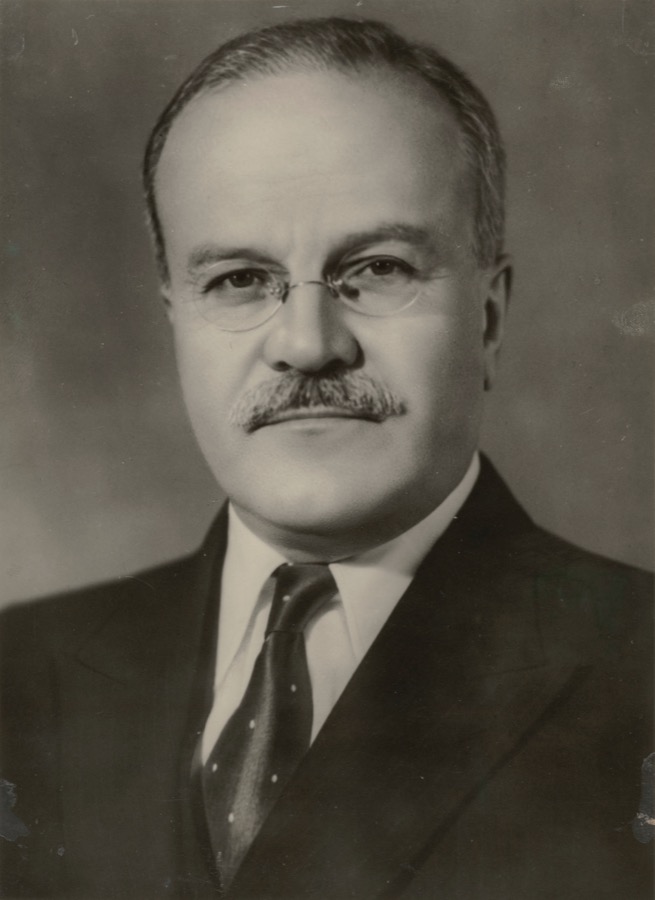
TASS portrait photograph of Vyacheslav Molotov
Mr. Nyet
Western diplomats who sat across the table from Vyacheslav Molotov learned to dread the sameness of him. He did not bluster, he did not charm, he did not improvise. He restated the Soviet position, word for word if necessary, across sessions that lasted hours, until the other side either conceded or gave up. They called him "Mr. Nyet," and the nickname was less about the refusals themselves than about the flat, procedural relentlessness behind them — a man who treated negotiation as an act of endurance rather than persuasion.
He was born Vyacheslav Skryabin in 1890 and took the revolutionary alias Molotov, from the Russian for "hammer," as a young Bolshevik functionary. It suited him. He rose not by charisma or theoretical brilliance but by being reliably, tirelessly useful to whoever led the party — first Lenin, then Stalin — and by 1939 he was Stalin's Commissar for Foreign Affairs, the man who put his signature on the Molotov-Ribbentrop Pact and its secret protocol carving up Poland and the Baltic states. He remained at Stalin's side through the war and after, one of the very few senior Bolsheviks who neither fell from favor nor lost his nerve, and one of the last, when the Soviet Union itself finally admitted the crimes of the era, to say he had done nothing wrong.
He is best read as an ISTJ, a temperament built for exactly this kind of service: precise, procedural, and immovably loyal to an established line, whether that line was a treaty text or a purge list.
Molotov did not originate Soviet foreign policy. He executed it — with a consistency so total it became, in its own grim way, a kind of integrity.
The Same Sentence Twice
Introverted Sensing is the function of the fixed reference point, the internally banked precedent that gets applied again and again regardless of what the room wants in the moment. Molotov negotiated by repetition. He would state the Soviet position, listen to the counterargument, and then restate the same position in nearly the same words, as though the counterargument had not been made at all. It was maddening to opposite numbers who expected negotiation to move, and it worked precisely because it did not move — eventually the other side adjusted to him, not the reverse.
The same rigidity that made him a wall across the table made him a survivor inside the party. He held to whatever line Stalin had set with total, unblinking consistency, long after the line had cost him personally. When Stalin ordered the arrest of Molotov's own wife, Polina Zhemchuzhina, and sent her to a labor camp, Molotov did not resign, did not protest publicly, and did not break with the line — he abstained, once, quietly, in a Politburo vote concerning her, and otherwise carried on. It is hard to imagine a more exact demonstration of Si loyalty to established authority overriding every other consideration.
The Signature on the Pact
Extraverted Thinking supplies the drive to organize the external world toward a defined objective, efficiently and without sentiment, and Molotov turned that capacity into the signature Soviet diplomatic instrument of the 1930s and 40s. He was the one who actually sat down with Ribbentrop in August 1939 and produced a workable document — a non-aggression pact and a secret protocol dividing Eastern Europe into spheres of influence — under enormous time pressure and with the whole logic of prior Soviet anti-fascist rhetoric to be quietly discarded. He did it cleanly, on schedule, without visible discomfort.
That Te competence, not any personal authorship of grand strategy, is what made him indispensable to Stalin for over a decade. He built the negotiating apparatus, kept the machinery of the Foreign Commissariat running, and represented the USSR at the wartime Allied conferences with the same procedural discipline he brought to Berlin. He was the executor Stalin trusted precisely because Molotov never tried to be the author.
Why ISTJ Over ISTP
Why not ISTP?
An ISTP negotiator would read the room and adjust tactics, feinting, probing for an opening, trading concessions where a concession bought advantage. Molotov did the opposite. His entire diplomatic style was built on refusing to adjust — repeating the same demand, the same objection, the same flat refusal, until the other side wore down. That is not tactical improvisation; it is Si-Te procedural stubbornness, an immovable stance held not because it was cleverly calculated in the moment but because it was the position already fixed in advance.
The distinction matters because Molotov is so often mistaken for a shrewd tactician when he was something closer to a human wall. ISTP explains cleverness under pressure; it does not explain a man who could say "no" in exactly the same words for the third straight hour of a session. ISTJ explains both the wall and the reason it never moved.
Connected Figures
Further Reading
- Molotov: A Biography — Derek WatsonThe standard scholarly biography, drawing on Soviet archives opened after 1991.
- Molotov: Stalin's Cold Warrior — Geoffrey RobertsA focused study of Molotov's diplomatic career and his defense of Stalinist policy.
- Stalin: The Court of the Red Tsar — Simon Sebag MontefiorePlaces Molotov within the inner circle around Stalin and its brutal internal politics.
- The Molotov-Ribbentrop Pact of 1939 — Roger MoorhouseA close narrative account of the negotiation and its consequences for Poland and the Baltics.
