 Historical Figure MBTI
#923 · 7-6-26 · The Rise of Fascism
Joachim von Ribbentrop
Foreign Minister · The Salesman Who Sold Germany a War
1893 — 1946
9 min read
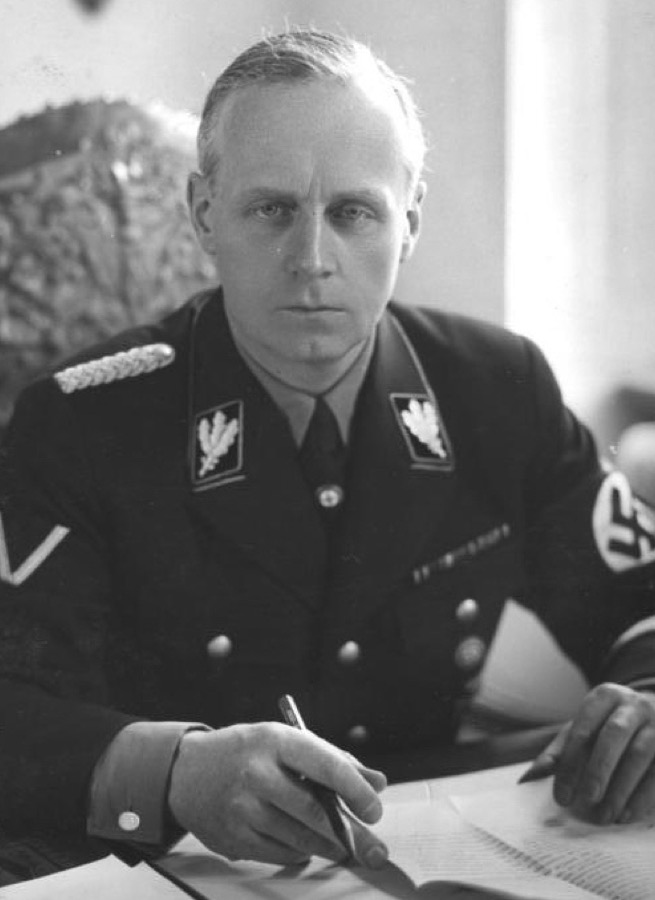
Portrait of Joachim von Ribbentrop (Bundesarchiv, Bild 183-H04810)
The Champagne Salesman at the Edge of the World
Joachim von Ribbentrop was Foreign Minister of Nazi Germany from 1938 to 1945. He negotiated the Molotov-Ribbentrop Pact of August 1939, whose secret protocol carved Poland and the Baltic states into German and Soviet spheres and removed the last strategic obstacle to the invasion that began the Second World War in Europe a week later. He pressed the diplomacy of aggression through the whole sequence — Austria, Czechoslovakia, Poland — and, as the war went on, applied German pressure on satellite governments to hand over their Jewish populations for deportation. At Nuremberg he was convicted on all four counts, including crimes against peace and crimes against humanity, and on 16 October 1946 he was the first of the defendants to hang.
He was also, in the assessment of virtually everyone who dealt with him, a fool. Goebbels thought him a nonentity who had bought his name and married his money. Göring called him a dirty little champagne pedlar. British diplomats found him pompous and unable to hear anything that contradicted what he intended to report. He had been a wine and spirits salesman who married into the Henkell sparkling-wine fortune and acquired the aristocratic "von" in 1925 by arranging to be adopted by a distant titled relative for a fee. He reached the top of German foreign policy not by understanding the world but by understanding one man.
That is the whole psychological case. Ribbentrop's career ran on social sensitivity aimed exclusively upward: an unerring instinct for what the powerful wanted to hear, no capacity to test whether it was true, and a status anxiety that made agreement feel like insight. The archive types him as an ESFJ — not the warm community-builder of the flattering description, but the version in which dominant Fe attaches itself to prestige and calls the result diplomacy.
Ribbentrop was an ESFJ whose dominant Fe read the room brilliantly and the world not at all — a salesman who told Hitler what he wanted to hear until the sale became a war.
Selling to an Audience of One
Dominant extraverted feeling orients on other people: their approval, their mood, the harmony of the group and one's standing within it. It is the function of the host, the diplomat, the salesman — and Ribbentrop was literally all three. He sold liquor by cultivating the customer rather than the product, he built a marriage and a fortune the same way, and he entered politics by opening his Dahlem villa to the Nazi leadership and making himself indispensable as a man who knew people, spoke languages, and could arrange a room. The secret meetings that brought Hitler into the chancellorship in January 1933 were held in his house. That was his qualification.
What followed was Fe with a single object. Ribbentrop studied Hitler with the total attention a salesman gives a prospect who has not yet signed. He learned the vocabulary, the hatreds, the preferred conclusions, and he fed them back amplified — which is precisely why Hitler valued him, and why the professionals at the Wilhelmstrasse despised him. Where the career diplomats reported difficulties, Ribbentrop reported that the Führer's instinct was correct. Goebbels's private verdict, that Ribbentrop "bought his name, married his money, and swindled his way into office", was an accurate description of a man whose entire method was ingratiation.
It made him monstrous in a distinctive way. He had no particular ideology of his own before 1933 and adopted the whole of it afterwards, including the antisemitism, which he pushed harder as the war went on — hectoring the Hungarian and Italian governments over deportations because that was the register in which approval was now given. A dominant-Fe personality with no independent moral centre does not resist an atmosphere. It becomes it.
The Man Who Kept Score of Slights
Auxiliary introverted sensing gives an ESFJ their memory for detail, their attachment to form, and — when it turns sour — their capacity to nurse a specific humiliation for years. Ribbentrop's protocol obsession was legendary. He fussed over precedence, titles, uniforms, and the exact staging of ceremonies; he had his ministry's officials taught how to bow; he designed himself a diplomatic livery. The "von" itself was an Si acquisition: a form correctly filled in, a title formally registered, and therefore, in his own mind, real.
His embassy in London from 1936 to 1938 was where the same function ruined him. He arrived intending to charm Britain into acquiescence and was instead comprehensively snubbed by a society that found him ridiculous, culminating in the notorious moment when he greeted George VI with a Nazi salute. He never recovered from it. From that point his reporting on Britain was not analysis but revenge: the British were decadent, degenerate, incapable of fighting, a spent power. He had stored the personal insult and generalised it into strategic intelligence, and he handed that intelligence to a leader already inclined to believe it.
So the most consequential misjudgement of 1939 — that Britain would not go to war over Poland — was in a real sense a wound turned into a forecast. When the British declaration arrived on 3 September, Hitler turned to him and asked, "What now?" Ribbentrop had no answer, because he had never had a model of Britain in the first place. He had only a memory of being laughed at in Mayfair.
The One Good Idea He Ever Had
Tertiary extraverted intuition supplies an ESFJ with occasional bursts of unexpected lateral thinking — genuine, but unmoored from any deep strategic sense, and typically pursued for the effect it will produce rather than for where it leads. Ribbentrop had exactly one such idea, and it was enormous. In the summer of 1939, with the Polish crisis building and Britain and France guaranteeing Warsaw, he proposed the thing nobody else in Europe thought possible: a pact between the two states whose mutual hatred was the fixed point of the entire continental system, National Socialist Germany and the Soviet Union.
He flew to Moscow on 23 August and closed it in a night — a non-aggression treaty with a secret protocol dividing Poland, the Baltic states, Bessarabia. Talking with Vyacheslav Molotov and then with Stalin himself, he was reportedly euphoric, telling his hosts he felt among old party comrades. It was the greatest moment of his life and the single greatest diplomatic disaster of the century: it freed Germany from the two-front problem, and the invasion of Poland followed on 1 September.
Note what the idea was, though. It was not a strategy. It was a closing technique — a way to remove the obstacle in front of the sale, with no thought whatsoever about the contract's second year. Twenty-two months later Germany invaded the Soviet Union and every advantage the pact had purchased was thrown away. Ne in the tertiary position generates the clever move; it does not generate the consequences, and Ribbentrop never once demonstrated that he had considered them.
No Argument Underneath
Inferior introverted thinking is the missing floor: no reliable internal test of whether a proposition actually holds together, and a corresponding fragility whenever one is demanded. Ribbentrop's method of persuasion was not to reason but to repeat, louder. Foreign statesmen who negotiated with him — Ciano, the Hungarians, the Romanians, the British — describe monologues rather than discussions, delivered at volume, immune to objection, in which the same three assertions were restated until the interview ended. He could not follow an opponent's case well enough to answer it, so he drowned it.
Under pressure inferior Ti turns into rigid, brittle legalism. At Nuremberg, faced with prosecutors who had his own ministry's documents, he retreated into pedantry about the precise wording of treaties and the technical status of his signature, and into the claim that he had merely transmitted decisions taken elsewhere. It convinced nobody. The court found that the man who had signed the pact, threatened the Czechs, drafted the ultimata, and pushed deportations on Germany's satellites had not been a postbox. He was found guilty on all four counts.
His last years in office were a study in what happens when a personality made entirely of social attunement loses the one relationship it was tuned to. Hitler increasingly ignored him; the SS and the military ran policy in the occupied east; Ribbentrop retreated into ministerial protocol and territorial disputes over which department owned which corridor. He remained Foreign Minister of a country with no foreign policy left, still fighting for precedence, still waiting to be told he had done well.
Why ESFJ Over ENFJ
Why not ENFJ?
ENFJ would mean genuine persuasive vision — the ability to build rapport across a room, read what people need, and move them toward something. Ribbentrop persuaded almost no one who was not already predisposed to agree, and he was regarded by contemporaries on every side, his fellow Nazis emphatically included, as vain, thin-skinned, humourless, and comically self-important. His social gift went outward only as far as the surface: he could detect flattery and status, and could not detect substance underneath either. That is Fe recruited by status anxiety, not Fe joined to intuition and used for authentic connection.
The distinction is not a technicality, because it explains the specific damage he did. A persuasive visionary in that chair might have understood Britain and argued Hitler out of the timetable. Ribbentrop understood only that Hitler wanted to hear Britain would not fight, and he sold him that, the way he had once sold sparkling wine — by telling the customer what would close the deal. The bill arrived on 3 September 1939, and eventually in the courtroom at Nuremberg.
Connected Figures
Further Reading
- Hitler's Diplomat: The Life and Times of Joachim von Ribbentrop — John WeitzReadable full-length life, strong on the wine trade, the bought title, and the London embassy.
- Ribbentrop — Michael BlochThe standard critical biography; unsparing on his vanity and his role in the deportations.
- The Devils' Alliance: Hitler's Pact with Stalin, 1939–1941 — Roger MoorhouseThe pact he made in Moscow and the twenty-two months it lasted.
- The Nuremberg Trial — Ann Tusa and John TusaThe trial, the defence he attempted, and the judgment on all four counts.
- The Third Reich in Power — Richard J. EvansPlaces his foreign ministry inside the wider machinery of the regime before 1939.
